


Add, Subtract, Divide, Multiply: MHSAA Not Alone
July 25, 2017
By Rob Kaminski
MHSAA benchmarks editor
This is the third part in a series on MHSAA tournament classification, past and present, that will be published over the next two weeks. This series originally ran in this spring's edition of MHSAA benchmarks.
As the MHSAA faces its most recent classification task with 8-Player Football, and opinions continue to swirl about as to the method, timeframe, location and other procedures, a look around the country provides plenty of company among state association brethren factoring variables into their own equations.
In the Pacific Northwest, the Oregon School Activities Association Football Playoffs are under public scrutiny as leadership ponders a five or six classification format beginning with the 2018-19 school year.
The OSAA has crowned six champions on the gridiron since 2006-07. Many of the state’s smaller schools would like to keep it that way, while larger schools lean toward a five-classification system, citing larger leagues, ease of travel and credibility to state championships as the advantages.
Still others would prefer more than six classes, pointing to safety issues and the opportunity to increase participation numbers as positives.
Moving southeast of Oregon, the Nevada Interscholastic Activities Association recently voted to hold serve on a classification proposal that was volleyed to the membership.
However, changes still could be forthcoming by as early as the 2018-19 season which would add a fifth classification in more populated southern Nevada while allowing northern schools to participate in four classifications. Such divisions could mean no state championship for the fifth class in southern Nevada.
Because of that, the NIAA wants equal numbers of schools in each classification on both ends of the state. Complicating the issue is the fact that the 24 largest schools in the state, by enrollment, are all in Clark County in Southern Nevada.
Across Nevada’s border into Arizona, charter schools are asking the Arizona Interscholastic Association to reconsider classification that was voted upon and approved in September 2015. That agreement called for the largest 33 percent of charter schools by enrollment to be placed in the state’s largest school classification, 3A, the middle 33 percent into 2A, and the smallest 33 percent into 1A.
Less than two years later the charter schools have had a change of heart and have asked to be considered the same as other Arizona public schools and be placed appropriately by enrollment beginning with the 2018-19 school year.
The situation in Arizona further illustrates how the public/private debate that all state associations have faced throughout existence now has the added dynamic of rapidly growing charter schools in today’s educational system, along with virtual school enrollment.
In the nation’s heartland, Nebraska has retooled its football classifications by using enrollment of boys students only in its schools rather than total enrollment. The Nebraska School Activities Association football-playing schools will kick off the 2018 season using this alignment.
Nebraska has three classes of 11-player football, with the smallest class divided in two, Class C-1 and C-2. The state also will have 8-player football for boys enrollments under 47, and the NSAA will sponsor a new 6-player tournament in 2018 for schools with 27 or fewer boys.
“This is a good proposal because some schools have a sizable imbalance between the number of boys and girls, and there’s a large gap (in enrollment) between the largest and smallest schools in Classes A and B,” NSAA executive director Jim Tenopir said. “I think this addresses both of those concerns.”
Swimmers in Georgia, meanwhile, will feel like they are moving with the current, rather than upstream in 2017-18, as the Georgia High School Association recently doubled the number of team championship events from two to four.
Swim enthusiasts can also count on longer days at the finals, as the top 30 finishers from the prelims will advance to the finals instead of 20, and all championship events will have three heats versus two.

Next Coach, Same Success as Gobles Drives On
By
Pam Shebest
Special for MHSAA.com
March 9, 2021
GOBLES — One coach retired and one coach was hired, but both have one reason in common: family.
 After 18 years leading the Gobles girls basketball team, John Curtis hung up his whistle.
“My two boys are the biggest reason,” Curtis said of Kellen, 13, and Gibson, 11.
“I just wanted to spend more time with them. Instead of being in a gym coaching on Tuesday and Friday, I would rather be with them studying or just having some Friday night fun.”
Greg Barber took over the position after coaching the junior varsity girls for five years.
That gives him more time to spend with his daughter, Amanda, a junior in her third year on varsity.
His other daughter, Erica, is an eighth grader who also plays basketball.
“I brought my daughters up through the youth program, so I was involved in that when they were in the third grade on up,” Barber said. “I just like coaching.”
One goal for the 8-3 Tigers is continued success in the MHSAA postseason which begins March 22 with District play.
Last year, Gobles won their District and then lost a 42-41 heartbreaker to Schoolcraft in a Division 3 Regional Semifinal. (Soon after, the season was put on hold and final rounds eventually canceled due to COVID-19.)
 Last year’s success was actually another factor that prompted Curtis’ retirement.
“I didn't want to be one of those coaches that retired when the program was struggling,” he said.
“We have a great group of young ladies back and some solid young talent that helped in my decision as well.”
He said handing the coaching reins to Barber was easy.
“He has been in the program for a very long time as a youth and JV coach and has a great rapport with the team,” Curtis said.
“Having (current junior varsity) Coach V. (Marc VanHeukelum) around was a big help as well. He's been by my side forever, and they will keep the program at an elite level.”
Junior guard Amanda Barber, who joined the varsity midway through her freshman season, did not see much of a change when her father took over as coach.
“They have different coaching styles, I would say, but overall they both are good coaches so it’s not hard to be coached by one or the other,” she said.
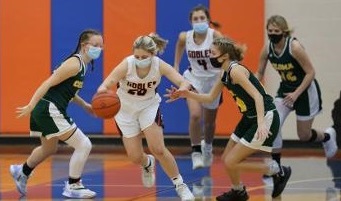 “Mr. Curtis is probably a little more in-your-face, and he’ll tell you how it is. My dad’s a little more laid back.”
The 5-foot-4 Barber leads the team in points, averaging 16 per game, and assists with three per game. Senior Karlee Henderson leads with seven rebounds per game.
“Amanda’s put hours and hours in the gym working on her game and her shooting,” he dad said. “Just countless hours of work.”
Other juniors on the team are Madi Brady, McKenzie Lisowski and Emily Baxter.
Other seniors are Keaghan Kelly, Abby Sandahl and Deven Thompson. The lone sophomore is Kaya Huizenga.
Moving Up, Staying Together
Kennadi Killeen made the jump from eighth grade hoops to varsity without playing a game of JV.
That took a bit of adjustment.
 “The game just got a lot faster and the girls got a lot bigger,” the freshman guard said. “You don’t have as much time between shots to think about everything, so you just have to know what you’re going to do before you do it.”
The pandemic restrictions limiting fans in the stands actually helped Killeen.
‘It did make the transition a lot easier because there weren’t a lot of people watching,” she said. “There weren’t as many people to be afraid of making a mistake in front of,” she added, laughing.
Killeen has worked her way into the starting lineup.
“She’s averaging five or six points a game and about five rebounds as a freshman, so she’s doing real well,” Barber said.
Deanna Wood is the other freshman on the team.
The coach said team unity is a key to their success.
“The junior class has played together since third grade so they’ve played the travel ball, some AAU stuff,” he said. “They’ve stuck together.
“It’s a very talented, athletic group. A couple young freshmen on the team this year have played a lot of basketball.”
Barber said working with the girls when he coached the JV team helped him with the move to varsity.
“I’ve coached them all through their JV years, so it was a pretty simple transition,” he said.
“They know what we do, they know what we want, they know what we like, so it went pretty smooth.”
Impressive numbers
In his 18 years as head coach, Curtis’ teams compiled a 304-107 record, won 10 conference, eight District and two Regional championships, making it to the Semifinals once.
 There are a few things Curtis will not miss.
“If I’m going to be 100 percent honest,” he said, “I won't miss dealing with all of the aspects off the court. The players and parents are changing just like society, which can make the job really tough.
“I've realized that as a coach you can't make everyone happy, and not too many people can see the entire picture these days.”
But since retiring, “the one thing I miss is those tough Friday night road games,” he said. “There is nothing better than going to an opponent's gym with a buzz in the gym and silencing their crowd with a win.
“I always took pride in how mentally tough my teams were, and that competitive feeling after those types of wins will be missed.”
 Pam Shebest served as a sportswriter at the Kalamazoo Gazette from 1985-2009 after 11 years part-time with the Gazette while teaching French and English at White Pigeon High School. She can be reached at [email protected] with story ideas for Calhoun, Kalamazoo and Van Buren counties.
PHOTOS: (Top) Gobles junior McKenzie Lisowski looks to break a trap against Allegan this season. (2) Gobles varsity girls basketball coach Greg Barber. (3) Tigers junior Amanda Barber makes her way through Coloma's defense. (4) Gobles freshman Kennadi Killeen. (5) Recently retired Gobles varsity coach John Curtis with sons Gibson and Kellen. (Action photos by Gala Rock. Head shots by Pam Shebest. Curtis photo courtesy of Curtis family.)