


Add, Subtract, Divide, Multiply: MHSAA Not Alone
July 25, 2017
By Rob Kaminski
MHSAA benchmarks editor
This is the third part in a series on MHSAA tournament classification, past and present, that will be published over the next two weeks. This series originally ran in this spring's edition of MHSAA benchmarks.
As the MHSAA faces its most recent classification task with 8-Player Football, and opinions continue to swirl about as to the method, timeframe, location and other procedures, a look around the country provides plenty of company among state association brethren factoring variables into their own equations.
In the Pacific Northwest, the Oregon School Activities Association Football Playoffs are under public scrutiny as leadership ponders a five or six classification format beginning with the 2018-19 school year.
The OSAA has crowned six champions on the gridiron since 2006-07. Many of the state’s smaller schools would like to keep it that way, while larger schools lean toward a five-classification system, citing larger leagues, ease of travel and credibility to state championships as the advantages.
Still others would prefer more than six classes, pointing to safety issues and the opportunity to increase participation numbers as positives.
Moving southeast of Oregon, the Nevada Interscholastic Activities Association recently voted to hold serve on a classification proposal that was volleyed to the membership.
However, changes still could be forthcoming by as early as the 2018-19 season which would add a fifth classification in more populated southern Nevada while allowing northern schools to participate in four classifications. Such divisions could mean no state championship for the fifth class in southern Nevada.
Because of that, the NIAA wants equal numbers of schools in each classification on both ends of the state. Complicating the issue is the fact that the 24 largest schools in the state, by enrollment, are all in Clark County in Southern Nevada.
Across Nevada’s border into Arizona, charter schools are asking the Arizona Interscholastic Association to reconsider classification that was voted upon and approved in September 2015. That agreement called for the largest 33 percent of charter schools by enrollment to be placed in the state’s largest school classification, 3A, the middle 33 percent into 2A, and the smallest 33 percent into 1A.
Less than two years later the charter schools have had a change of heart and have asked to be considered the same as other Arizona public schools and be placed appropriately by enrollment beginning with the 2018-19 school year.
The situation in Arizona further illustrates how the public/private debate that all state associations have faced throughout existence now has the added dynamic of rapidly growing charter schools in today’s educational system, along with virtual school enrollment.
In the nation’s heartland, Nebraska has retooled its football classifications by using enrollment of boys students only in its schools rather than total enrollment. The Nebraska School Activities Association football-playing schools will kick off the 2018 season using this alignment.
Nebraska has three classes of 11-player football, with the smallest class divided in two, Class C-1 and C-2. The state also will have 8-player football for boys enrollments under 47, and the NSAA will sponsor a new 6-player tournament in 2018 for schools with 27 or fewer boys.
“This is a good proposal because some schools have a sizable imbalance between the number of boys and girls, and there’s a large gap (in enrollment) between the largest and smallest schools in Classes A and B,” NSAA executive director Jim Tenopir said. “I think this addresses both of those concerns.”
Swimmers in Georgia, meanwhile, will feel like they are moving with the current, rather than upstream in 2017-18, as the Georgia High School Association recently doubled the number of team championship events from two to four.
Swim enthusiasts can also count on longer days at the finals, as the top 30 finishers from the prelims will advance to the finals instead of 20, and all championship events will have three heats versus two.
Petoskey Overtakes Rival to Repeat as D2 Champ
February 22, 2021
By Andrew Rosenthal
Special for Second Half
HARBOR SPRINGS — The streak has started again.
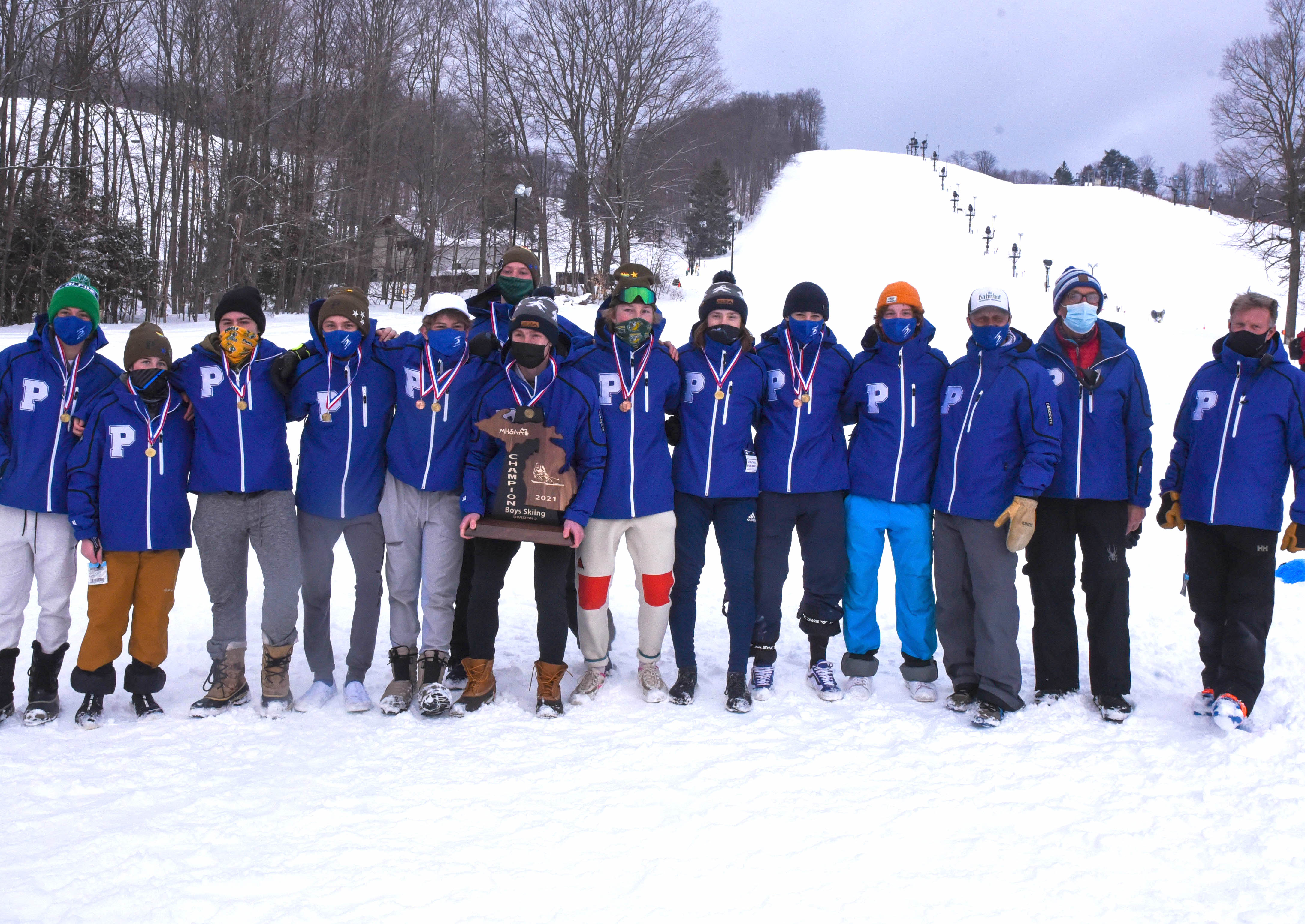
Petoskey beat out Great North Alpine for the Division 2 skiing title at Boyne Highlands Resort on Monday after missing out on the Regional title to GNA last week.
The Northmen went back-to-back to make it 10 championships out of the last 11 years. The only team to win a Division 2 title during that run was Great North Alpine in 2019, the co-op program combining athletes from Elk Rapids, Traverse City St. Francis and Grand Traverse Academy.
Monday’s win also made the Northmen the third team in the Big North Conference to take home a Finals championship trophy this winter. Traverse City West’s boys and Traverse City Central’s girls won titles just across the street at Nubs Nob in the Division 1 Finals.
Ben Crockett, who coaches the Petoskey boys, wasn't really surprised at that given the reputation of BNC schools producing quality skiers.
"We're getting a lot more challenges from schools in the Grand Rapids and Detroit areas," Crockett said. "To stay on top, we're going to have to keep working hard to be able to stay in the position that we're in, but we're feeling pretty good that we've got such good strength locally here."
Both Petoskey and GNA had a bevy of all-state finishers Monday.
For Petoskey in the giant slalom, Anders McCarthy was the leader taking third (1:02.13), Wyatt Mattson took fifth (1:02.86), and William Goelz placed 12th for second-team all-state (1:04.02). McCarthy (fifth) and Goelz (10th) finished with all-state honors in the slalom, Nolan Walkerdine (11th) and Mattson (13th) earning second-team all-state. Michael Iverson finished 21st in slalom to narrowly miss making the second team.
Sully Husband was the only Great North Alpine skier to medal in the morning session, taking fourth in the GS with a time of 1:02.41. Ayden Ferris (13th), Shane Pilate (15th) and Corbin Murphy (19th) each earned second-team all-state nods. Husband doubled up in the afternoon, finishing sixth in slalom, and Ferris joined him at the podium in seventh.
Husband attributed the team's success to getting four solid runs in. He said that's also what led to GNA's Regional title win over Petoskey.
"I'm kind of happy that we got a nice finish," Husband said. "We got second place; kind of stinks that we didn't get first place. But you know, I'm happy that we made it down in one piece because that's really the challenge at the end of the day."
Ben Ferris, who coaches GNA, said it's always nice to bring hardware back. When a co-op school wins a Finals trophy, a duplicate trophy goes to each school that is a part of the co-op.
"It's really about who skis the cleanest all day long and brings things together," Ferris said. "D2 has a really strong skier population anyways, so anytime you get somewhere up and you can make (it) in that top three it's a pretty successful season."
 Crockett said 10 titles in 11 years doesn't take away from the years the Northmen won eight straight. If anything, he said it's a good thing to have several teams knocking on the door.
Pontiac Notre Dame Prep (72 points) finished just behind Great North Alpine (71 points), narrowly missing a first top-two Finals finish in program history.
"We want a sport where we have competitive teams and where we're all pushing each other to be better athletes and better competitors," Crockett said. "I think the more competition that we have, and the closer it is, the more the win means."
Jack Lintol led the Fighting Irish in their third-place finish, taking home a title from the morning giant slalom session with a time of 1:01.35. Reed Heathman, who competed individually from Houghton, took second in that same event.
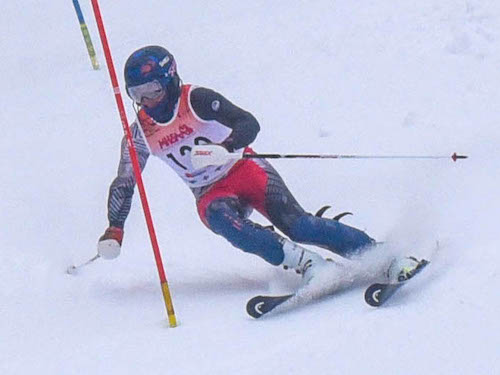
But then Heathman, a junior, came back and beat out Lintol in the slalom for the other individual title of the day. He had the fastest time on his first run with a 39.17 and built on that time with the fastest on the second run as well, a 41.95 to win with 1:21.12.
Heathman took third in GS last year — and said his goal going into last offseason was to improve on that.
“I’m glad to see that was accomplished. I’m happy,” Heathman said. “I didn’t know that I was going to win, but that was the ultimate goal. I knew that competition was going be tough, so I had my work cut out for me.
“I felt in control the whole time. I stayed forward, I stayed ahead of it, it felt good.”
Outside of Petoskey or Great North Alpine, the only other skiers to medal in both GS and slalom were Harbor Springs' Conner Truman and Quincy Thayer, a Frankfort student who competes for Benzie Central. Thayer took seventh in GS with a time of 1:03.31 and eighth in slalom at 1:26.06, while Truman was fourth in slalom at 1:23.40 and ninth in GS with a 1:03.80.
PHOTOS: (Top) Petoskey celebrates its 10th Division 2 championship in 11 seasons Monday. (Middle) Houghton’s Reed Heathman races toward his championship in the slalom. (Click for more from Sports in Motion.)