


Add, Subtract, Divide, Multiply: MHSAA Not Alone
July 25, 2017
By Rob Kaminski
MHSAA benchmarks editor
This is the third part in a series on MHSAA tournament classification, past and present, that will be published over the next two weeks. This series originally ran in this spring's edition of MHSAA benchmarks.
As the MHSAA faces its most recent classification task with 8-Player Football, and opinions continue to swirl about as to the method, timeframe, location and other procedures, a look around the country provides plenty of company among state association brethren factoring variables into their own equations.
In the Pacific Northwest, the Oregon School Activities Association Football Playoffs are under public scrutiny as leadership ponders a five or six classification format beginning with the 2018-19 school year.
The OSAA has crowned six champions on the gridiron since 2006-07. Many of the state’s smaller schools would like to keep it that way, while larger schools lean toward a five-classification system, citing larger leagues, ease of travel and credibility to state championships as the advantages.
Still others would prefer more than six classes, pointing to safety issues and the opportunity to increase participation numbers as positives.
Moving southeast of Oregon, the Nevada Interscholastic Activities Association recently voted to hold serve on a classification proposal that was volleyed to the membership.
However, changes still could be forthcoming by as early as the 2018-19 season which would add a fifth classification in more populated southern Nevada while allowing northern schools to participate in four classifications. Such divisions could mean no state championship for the fifth class in southern Nevada.
Because of that, the NIAA wants equal numbers of schools in each classification on both ends of the state. Complicating the issue is the fact that the 24 largest schools in the state, by enrollment, are all in Clark County in Southern Nevada.
Across Nevada’s border into Arizona, charter schools are asking the Arizona Interscholastic Association to reconsider classification that was voted upon and approved in September 2015. That agreement called for the largest 33 percent of charter schools by enrollment to be placed in the state’s largest school classification, 3A, the middle 33 percent into 2A, and the smallest 33 percent into 1A.
Less than two years later the charter schools have had a change of heart and have asked to be considered the same as other Arizona public schools and be placed appropriately by enrollment beginning with the 2018-19 school year.
The situation in Arizona further illustrates how the public/private debate that all state associations have faced throughout existence now has the added dynamic of rapidly growing charter schools in today’s educational system, along with virtual school enrollment.
In the nation’s heartland, Nebraska has retooled its football classifications by using enrollment of boys students only in its schools rather than total enrollment. The Nebraska School Activities Association football-playing schools will kick off the 2018 season using this alignment.
Nebraska has three classes of 11-player football, with the smallest class divided in two, Class C-1 and C-2. The state also will have 8-player football for boys enrollments under 47, and the NSAA will sponsor a new 6-player tournament in 2018 for schools with 27 or fewer boys.
“This is a good proposal because some schools have a sizable imbalance between the number of boys and girls, and there’s a large gap (in enrollment) between the largest and smallest schools in Classes A and B,” NSAA executive director Jim Tenopir said. “I think this addresses both of those concerns.”
Swimmers in Georgia, meanwhile, will feel like they are moving with the current, rather than upstream in 2017-18, as the Georgia High School Association recently doubled the number of team championship events from two to four.
Swim enthusiasts can also count on longer days at the finals, as the top 30 finishers from the prelims will advance to the finals instead of 20, and all championship events will have three heats versus two.
1st Finals Win Might Only be Start for Traverse City West
By
James Cook
Special for MHSAA.com
February 22, 2021
HARBOR SPRINGS — Recent history in Michigan high school skiing is dotted with dynasties.
Maybe it's time to welcome the newest one.
Traverse City West's boys ski team made history Monday, winning the program's first MHSAA Finals championship at Nub's Nob in Harbor Springs. The Titans can return the same lineup next season for a title defense.
"We had the talent," Titans sophomore Luke Wiersema said. "We just had to put it all together, and then we could be a state champions. It's really exciting. I feel like we could do this for the next two, three years."
West won with 63.5 points, surviving a Rochester Adams comeback attempt in the afternoon to win by 5.5. Bloomfield Hills placed third at 85.5 and Traverse City Central fourth with 140.
Wiersema placed eighth in slalom and seventh in giant slalom to earn first-team all-state in both disciplines. Junior Andy Hill did the same all-state double dip, placing eighth in GS and taking runner-up honors in the afternoon's slalom.
"I think everyone thought at the beginning of the season that we could," Wiersema said. "We could destroy this season. We could win it all."
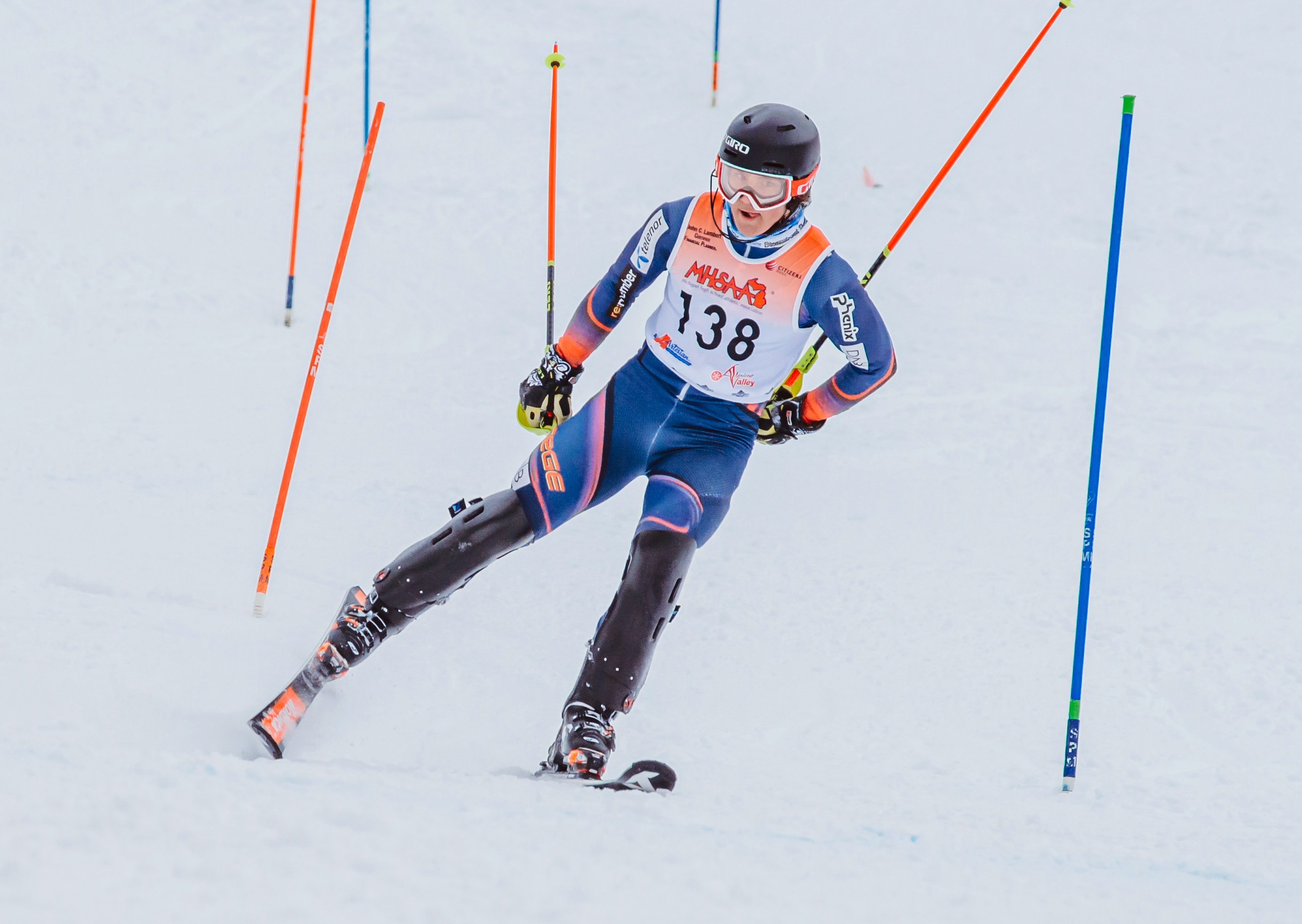
West junior Aiden Lewandowski won the giant slalom by one tenth of a second over Nathan Dehart of Rochester Adams, posting the only sub-24-second GS time of the day in his second run. He trailed Dehart by 0.03 after the first.
The Titans' history-making championship is the first since the school split off from Traverse City Central in 1997. Ed Johnson, who coached West its first season in 1997, said finally getting that championship trophy was a huge relief, especially after three runner-up finishes, the most recent in 2019 behind Marquette.
"It means a lot. It means a lot for me," Johnson said. "I've been coaching at that school since the school was opened. So it's incredible just to see it finally happen. We've had a number of runner-ups over the years, so we were close, and we had other teams that could have done it as well but just didn't quite pull it together on that day. So it's just so nice to see it happen finally."
Marquette's run of eight straight Division 1 championships ended at Regionals, when the Redmen didn't qualify among the top three to move on to Monday's Finals. Since 1997 when TC West opened, the only schools that had won a D1 Finals title were Marquette (15 times), TC Central (four), Clarkston (one), Petoskey (two) and Bloomfield Hills Brother Rice (one).
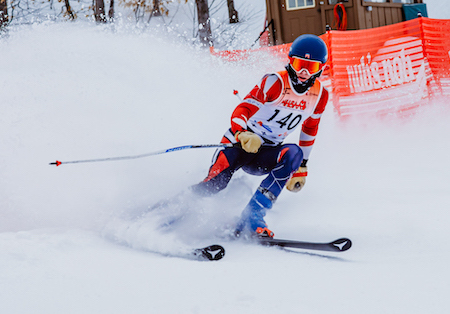 Hill was eighth after the first slalom run, then made up for that with the best time of all second runs at 34.53 seconds, 0.99 seconds better than eventual champ Hunter Halstead of Bloomfield Hills.
"The first one I felt really iffy," Hill said. "I just wasn't really mentally prepared. We were waiting at the top for a long time, so I kind of lost my focus. But the second run, I knew that I had to make up some time. So I just got in the zone and gave it all I had."
After Halstead and Hill in slalom were Adams' Zeke King in third, followed by Bloomfield Hills' Matthew Coates, Adams' Jacob Corsi, Traverse City Central’s Max Werner, West's Caleb Lewandowski, Wiersema, Adams' Charlie Buckmaster and Brighton's Andrew Myers.
Halstead placed third in GS, behind Aiden Lewandowski and Dehart. The rest of the top 10 was comprised of Clarkston's Andrew Roeser, Marquette's Logan Audette, Brighton's Luke Vaden, Wiersema, Bloomfield Hills' Bode Iuppenlatz, Hill and West’s Ben Lober.
Aiden Lewandowski finished 45th in slalom after hiking on both runs, but his GS championship helped give the Titans a nice cushion over Rochester Adams going into slalom.
"We were definitely concerned to have that happen on that first run of the afternoon, so that put the rest of our guys into a tough spot," Johnson said. "But they all work together and without Aidan's win in the morning, it wouldn't have happened either. So everybody did their thing today, did what they had to do so."
While Lewandowski didn't place in slalom, the family still did. His younger brother Caleb took seventh as a freshman.
"It's just amazing how much we can do when we put everything together," Hill said. "We're all super strong individuals, but when we put ourselves together we make something that's like unbreakable. We will be back in full force next year."
West was the only team with more than two competitors in the GS top 10, boasting four.
"First run of GS, we all score within the top 10," Hill said. "And we're like, 'If we do this, we can really do it,' and then GS ends and we had four in the top 10. We knew from there that as long as we make it down with relatively good times, we will win.
“But then slalom was a bit of a scare; some of our top athletes fell. So then we all had to ski a little bit more conservatively and just make sure not to fall."
Maybe Nub's Nob itself served as a lift for the Titans, who had been strong all season. The green and gold lifts match the Titans’ colors and suited them well as a youthful West team reached new heights.
"It's so much fun to see these guys do this," Johnson said. "We knew we could do it at the beginning of the year. We just had to pull them together as a team and not just a bunch of individuals that were really good. That was our main focus all season was to ski as a team, perform as a team, and they stepped up to it. They stepped up in the middle of the season, and just kept carrying it all the way through."
PHOTOS: (Top) Traverse City West's Aiden Lewandowski navigates the course during Monday's Division 1 Finals at Nub's Nob. (Middle) Bloomfield Hills' Hunter Halstead claimed the slalom championship. (Click for more photos from Sports in Motion.)