


Add, Subtract, Divide, Multiply: MHSAA Not Alone
July 25, 2017
By Rob Kaminski
MHSAA benchmarks editor
This is the third part in a series on MHSAA tournament classification, past and present, that will be published over the next two weeks. This series originally ran in this spring's edition of MHSAA benchmarks.
As the MHSAA faces its most recent classification task with 8-Player Football, and opinions continue to swirl about as to the method, timeframe, location and other procedures, a look around the country provides plenty of company among state association brethren factoring variables into their own equations.
In the Pacific Northwest, the Oregon School Activities Association Football Playoffs are under public scrutiny as leadership ponders a five or six classification format beginning with the 2018-19 school year.
The OSAA has crowned six champions on the gridiron since 2006-07. Many of the state’s smaller schools would like to keep it that way, while larger schools lean toward a five-classification system, citing larger leagues, ease of travel and credibility to state championships as the advantages.
Still others would prefer more than six classes, pointing to safety issues and the opportunity to increase participation numbers as positives.
Moving southeast of Oregon, the Nevada Interscholastic Activities Association recently voted to hold serve on a classification proposal that was volleyed to the membership.
However, changes still could be forthcoming by as early as the 2018-19 season which would add a fifth classification in more populated southern Nevada while allowing northern schools to participate in four classifications. Such divisions could mean no state championship for the fifth class in southern Nevada.
Because of that, the NIAA wants equal numbers of schools in each classification on both ends of the state. Complicating the issue is the fact that the 24 largest schools in the state, by enrollment, are all in Clark County in Southern Nevada.
Across Nevada’s border into Arizona, charter schools are asking the Arizona Interscholastic Association to reconsider classification that was voted upon and approved in September 2015. That agreement called for the largest 33 percent of charter schools by enrollment to be placed in the state’s largest school classification, 3A, the middle 33 percent into 2A, and the smallest 33 percent into 1A.
Less than two years later the charter schools have had a change of heart and have asked to be considered the same as other Arizona public schools and be placed appropriately by enrollment beginning with the 2018-19 school year.
The situation in Arizona further illustrates how the public/private debate that all state associations have faced throughout existence now has the added dynamic of rapidly growing charter schools in today’s educational system, along with virtual school enrollment.
In the nation’s heartland, Nebraska has retooled its football classifications by using enrollment of boys students only in its schools rather than total enrollment. The Nebraska School Activities Association football-playing schools will kick off the 2018 season using this alignment.
Nebraska has three classes of 11-player football, with the smallest class divided in two, Class C-1 and C-2. The state also will have 8-player football for boys enrollments under 47, and the NSAA will sponsor a new 6-player tournament in 2018 for schools with 27 or fewer boys.
“This is a good proposal because some schools have a sizable imbalance between the number of boys and girls, and there’s a large gap (in enrollment) between the largest and smallest schools in Classes A and B,” NSAA executive director Jim Tenopir said. “I think this addresses both of those concerns.”
Swimmers in Georgia, meanwhile, will feel like they are moving with the current, rather than upstream in 2017-18, as the Georgia High School Association recently doubled the number of team championship events from two to four.
Swim enthusiasts can also count on longer days at the finals, as the top 30 finishers from the prelims will advance to the finals instead of 20, and all championship events will have three heats versus two.

After Regional Run, Paw Paw Rolling Again
By
Pam Shebest
Special for MHSAA.com
February 17, 2021
PAW PAW — Ethan Van Der Slik has some definite goals in mind when it comes to bowling.
 The Paw Paw junior is aiming to break personal records set by his mentor and grandfather, Rich Van Der Slik.
“When I heard that I said, ‘Good for you. Beat this old man,” his grandpa said.
The younger bowler has plenty of time to catch up.
His grandfather started bowling at age 20, had his first of two 300s at age 51 and threw an 810 series at age 59.
So far, Ethan has one 700 series. But there are plenty of opportunities ahead – both for individual achievements and as part of a Paw Paw varsity with experience from last season and aspirations to finish this one even better.
Van Der Slik is the youngest on a senior-laden Paw Paw team that won its Regional last year and is 2-0 this young Southwest Michigan High School Bowling Conference season.
However, after dominating performances at the local level last year, the boys underwent an eye-opening experience at state competition.
Bowling was one of the few winter sports that actually competed through the Finals during the 2019-20 winter season, and the Red Wolves hope to build on that experience if they return to the MHSAA Division 3 Finals this March 26-27. At last year’s Finals, Paw Paw missed the team match play by 148 pins during qualifying despite showing potential with an 852 regular game and high Baker of 187.
“Competition is a lot harder outside our little town,” said Derek Ballard, one of five seniors on the team. “You can’t get nervous; you have to keep striking. You can’t get away from what you do just because you’re in a bigger town.
“The important thing is, if you’re nervous, you’re going to miss your mark. You’ve got to keep steady and if you keep steady, your shots are going to look good.”
Lifetime Sport
“I bowled for 44 years and quit when my shoulder said it didn’t want to do it anymore,” Rich Van Der Slik said. Now he spends his time at bowling centers working with his grandson.
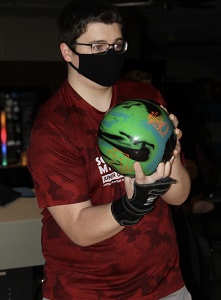 “He’s a good kid and very coachable,” Rich Van Der Slik said. “He listens and he tries.
“He’s thinking ahead. He knows when it’s time to make his ball changes.”
Trying to best his grandfather “pushes me to be better,” said Van Der Slik, who has a few warmup routines before his Saturday high school matches.
He and his grandfather go to breakfast, then he shoots splits and strikes at Continental Lanes when the high school match is not there.
Although baseball is his other sport, Van Der Slik also throws a football before matches, an exercise he learned from Scott Brunner, who has the pro shop at Continental.
“It helps me get my hand through the (bowling) ball better; shows me the spin,” Van Der Slik said.
Paw Paw bowling brings together the Zolp family as well.
Boys coach Chuck Zolp is in his 22nd season. His daughter, Jessica, coaches the girls and “I’ve been working (at Rainbow Lanes) since 1972 and bought the place in 1979,” Zolp said.
That is a big advantage for both teams since they do not have to worry about scheduling practice time. While the Red Wolves boys are an experienced contender, they are relying on a new anchor, Ballard, after the team graduated Michael Hiestand last spring.
Hiestand was the team’s top singles roller at last year’s Regional, just missing the Finals with a 13th place. Van Der Slik was 24th and Ballard 25th.
“(Derek) helps with the rest of the team, coaches them in-between matches and in practice,” said Chuck Zolp, in his 22nd year coaching the team. “He’s very consistent. He brings a lot to the team.”
The other seniors on the team are Peyton Long, Zach Dooley, Christian Johnson and Vaughn Stiglich. Long, Dooley and Stiglich all bowled during last season’s Singles Regional as well.
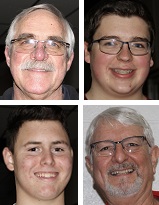 Although he has not thrown a 700 series yet, Ballard’s top score is 277.
He started bowling at a young age.
“There was a youth sign up out here (at Rainbow) and I asked my dad (Doug) if I could join and I never stopped,” he said.
Making Adjustments
The biggest differences for bowlers this year are wearing masks and having no spectators. However, MHSAA guidelines allow them to drop the masks at the approach.
“It’s kind of hot after a few games, but it’s not bad,” Ballard said. “We can take it down on the approach, but I usually don’t because it’s annoying to pull it down. I have no problem with it.”
Van Der Slik, who also has no problem with the mask, is aware of his role on the team.
“Being the young guy, I’m going to be the only one here next year so I’ve got to do what I can to make the team better,” he said.
“I see myself as almost the middle man, trying to keep everyone happy and doing the best I can.”
The lack of spectators also does not bother Van Der Slik at all.
“It’s actually not as bad as you would think because I’m a very loud person,” he said. “Everyone hearing me, it’s definitely a scary thing for them but fun for us.”
 Pam Shebest served as a sportswriter at the Kalamazoo Gazette from 1985-2009 after 11 years part-time with the Gazette while teaching French and English at White Pigeon High School. She can be reached at [email protected] with story ideas for Calhoun, Kalamazoo and Van Buren counties.
PHOTOS: (Top) Paw Paw’s Ethan Van Der Slik begins his approach during a recent practice. (Middle) Senior Derek Ballard lines up his next shot. (Below) Clockwise from top left: Red Wolves boys bowling coach Chuck Zolp, Ballard, Rich Van Der Slik and Ethan Van Der Slik. (Photos by Pam Shebest.)