


Add, Subtract, Divide, Multiply: MHSAA Not Alone
July 25, 2017
By Rob Kaminski
MHSAA benchmarks editor
This is the third part in a series on MHSAA tournament classification, past and present, that will be published over the next two weeks. This series originally ran in this spring's edition of MHSAA benchmarks.
As the MHSAA faces its most recent classification task with 8-Player Football, and opinions continue to swirl about as to the method, timeframe, location and other procedures, a look around the country provides plenty of company among state association brethren factoring variables into their own equations.
In the Pacific Northwest, the Oregon School Activities Association Football Playoffs are under public scrutiny as leadership ponders a five or six classification format beginning with the 2018-19 school year.
The OSAA has crowned six champions on the gridiron since 2006-07. Many of the state’s smaller schools would like to keep it that way, while larger schools lean toward a five-classification system, citing larger leagues, ease of travel and credibility to state championships as the advantages.
Still others would prefer more than six classes, pointing to safety issues and the opportunity to increase participation numbers as positives.
Moving southeast of Oregon, the Nevada Interscholastic Activities Association recently voted to hold serve on a classification proposal that was volleyed to the membership.
However, changes still could be forthcoming by as early as the 2018-19 season which would add a fifth classification in more populated southern Nevada while allowing northern schools to participate in four classifications. Such divisions could mean no state championship for the fifth class in southern Nevada.
Because of that, the NIAA wants equal numbers of schools in each classification on both ends of the state. Complicating the issue is the fact that the 24 largest schools in the state, by enrollment, are all in Clark County in Southern Nevada.
Across Nevada’s border into Arizona, charter schools are asking the Arizona Interscholastic Association to reconsider classification that was voted upon and approved in September 2015. That agreement called for the largest 33 percent of charter schools by enrollment to be placed in the state’s largest school classification, 3A, the middle 33 percent into 2A, and the smallest 33 percent into 1A.
Less than two years later the charter schools have had a change of heart and have asked to be considered the same as other Arizona public schools and be placed appropriately by enrollment beginning with the 2018-19 school year.
The situation in Arizona further illustrates how the public/private debate that all state associations have faced throughout existence now has the added dynamic of rapidly growing charter schools in today’s educational system, along with virtual school enrollment.
In the nation’s heartland, Nebraska has retooled its football classifications by using enrollment of boys students only in its schools rather than total enrollment. The Nebraska School Activities Association football-playing schools will kick off the 2018 season using this alignment.
Nebraska has three classes of 11-player football, with the smallest class divided in two, Class C-1 and C-2. The state also will have 8-player football for boys enrollments under 47, and the NSAA will sponsor a new 6-player tournament in 2018 for schools with 27 or fewer boys.
“This is a good proposal because some schools have a sizable imbalance between the number of boys and girls, and there’s a large gap (in enrollment) between the largest and smallest schools in Classes A and B,” NSAA executive director Jim Tenopir said. “I think this addresses both of those concerns.”
Swimmers in Georgia, meanwhile, will feel like they are moving with the current, rather than upstream in 2017-18, as the Georgia High School Association recently doubled the number of team championship events from two to four.
Swim enthusiasts can also count on longer days at the finals, as the top 30 finishers from the prelims will advance to the finals instead of 20, and all championship events will have three heats versus two.
Traverse City Supports in Force on Ski Hill
February 12, 2021
By Tom Spencer
Special for Second Half
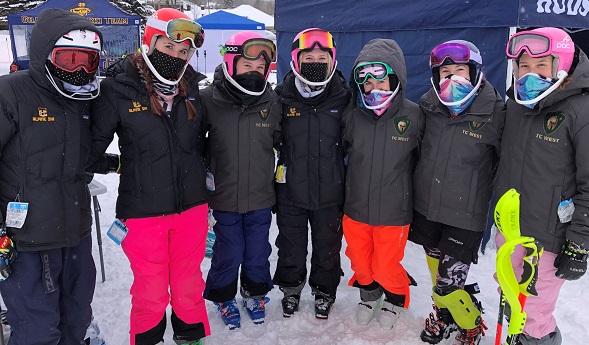
This might seem like the logical time for Traverse City West’s girls Alpine ski team to discontinue its long-standing support of its cross-town rival at the upcoming MHSAA Finals.
 While Traverse City’s Central’s girls won Wednesday’s Regional at Crystal Mountain, the Titans girls didn’t finish among the top three. So the West girls won’t be at the Feb. 22 Final.
Or will they?
Three qualified as individuals. And not many would be surprised if the rest of the Titans girls squad and their supporters make the 70-some mile trip to Nub’s Nob – and continue cheering on not only the Titans boys team, but of both Central teams as well.
The West and Central boys and girls have been competing with and against each other since their beginning days on the slopes. Their families all know each other well. And no one denies the special relationship the girls have.
“We’ve known them (West’s girls) for our whole skiing careers,” said Central junior Elle Craven after the Trojans girls’ Regional win. “So we always cheer for each other, and we always want each other to do great.
“They’ve been on my team until my freshmen year – that’s when we get split up,” she continued. “They are our great friends, and we hang out with them outside of school also.”
Central’s Sarah Beattie, a senior captain, echoed the sentiment.
“They are a great group of girls too,” she noted. “They are hilarious and so fun to be around.
“We all live in Traverse City and see each other around town, and our families know each other and that makes us closer.”
West freshman Charlie Schultz, one of the three Titans’ individual qualifiers, admitted it was tough seeing her Central friends move on but not her team.
West missed the final qualifying berth by eight points.
“We pretty much have been skiing together our whole lives, so we’re all pretty close,” she said. “It is competitive, but it is like friendly competitive.
“Our team was kind of bummed. We’re just hoping next year we can (reach the Finals).”
Lila Warren and Ellie Gruber also qualified for the Final for West. Central was led by Beattie and Craven. Trojans Maddy Cox, Lily Kuberski, and Pearl Hale also had top-10 finishes in the Regional.
West junior Aiden Lewandowski won both the slalom and giant slalom in the boys Regional as West topped the field including Central and third-place qualifier Grand Rapids Forest Hills Northern.
 The other top-10 West finishers on the boys side were Andy Hill, Luke Wiersma and Caleb Lewandowski. Max Werner, Will Russell, Michael Booher and Gus Dutmers posted top-10 finishes for Central.
West coach Ed Johnson has seen a lot during his more than 30-year tenure coaching West’s boys and girls. The closeness of the boys and girls teams from each school really adds to the fun for him.
“It doesn’t matter which side of town they’re from or which school they go to, they are all really close friends,” he said. “It is a close-knit group, and it is really fun to see.
“The coaches get along great. The athletes get along great. (Skiing) is a fun program for both schools.”
Central boys and girls coach Amy Kudary agrees.
“They have grown up together,” she said. “It is very cool when other teams look at us when we’re cheering for our biggest rivals.
“And, I think that is teaching the kids a lot beyond the ski hill too.”
Championships are in the sight for both Central squads and the West boys due to all three teams’ depth. Marquette’s boys, Division 1 champs the past eight years, finished fourth at the same Regional and did not qualify for the Finals. The Marquette girls, Division 1 champions the last five years, finished 33 points behind Central at the Regional.
“Today (at Regionals) that (depth) was why both of our teams did so well,” said Kudary. “They all skied as a team. We didn’t have to rely on one or two skiers.
“We each had a couple skiers go down,” she continued. “The other skiers stepped in and performed like they needed to. It was truly team skiing today, and that is what is most fun to see as a coach.”
Now, both coaches have the difficult, but welcomed, challenge of selecting the six skiers from their deep squads to compete for the Division 1 championships.
“That’s tough for those alternates,” Kudary acknowledged. “I have to tell them they’re not racing for the Regionals and states when they could be one of the top skiers on any other team in the state.”
 Tom Spencer is a longtime MHSAA-registered basketball and soccer official, and former softball and baseball official, and he also has coached in the northern Lower Peninsula area. He previously has written for the Saginaw News, Bay County Sports Page and Midland Daily News. He can be reached at [email protected] with story ideas for Manistee, Wexford, Missaukee, Roscommon, Ogemaw, Iosco, Alcona, Oscoda, Crawford, Kalkaska, Grand Traverse, Benzie, Leelanau, Antrim, Otsego, Montmorency, Alpena, Presque Isle, Cheboygan, Charlevoix and Emmet counties.
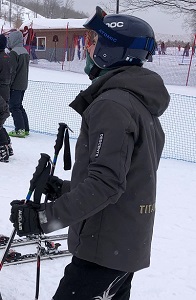
PHOTOS: (Top) Traverse City West and Central skiers support each other’s teams together during their Division 1 Regional, from left: Maddy Cox, Pearl Hale, Mackenzie Cronk, Avery Sill, Charlie Schultz, Lola Hisenkcamp and Ellie Gruber. (Middle) One of the Titans’ boys competitors keeps an eye on the hill. (Photos by Tom Spencer.)