


Add, Subtract, Divide, Multiply: MHSAA Not Alone
July 25, 2017
By Rob Kaminski
MHSAA benchmarks editor
This is the third part in a series on MHSAA tournament classification, past and present, that will be published over the next two weeks. This series originally ran in this spring's edition of MHSAA benchmarks.
As the MHSAA faces its most recent classification task with 8-Player Football, and opinions continue to swirl about as to the method, timeframe, location and other procedures, a look around the country provides plenty of company among state association brethren factoring variables into their own equations.
In the Pacific Northwest, the Oregon School Activities Association Football Playoffs are under public scrutiny as leadership ponders a five or six classification format beginning with the 2018-19 school year.
The OSAA has crowned six champions on the gridiron since 2006-07. Many of the state’s smaller schools would like to keep it that way, while larger schools lean toward a five-classification system, citing larger leagues, ease of travel and credibility to state championships as the advantages.
Still others would prefer more than six classes, pointing to safety issues and the opportunity to increase participation numbers as positives.
Moving southeast of Oregon, the Nevada Interscholastic Activities Association recently voted to hold serve on a classification proposal that was volleyed to the membership.
However, changes still could be forthcoming by as early as the 2018-19 season which would add a fifth classification in more populated southern Nevada while allowing northern schools to participate in four classifications. Such divisions could mean no state championship for the fifth class in southern Nevada.
Because of that, the NIAA wants equal numbers of schools in each classification on both ends of the state. Complicating the issue is the fact that the 24 largest schools in the state, by enrollment, are all in Clark County in Southern Nevada.
Across Nevada’s border into Arizona, charter schools are asking the Arizona Interscholastic Association to reconsider classification that was voted upon and approved in September 2015. That agreement called for the largest 33 percent of charter schools by enrollment to be placed in the state’s largest school classification, 3A, the middle 33 percent into 2A, and the smallest 33 percent into 1A.
Less than two years later the charter schools have had a change of heart and have asked to be considered the same as other Arizona public schools and be placed appropriately by enrollment beginning with the 2018-19 school year.
The situation in Arizona further illustrates how the public/private debate that all state associations have faced throughout existence now has the added dynamic of rapidly growing charter schools in today’s educational system, along with virtual school enrollment.
In the nation’s heartland, Nebraska has retooled its football classifications by using enrollment of boys students only in its schools rather than total enrollment. The Nebraska School Activities Association football-playing schools will kick off the 2018 season using this alignment.
Nebraska has three classes of 11-player football, with the smallest class divided in two, Class C-1 and C-2. The state also will have 8-player football for boys enrollments under 47, and the NSAA will sponsor a new 6-player tournament in 2018 for schools with 27 or fewer boys.
“This is a good proposal because some schools have a sizable imbalance between the number of boys and girls, and there’s a large gap (in enrollment) between the largest and smallest schools in Classes A and B,” NSAA executive director Jim Tenopir said. “I think this addresses both of those concerns.”
Swimmers in Georgia, meanwhile, will feel like they are moving with the current, rather than upstream in 2017-18, as the Georgia High School Association recently doubled the number of team championship events from two to four.
Swim enthusiasts can also count on longer days at the finals, as the top 30 finishers from the prelims will advance to the finals instead of 20, and all championship events will have three heats versus two.

Lowell's Byrne Siblings Speed Into Finals
February 12, 2021
By Dean Holzwarth
Special for Second Half
LOWELL – Kaylee Byrne became emotional upon completion of the giant slalom course at this week’s MHSAA Division 2 Regional.
The Lowell junior skier has endured an up-and-down season, so a first-place finish was a gratifying accomplishment.
“I actually shed a few tears at the bottom of the GS course, but they were tears of joy,” Byrne said. “It was a little rocky to begin the season, so finishing like that felt really good.
“I had high hopes and a lot of confidence going into Regionals. I knew I could ski well enough to finish like that, so I’m just glad I pulled it out.”
Byrne clocked a winning time of 52.88 seconds to win the giant slalom and also finished runner-up in the slalom (1:05.51).
She qualified as an individual for the Finals, which will take place Feb. 22 at Boyne Highlands.
Byrne’s younger brother, Colton, also advanced to the Finals by placing second and third, respectively, in the slalom and giant slalom.
The opportunity to compete this season amid the pandemic has been a blessing for the siblings.
“It’s been great,” Kaylee Byrne said. “Skiing is a huge part of my life, so if I had missed that it would have crushed me a little bit. I was really thankful for that.”
Skiing, non-contact and competed outdoors, was allowed to begin activity first among winter sports, on Dec. 21.
Lowell ski coach Karla Byrne was thrilled to see her children return to the sport toward which they’ve dedicated many hours.
 “It’s been amazing, and we feel so lucky,” Karla Byrne said. “I know how much my kids love the sport and how detrimental they would feel not to be out there. We knew we might not have a season, and we prepped them all summer long that it might not happen and for them to be pleasantly surprised if it did.
“When we found out that we could compete, we felt so fortunate to be one of the sports allowed to be out there and we’ve taken every precaution to stay out there.”
Kaylee Byrne has been racing competitively for the past seven years and has taken part in competitions in Colorado and the Upper Peninsula.
She has continued to improve since she first inquired about the racing gates at Cannonsburg Ski Area at a young age.
Kayla Byrne said her daughter is a student of the sport.
“She’s extremely dedicated and she’s training year around to make herself better,” Kayla said. “She’s super knowledgeable about the sport and studies it. She’s a way better coach than I’ll ever be. She reads, she learns and she watches. She takes that all to heart, and that truly puts her over the top.”
Kaylee Byrne enjoyed the camaraderie of the sport when she was younger, as well as the thrill of victory.
“My first two years racing, I had this group of friends and we were so close,” Kaylee Byrne said. “We caused so much trouble together, and then I started winning races. I was like, ‘I like winning, that’s cool’ and it just helped to have a great community and friendships that I made.”
Colton Byrne, a sophomore, said he and his sister encourage and support each other while pushing the other to ski their best.
“It’s a lot of sibling coaching,” Colton Byrne said. “We see each other ski so often that we know when something is off. The small things that not everyone sees, but we do because we see each other ski every day.
“It’s definitely competitive, and we go back and forth a lot. We have good days and bad days at different times. One day I’ll beat her, and the other day she will beat me.”
 Added Kaylee Byrne: “We train on dual courses, and every time we race we’re both going all out trying to see who can beat the other one. It’s 50-50, and you just never know who’s going to win.”
The sibling rivalry has forged a close-knit bond.
“They really are best buddies, but there will always be a little competitiveness there,” Karla Byrne said. “If the two are out on the hill, you can bet they are trying to one-up each other a little bit, especially as Colton is growing and getting bigger and stronger.
“She certainly doesn’t ever want him to beat her, but it’s always been very friendly competition for sure.”
Skiing has become a family affair for the Byrnes, who also have a seventh-grader, Cooper.
The sport has allowed them to spend quality time together.
“We got wrapped up into it by chance almost, and it’s a great thing for them to do all winter long and it keeps us busy,” Karla Byrne said. “We go everywhere as a family together all winter long, which is really nice. It’s pretty unique to be able to do that.”
Kaylee Byrne, who also runs cross country and is a thrower in track & field, finished third in the giant slalom a year ago at the Finals.
She has similar aspirations this time around.
“I’m definitely gunning for top three, and I think I could potentially take first,” she said. “That’s always the goal.”
Colton Byrne, who’s been racing for the past six years, qualified for the Finals as a freshman and finished 23rd in the giant slalom.
“I think he can be competitive up there and finish in the top 16,” Karla Byrne said. “And we are hopeful that Kaylee can be in the top spots again, hopefully in both events.”
 Dean Holzwarth has covered primarily high school sports for Grand Rapids-based WOOD-TV for four years after serving at the Grand Rapids Press and MLive for 16 years along with shorter stints at the Ionia Sentinel and WZZM. Contact him at [email protected] with story ideas for Allegan, Kent and Ottawa counties.
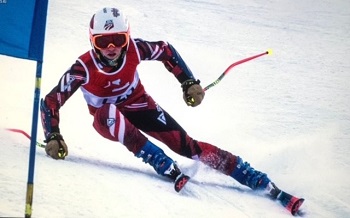
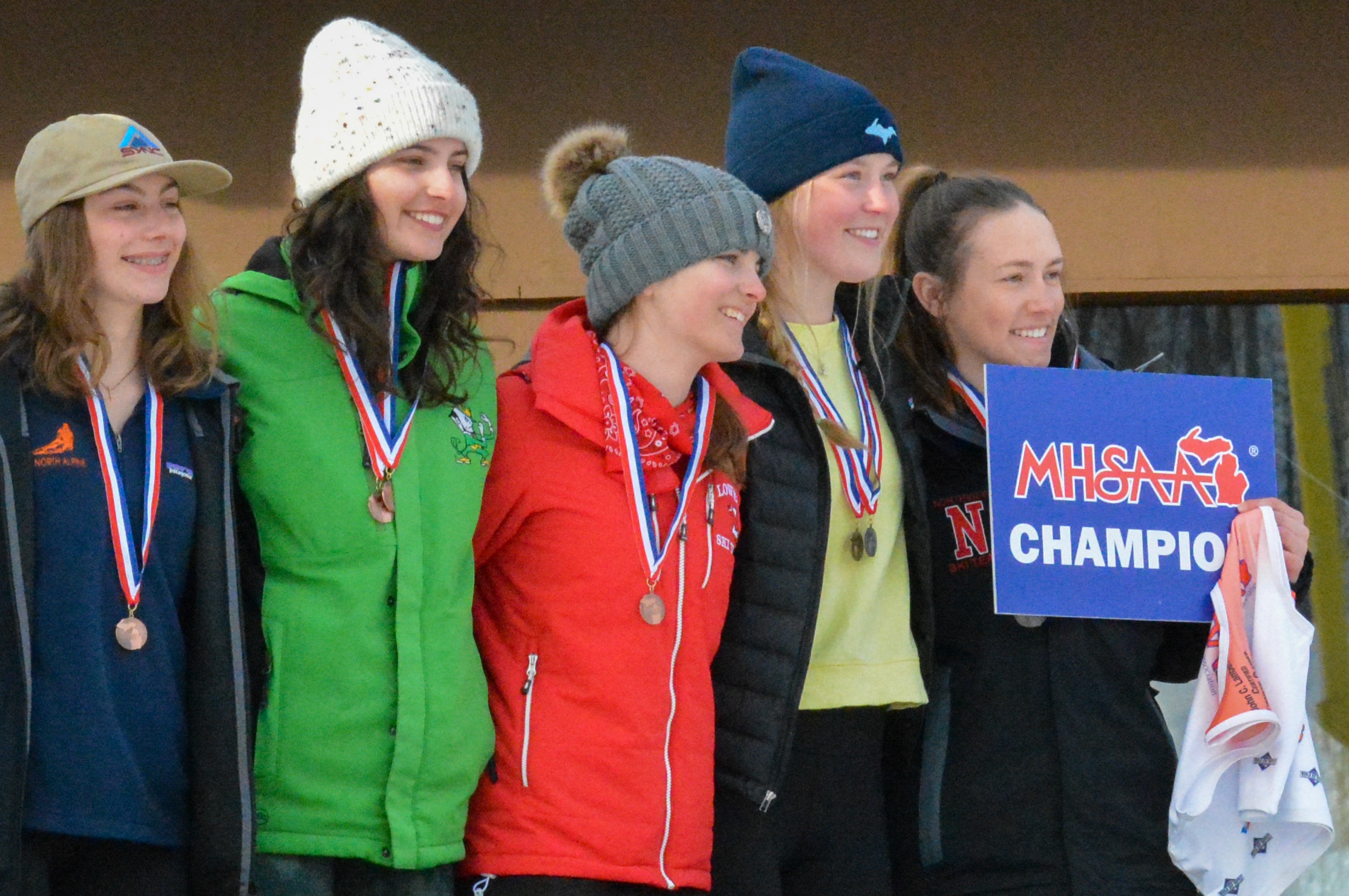
PHOTOS: (Top) Lowell’s Kaylee Byrne races past a ski gate. (Middle) Brother Colton Byrne leans into a turn. (Below) Kaylee Byrne, middle, stands with the rest of the top-10 giant slalom finishers at last season’s Division 2 Finals at Nub’s Nob. (Top and middle photo courtesy of Byrne family, bottom photo by Sports in Motion.)