


Add, Subtract, Divide, Multiply: MHSAA Not Alone
July 25, 2017
By Rob Kaminski
MHSAA benchmarks editor
This is the third part in a series on MHSAA tournament classification, past and present, that will be published over the next two weeks. This series originally ran in this spring's edition of MHSAA benchmarks.
As the MHSAA faces its most recent classification task with 8-Player Football, and opinions continue to swirl about as to the method, timeframe, location and other procedures, a look around the country provides plenty of company among state association brethren factoring variables into their own equations.
In the Pacific Northwest, the Oregon School Activities Association Football Playoffs are under public scrutiny as leadership ponders a five or six classification format beginning with the 2018-19 school year.
The OSAA has crowned six champions on the gridiron since 2006-07. Many of the state’s smaller schools would like to keep it that way, while larger schools lean toward a five-classification system, citing larger leagues, ease of travel and credibility to state championships as the advantages.
Still others would prefer more than six classes, pointing to safety issues and the opportunity to increase participation numbers as positives.
Moving southeast of Oregon, the Nevada Interscholastic Activities Association recently voted to hold serve on a classification proposal that was volleyed to the membership.
However, changes still could be forthcoming by as early as the 2018-19 season which would add a fifth classification in more populated southern Nevada while allowing northern schools to participate in four classifications. Such divisions could mean no state championship for the fifth class in southern Nevada.
Because of that, the NIAA wants equal numbers of schools in each classification on both ends of the state. Complicating the issue is the fact that the 24 largest schools in the state, by enrollment, are all in Clark County in Southern Nevada.
Across Nevada’s border into Arizona, charter schools are asking the Arizona Interscholastic Association to reconsider classification that was voted upon and approved in September 2015. That agreement called for the largest 33 percent of charter schools by enrollment to be placed in the state’s largest school classification, 3A, the middle 33 percent into 2A, and the smallest 33 percent into 1A.
Less than two years later the charter schools have had a change of heart and have asked to be considered the same as other Arizona public schools and be placed appropriately by enrollment beginning with the 2018-19 school year.
The situation in Arizona further illustrates how the public/private debate that all state associations have faced throughout existence now has the added dynamic of rapidly growing charter schools in today’s educational system, along with virtual school enrollment.
In the nation’s heartland, Nebraska has retooled its football classifications by using enrollment of boys students only in its schools rather than total enrollment. The Nebraska School Activities Association football-playing schools will kick off the 2018 season using this alignment.
Nebraska has three classes of 11-player football, with the smallest class divided in two, Class C-1 and C-2. The state also will have 8-player football for boys enrollments under 47, and the NSAA will sponsor a new 6-player tournament in 2018 for schools with 27 or fewer boys.
“This is a good proposal because some schools have a sizable imbalance between the number of boys and girls, and there’s a large gap (in enrollment) between the largest and smallest schools in Classes A and B,” NSAA executive director Jim Tenopir said. “I think this addresses both of those concerns.”
Swimmers in Georgia, meanwhile, will feel like they are moving with the current, rather than upstream in 2017-18, as the Georgia High School Association recently doubled the number of team championship events from two to four.
Swim enthusiasts can also count on longer days at the finals, as the top 30 finishers from the prelims will advance to the finals instead of 20, and all championship events will have three heats versus two.
Workout Basics: Warm-Ups & Cool-Downs
February 3, 2021

By Nick Parkinson, M.Ed., AT, ATC, TSAC-F
Henry Ford Health Systems
You may know a good warm-up — and cool-down — are essential to getting a good workout. You may also know that warming up your muscles and stretching them out after exercise can help prevent injury and keep you at the top of your game.
They’re the two bookends that help maximize a workout. Unfortunately, a lot of exercise enthusiasts don’t know how to warm up and cool down correctly.
Warm-Up Basics
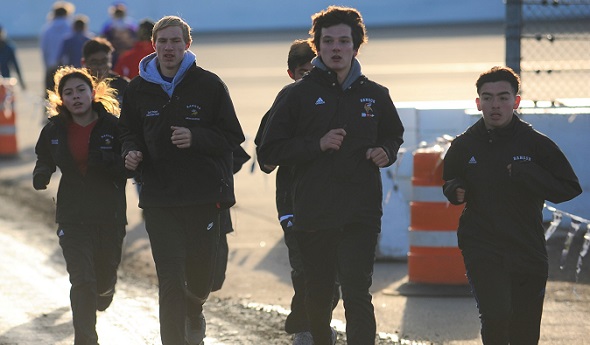
A warm-up is exactly what it sounds like: The goal is to warm up your muscles and prepare your body for whatever you’re asking it to do. Warming up increases your body temperature and helps blood flow to the muscles that you’re using.
So if you’re going to play soccer, your warm-up should touch all of the muscles in your legs and core. Shooting hoops? You’ll need to add shoulders and arms to your routine. Circuit training at the gym? Choose a warm-up that flexes all of the muscles you’re about to use.
The thing that all warm-ups have in common is that they require dynamic (or constantly moving) motion, not static stretching (holding poses for a certain amount of time). In fact, static stretching prior to a workout can inhibit power and strength, especially if you’re doing something like weightlifting.
The anatomy of a solid warm-up:
• Before any activity, do about 10 minutes of light cardiovascular activity, whether walking, biking or jogging.
• Dynamic stretches. After you get your muscles moving, do a series of lunges, jumping jacks or toe touches to stretch a bit.
• Dive in. When you start your workout, begin slowly and gradually increase power and speed.
Cool-Down Basics
After you’ve put your body through a challenge, a good cool-down is essential. It helps slow down your heart rate gradually, relax your muscles and stretch them out.
Cool-down routines should always include some type of motion before you get to static stretching, especially if you’ve just finished a high-intensity workout. Static stretching improves flexibility and performance and it can also help stave off future injury.
As with warm-ups, the right cool-down exercises depend on the activity you engaged in. If you biked for 20 miles, you might coast on your cycle for a while before coming to a stop. If you ran, you might jog or walk before you begin stretching. As with your warm-up, the key is addressing every muscle group you worked during your workout.
The anatomy of a solid cool-down:
• At the end of your workout, slow the pace and intensity of whatever activity you’re doing. So, if you’re running, slow to a jog and then a walk for 5 to 10 minutes before stopping.
• Stretch out the muscles you work, but don’t push past the point where you feel tight. Then, hold the position for at least 30 seconds. That’s how long it takes for the body to overcome its stretch reflex.
• Breathe through your stretches and make sure to finish your cool-down with deep, belly breaths.
Running short on time? Target muscle groups you may have injured in the past or that tend to get sore after activity. Cooling down will preserve your athleticism — and your ability to participate in daily activities — over the long term.
Be Good to Your Body
While there’s some controversy about whether warming up and cooling down can help prevent injury, there’s little dispute that they can help you ease in and out of activity.
The key is to find something that works for you. Your warm-up could be as simple as walking to the gym and doing a set of jumping jacks when you arrive. Your cool-down might just involve ending your workout 10 minutes early so you can slow down.
It doesn’t have to be complicated. It just has to give your heart and blood vessels a chance to breathe before and after activity.
Nick Parkinson, M.Ed., AT, ATC, TSAC-F, is the Supervisor of Athletic Training with Henry Ford Sports Medicine and also leads Sports Performance training at the William Clay Ford Center for Athletic Medicine. Learn more about Nick.
Want to learn more? Henry Ford Health System sports medicine experts are treating the whole athlete, in a whole new way. From nutrition to neurology, and from injury prevention to treatment of sports-related conditions, they can give your athlete a unique game plan.
Visit henryford.com/sports or call (313) 972-4216.