


Add, Subtract, Divide, Multiply: MHSAA Not Alone
July 25, 2017
By Rob Kaminski
MHSAA benchmarks editor
This is the third part in a series on MHSAA tournament classification, past and present, that will be published over the next two weeks. This series originally ran in this spring's edition of MHSAA benchmarks.
As the MHSAA faces its most recent classification task with 8-Player Football, and opinions continue to swirl about as to the method, timeframe, location and other procedures, a look around the country provides plenty of company among state association brethren factoring variables into their own equations.
In the Pacific Northwest, the Oregon School Activities Association Football Playoffs are under public scrutiny as leadership ponders a five or six classification format beginning with the 2018-19 school year.
The OSAA has crowned six champions on the gridiron since 2006-07. Many of the state’s smaller schools would like to keep it that way, while larger schools lean toward a five-classification system, citing larger leagues, ease of travel and credibility to state championships as the advantages.
Still others would prefer more than six classes, pointing to safety issues and the opportunity to increase participation numbers as positives.
Moving southeast of Oregon, the Nevada Interscholastic Activities Association recently voted to hold serve on a classification proposal that was volleyed to the membership.
However, changes still could be forthcoming by as early as the 2018-19 season which would add a fifth classification in more populated southern Nevada while allowing northern schools to participate in four classifications. Such divisions could mean no state championship for the fifth class in southern Nevada.
Because of that, the NIAA wants equal numbers of schools in each classification on both ends of the state. Complicating the issue is the fact that the 24 largest schools in the state, by enrollment, are all in Clark County in Southern Nevada.
Across Nevada’s border into Arizona, charter schools are asking the Arizona Interscholastic Association to reconsider classification that was voted upon and approved in September 2015. That agreement called for the largest 33 percent of charter schools by enrollment to be placed in the state’s largest school classification, 3A, the middle 33 percent into 2A, and the smallest 33 percent into 1A.
Less than two years later the charter schools have had a change of heart and have asked to be considered the same as other Arizona public schools and be placed appropriately by enrollment beginning with the 2018-19 school year.
The situation in Arizona further illustrates how the public/private debate that all state associations have faced throughout existence now has the added dynamic of rapidly growing charter schools in today’s educational system, along with virtual school enrollment.
In the nation’s heartland, Nebraska has retooled its football classifications by using enrollment of boys students only in its schools rather than total enrollment. The Nebraska School Activities Association football-playing schools will kick off the 2018 season using this alignment.
Nebraska has three classes of 11-player football, with the smallest class divided in two, Class C-1 and C-2. The state also will have 8-player football for boys enrollments under 47, and the NSAA will sponsor a new 6-player tournament in 2018 for schools with 27 or fewer boys.
“This is a good proposal because some schools have a sizable imbalance between the number of boys and girls, and there’s a large gap (in enrollment) between the largest and smallest schools in Classes A and B,” NSAA executive director Jim Tenopir said. “I think this addresses both of those concerns.”
Swimmers in Georgia, meanwhile, will feel like they are moving with the current, rather than upstream in 2017-18, as the Georgia High School Association recently doubled the number of team championship events from two to four.
Swim enthusiasts can also count on longer days at the finals, as the top 30 finishers from the prelims will advance to the finals instead of 20, and all championship events will have three heats versus two.
'D' Propels Centreville to 1st Finals Win
By
Paul Costanzo
Special for MHSAA.com
January 22, 2021
DETROIT – It didn’t take long Friday for the Centreville defense to prove its season statistics were no fluke.
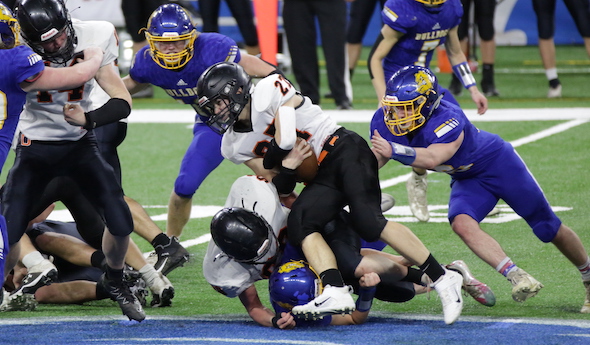
The Bulldogs stuffed Ubly on a 4th-and-short at midfield on the first possession of the MHSAA Division 8 Football Final, setting the tone for a dominant performance in their 22-0 victory at Ford Field.
“The defense played hard today,” Centreville senior defensive end and fullback Jared Spencer said. “I think we went all out – our seniors went all out just because it was our last game. Our first time making it to state, so I just think our defense, we were ready for the game.”
The title is the first for the Bulldogs (11-0), who had never won a District title in the sport prior to this season. While it didn’t look like it to those observing, coach Jerry Schultz said the nerves were certainly there pregame.
“If they’re going to say (they weren’t nervous), then they’re lying,” said Schultz, who is in his first year leading the program. “I could see it on their faces that they were nervous, especially this morning. That’s why we got on the field so early … we went and ran routes, I wanted them to just throw the ball around. As we told them, it’s 100 yards. Even I walked out here – I've never been here before, I’m actually a Packer fan – but just walking out here, it’s awesome.”
The 11 wins are a school record, despite the regular season being shortened by three games. The program was in the postseason for the third straight year, but just the seventh in school history.
“All the offseason work in the weight room and all the conditioning – everything that we had done since we were freshmen, it’s the best feeling to have to come in as a senior (and win) with this group of guys,” senior quarterback and safety Sam Todd said. “So, coming out on top as a senior, it doesn’t get better than that.”
Centreville was dominant throughout the year, with only two of the 10 games it played – its Semifinal was won by forfeit over Clarkston Everest Collegiate – being decided by single digits. That effort was led by a defense that had seven shutouts and allowed 29 points on the season.
“Just buying into the defense,” Spencer said when asked to explain the success. “It’s been the same defense since (defensive coordinator Trevor Haas) has been here. We’ve had the same players since freshman year, so I think we just had that bond to keep it tight.”
The Bulldogs held Ubly (9-3) to 142 yards of total offense, but 103 of those came on second half possessions when they had already built a 22-0 lead. Ubly was held to 24 yards in the first half, and didn’t record a first down until there was 3:54 to play in the third quarter.
 Jacob Spencer led the Bulldogs defense with 10 tackles, while Ethan Brownridge had seven. Tristan McElroy had an interception in the end zone, which ended Ubly’s best drive of the day.
“One thing that they do is they have that angle front,” Ubly coach Eric Sweeney said. “Four years ago, (former Centreville coach) Tyler Langs coached at (Unionville-Sebewaing) and they’re still running his defense. So, it’s not something we haven’t seen, but we knew it was going to be tough because when you’re trying to run a trap and they’re angling those guys up front, you have to do some different things. They flew to the ball. Their linebackers came downfield. It was nothing we didn’t expect, but I kind of thought we’d block it better, but we didn’t. I thought they played incredible defense.”
When the Centreville defense wasn’t on the field stifling the Bearcats, the offense was giving it plenty of rest. The Bulldogs’ ball-control attack chewed up clock, with nearly 30 minutes of possession to Ubly’s 18. They ran the ball 42 times for 156 yards, and made big plays in the passing game when needed, as Todd was 6-for-7 for 130 yards and a pair of touchdowns, both to junior receiver Tyler Swanwick.
Todd also led the Centreville rushing attack with 70 yards and a touchdown on 19 carries.
“I think our biggest problem like I was saying before, we like to play ball-control offense, and that’s what they did,” Sweeney said. “When they needed a big play, they got it. When we only run 10 plays in the first half, that’s not ball-control offense. Personally, I thought our defense played very well, but our defense never got rest, because we played bad offense. We knew (Todd) was an excellent football player. There were no surprises there.”
Todd’s first score came on a 1-yard run midway through the second quarter. The fourth-down play was nearly blown up in the backfield, but Jared Spencer had a big block to help his quarterback get the edge.
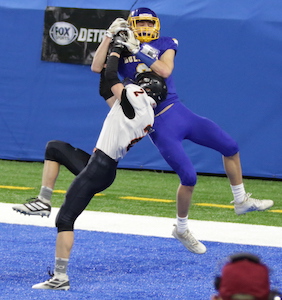
Swanwick made a pair of big plays on the second scoring drive, catching a deflected pass for a 31-yard gain, setting his team up at the 20-yard line with nine seconds to play in the half. On the next play, Todd found his top target with a well-thrown jump ball in the end zone, and the Bulldogs took a 16-0 lead into the half.
The Bulldogs all but put the game away with their first drive of the third quarter, eating up 7:46 on the clock, and finishing the drive off with a 12-yard pass from Todd to Swanwick.
Carson Heleski led the Bearcats in his final game, recording 16 tackles, including 1.5 for loss. He also had a team-high 67 rushing yards.
PHOTOS: (Top) Centreville defenders swarm around Ubly running back Mark Hellig during Friday’s Division 8 Final. (Middle) Centreville’s Tyler Swanwick pulls in one of his two touchdown catches. (Click for more from Hockey Weekly Action Photos.)