


Add, Subtract, Divide, Multiply: MHSAA Not Alone
July 25, 2017
By Rob Kaminski
MHSAA benchmarks editor
This is the third part in a series on MHSAA tournament classification, past and present, that will be published over the next two weeks. This series originally ran in this spring's edition of MHSAA benchmarks.
As the MHSAA faces its most recent classification task with 8-Player Football, and opinions continue to swirl about as to the method, timeframe, location and other procedures, a look around the country provides plenty of company among state association brethren factoring variables into their own equations.
In the Pacific Northwest, the Oregon School Activities Association Football Playoffs are under public scrutiny as leadership ponders a five or six classification format beginning with the 2018-19 school year.
The OSAA has crowned six champions on the gridiron since 2006-07. Many of the state’s smaller schools would like to keep it that way, while larger schools lean toward a five-classification system, citing larger leagues, ease of travel and credibility to state championships as the advantages.
Still others would prefer more than six classes, pointing to safety issues and the opportunity to increase participation numbers as positives.
Moving southeast of Oregon, the Nevada Interscholastic Activities Association recently voted to hold serve on a classification proposal that was volleyed to the membership.
However, changes still could be forthcoming by as early as the 2018-19 season which would add a fifth classification in more populated southern Nevada while allowing northern schools to participate in four classifications. Such divisions could mean no state championship for the fifth class in southern Nevada.
Because of that, the NIAA wants equal numbers of schools in each classification on both ends of the state. Complicating the issue is the fact that the 24 largest schools in the state, by enrollment, are all in Clark County in Southern Nevada.
Across Nevada’s border into Arizona, charter schools are asking the Arizona Interscholastic Association to reconsider classification that was voted upon and approved in September 2015. That agreement called for the largest 33 percent of charter schools by enrollment to be placed in the state’s largest school classification, 3A, the middle 33 percent into 2A, and the smallest 33 percent into 1A.
Less than two years later the charter schools have had a change of heart and have asked to be considered the same as other Arizona public schools and be placed appropriately by enrollment beginning with the 2018-19 school year.
The situation in Arizona further illustrates how the public/private debate that all state associations have faced throughout existence now has the added dynamic of rapidly growing charter schools in today’s educational system, along with virtual school enrollment.
In the nation’s heartland, Nebraska has retooled its football classifications by using enrollment of boys students only in its schools rather than total enrollment. The Nebraska School Activities Association football-playing schools will kick off the 2018 season using this alignment.
Nebraska has three classes of 11-player football, with the smallest class divided in two, Class C-1 and C-2. The state also will have 8-player football for boys enrollments under 47, and the NSAA will sponsor a new 6-player tournament in 2018 for schools with 27 or fewer boys.
“This is a good proposal because some schools have a sizable imbalance between the number of boys and girls, and there’s a large gap (in enrollment) between the largest and smallest schools in Classes A and B,” NSAA executive director Jim Tenopir said. “I think this addresses both of those concerns.”
Swimmers in Georgia, meanwhile, will feel like they are moving with the current, rather than upstream in 2017-18, as the Georgia High School Association recently doubled the number of team championship events from two to four.
Swim enthusiasts can also count on longer days at the finals, as the top 30 finishers from the prelims will advance to the finals instead of 20, and all championship events will have three heats versus two.
Amid Loss, Marian Closes Out Inspired Win
By
Paul Costanzo
Special for MHSAA.com
January 16, 2021
BATTLE CREEK – One of the great moments at the end of any MHSAA Final is the winning coach hoisting the trophy aloft and joining their players in celebration.
On Saturday, Bloomfield Hills Marian volleyball coach Mayssa Cook passed on that moment, and in the process made it even more special for all involved.
Cook handed the honor off to Jacqui Feldman, the daughter of Dave Feldman, the Marian athletic director who died Thursday after a long battle with COVID-19.
“It was so special,” Marian junior outside hitter Ava Brizard said. “Me, Sara Sylvester and Sophie Treder played with her our freshman year, so we know the Feldman family really well. It was so devastating to hear that he passed away the night before we were supposed to go to Battle Creek, because he was just as competitive as we were the whole season. He loved volleyball so much, and we know that. It was just kind of more fuel to our fire to win a state championship, as if we didn’t have enough already, to win it for him and win it for her. It was just so special for her to give us that trophy, because we were like, ‘We did it for your dad.’”
The players had Feldman in their hearts as they defeated Lowell 25-17, 25-20, 25-19 in the Division 1 Final at Kellogg Arena. It’s the Mustangs’ third title, and first since 2010.
“I think this whole season, it was just about resilience,” Brizard said. “Starting off in August, we didn’t get to start right away and we had to practice in the muddy water on the beach and the grass. We just dealt with all the punches that came our way this season, so to finally get here to Battle Creek and win the whole thing and play the way we did out there and play so amazing, it feels like all of our hard work paid off. Especially with Mr. Feldman passing, we feel so grateful that we can win it for him, and we know he’s definitely smiling and jumping around up in heaven, cheering us on.”
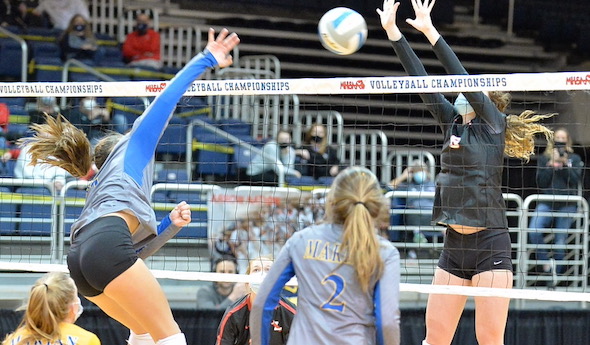
Marian (35-5) was solid in all phases, but Brizard’s dominance at the net was too much for Lowell to contain. She finished with 29 kills compared to just four errors on 52 attacks. Her last three kills provided the final three points of the match.
 “We do call her our finisher, our closer,” Cook said. “It’s one of those things they know that if she’s in the front row, we’re going to fight to keep her in the front row. Obviously, we have capable hitters all around. It’s nice, because she’s probably hitting close to .500 on the season, so at the end of the day, the odds are that one out of two balls is likely to be a kill. Let’s just play those odds.”
Brizard was fed by Ava Sarafa, who finished the match with 39 assists. Ella Schomer added eight kills and 11 digs for the Mustangs, while Lauren Heming had 15 digs.
Marian’s entire roster is eligible to come back next season, and while that’s nice to think about now, it was something that drove Cook and her team all season.
“A reporter was already talking about next year, and I said, ‘I don’t know why you’re talking about next year. This year’s not over, and we have a mission, we have a goal,’” Cook said. “I went back to the team and said, ‘This is what this reporter said, can you believe it?’ We grab little things as coaches, and we use it as fuel to push them to go beyond their comfort zone.”
Lowell (35-5) was led by Jenna Reitsma, who had 22 kills, while Emily Struckmeyer had 10. Sophie Powell finished with 32 assists, and Emma Hall had 17 digs.
“(Reitsma) is phenomenal; she’s special,” Lowell coach Jordan Drake said. “I don’t know if I’ll ever coach a hitter like her again. She’s the best of the best. At the same time, she doesn’t get the kills she does without a good pass. She doesn’t get the kills she does without a good set. These three (seniors Reitsma, Powell and Hall) are like sisters, and it’s not just Jenna, it’s the whole team.”
It was the second straight Finals appearance for Lowell, and while neither ended with a title, that success has elevated the program to a new level.
“It’s just really cool to see the support from our community,” Reitsma said. “And all of the younger girls that we can have an impression on, and see how they grow up to be, and just how they watch us. It’s going to be amazing to come back and watch the program over the years to see what an impact we had, because all the little girls out there that watch us play have big dreams to do what we do, too. It’s really cool, and I’m hoping they can keep that legacy going.”
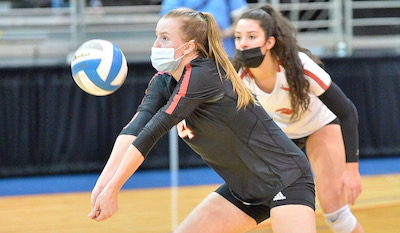
PHOTOS: (Top) Bloomfield Hills Marian’s Ava Brizard sends a kill attempt during Saturday’s Division 1 Final. (Middle) Lowell’s Jenna Reitsma controls possession. (Click for more from Hockey Weekly Action Photos.)