


Add, Subtract, Divide, Multiply: MHSAA Not Alone
July 25, 2017
By Rob Kaminski
MHSAA benchmarks editor
This is the third part in a series on MHSAA tournament classification, past and present, that will be published over the next two weeks. This series originally ran in this spring's edition of MHSAA benchmarks.
As the MHSAA faces its most recent classification task with 8-Player Football, and opinions continue to swirl about as to the method, timeframe, location and other procedures, a look around the country provides plenty of company among state association brethren factoring variables into their own equations.
In the Pacific Northwest, the Oregon School Activities Association Football Playoffs are under public scrutiny as leadership ponders a five or six classification format beginning with the 2018-19 school year.
The OSAA has crowned six champions on the gridiron since 2006-07. Many of the state’s smaller schools would like to keep it that way, while larger schools lean toward a five-classification system, citing larger leagues, ease of travel and credibility to state championships as the advantages.
Still others would prefer more than six classes, pointing to safety issues and the opportunity to increase participation numbers as positives.
Moving southeast of Oregon, the Nevada Interscholastic Activities Association recently voted to hold serve on a classification proposal that was volleyed to the membership.
However, changes still could be forthcoming by as early as the 2018-19 season which would add a fifth classification in more populated southern Nevada while allowing northern schools to participate in four classifications. Such divisions could mean no state championship for the fifth class in southern Nevada.
Because of that, the NIAA wants equal numbers of schools in each classification on both ends of the state. Complicating the issue is the fact that the 24 largest schools in the state, by enrollment, are all in Clark County in Southern Nevada.
Across Nevada’s border into Arizona, charter schools are asking the Arizona Interscholastic Association to reconsider classification that was voted upon and approved in September 2015. That agreement called for the largest 33 percent of charter schools by enrollment to be placed in the state’s largest school classification, 3A, the middle 33 percent into 2A, and the smallest 33 percent into 1A.
Less than two years later the charter schools have had a change of heart and have asked to be considered the same as other Arizona public schools and be placed appropriately by enrollment beginning with the 2018-19 school year.
The situation in Arizona further illustrates how the public/private debate that all state associations have faced throughout existence now has the added dynamic of rapidly growing charter schools in today’s educational system, along with virtual school enrollment.
In the nation’s heartland, Nebraska has retooled its football classifications by using enrollment of boys students only in its schools rather than total enrollment. The Nebraska School Activities Association football-playing schools will kick off the 2018 season using this alignment.
Nebraska has three classes of 11-player football, with the smallest class divided in two, Class C-1 and C-2. The state also will have 8-player football for boys enrollments under 47, and the NSAA will sponsor a new 6-player tournament in 2018 for schools with 27 or fewer boys.
“This is a good proposal because some schools have a sizable imbalance between the number of boys and girls, and there’s a large gap (in enrollment) between the largest and smallest schools in Classes A and B,” NSAA executive director Jim Tenopir said. “I think this addresses both of those concerns.”
Swimmers in Georgia, meanwhile, will feel like they are moving with the current, rather than upstream in 2017-18, as the Georgia High School Association recently doubled the number of team championship events from two to four.
Swim enthusiasts can also count on longer days at the finals, as the top 30 finishers from the prelims will advance to the finals instead of 20, and all championship events will have three heats versus two.
St Philip Adds to Record Title Total
By
Paul Costanzo
Special for MHSAA.com
January 16, 2021
BATTLE CREEK – For most programs, a five-year gap between MHSAA Finals appearances is a sign of incredible strength.
For Battle Creek St. Philip volleyball, it must have felt like an eternity.
The state’s winningest program made its way back to the top Saturday, defeating Auburn Hills Oakland Christian 25-8, 25-15, 22-25, 22-25, 17-15 in the Division 4 Final at Kellogg Arena. It’s the 21st title for the Tigers, and first since 2014.
“I think it’s about time we got another one for Coach (Vicky) Groat,” St. Philip senior Harleen Deol said. “It’s been a dream since fifth grade, so it’s a dream come true my senior year.”
St. Philip dominated the sport after the turn of the century, making 15 straight Finals appearances and winning 10 titles – including a record nine straight – from 2002-15.
“I think in the past – I don’t think our team would take it for granted – I think our supporters took it for granted,” said Groat, who has now won 11 titles as St. Philip coach. “I’ve had many people say, ‘Oh, you’re always going to win state. St. Phil, we’re tired of St. Phil, they recruit.’ We don’t recruit, our numbers are going down – we have 10 total players in our program. … We preach about it at the start of every year, our goal is to win a state title. That’s what you want to strive for, and these kids believed in it.”
It took everything the Tigers had to get No. 21, as Oakland Christian pushed them deep into the fifth set. The back-and-forth final frame ended with a Lancer attack going long, followed by St. Philp jubilation.
“It was mentally and physically draining,” said St. Philip junior Brooke Dzwik, who had 37 kills in the match. “But at the end of the day, when you work your tail off and leave it all on the court, it makes the reward so much greater. We were able to do it for our senior, Harleen, and we reminded the youngers of that multiple times in the huddles. Everybody just was working, and that helped.”
Groat looked to the sky before being embraced by her assistant coaches.
“It feels like the first time,” Groat said. “I’ll never forget (2005), that was my first title as coach, but this is extra special, with the break (because of COVID-19).
Volleyball teams, and all fall sports teams, paused activity for nearly two months because of rising COVID-19 metrics. Teams returned to practice two weeks ago and restarted the tournament with Quarterfinals on Tuesday.
 Early on Saturday, it didn’t appear as if St. Philip would have much trouble collecting title No. 21. The Tigers rolled through the first set, winning 15 of the final 16 points. While the second was tighter, it was never in doubt, as Oakland Christian didn’t have any answers for the Tigers’ attack.
Midway through that set, after a back-row attack found a hole in the back of the Lancers’ defense, Dzwik had her 13th kill of the match. Oakland Christian, meanwhile, had scored 14 points as a team.
“She did all right,” Groat said with a laugh. “Brooke has been our main hitter this year, and today we kind of relied on her a lot. Besides Brooke, Harleen in the middle played a great game … to complement Brooke. But Brooke is an outstanding volleyball player. She sees the court so well, she wants it so bad, she pushes her teammates. I preach we’re a team, it’s not about individuals. We have 10 girls out there who bust their behind and help Brooke out.”
Oakland Christian flipped a switch in the third set, however, winning a back-and-forth affair to extend the match. They kept that momentum going in the fourth, turning what had looked like a St. Philip walkover into a toss-up.
“I didn’t want them to go down like this,” Oakland Christian coach Brian Theut said. “We’ve been through a lot of stuff this year, and this wasn’t how we were going to end it. Today, what was that final chapter going to be in the book that we wrote this year. I knew our seniors deserved a better way out, so I just kept telling them to hang in there. That third game, I knew if we could just get one, get a couple points in a row, I knew we had it. I just wanted to give us a chance, and that fifth set, it was anyone’s game. I wanted us to compete and show that we could.”
Oakland Christian was led by senior libero Olivia Colletti, who had 36 digs. Katie Hopkins had 27 assists, guiding a balanced Lancers attack, led by Anna Frazee’s 10 kills. Kylie Morga added nine kills, while Kaylee Page had eight.
“I am extremely proud of my team,” Page said. “This has been our dream, our goal, and we got to where we wanted. We may not have gotten the outcome we desired, but we laid it all out on the floor, every single girl – our whole bench, all our fans, our parents. We are so incredibly blessed to be where we are now, and that’s all I could ask for. Of course I want to win, but I’m proud of how we played.”
Dzwik added 32 digs to her match-high kill total. Rachel Myers had 51 assists, while Bailey Fancher had 29 digs, Kate Doyle had 20, and Deol had 16 kills.
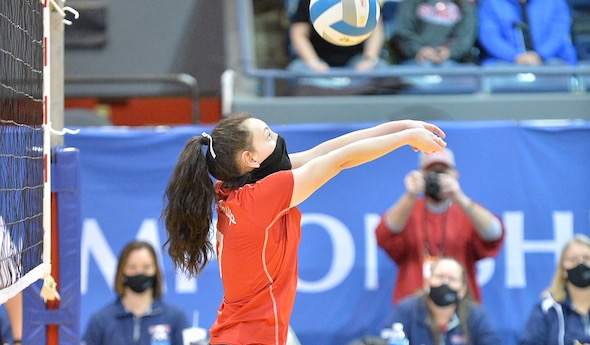
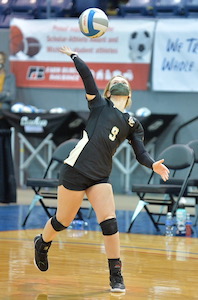
PHOTOS: (Top) Battle Creek St. Philip’s Rachel Myers controls possession for the Tigers during the Division 4 Final. (Middle) Abigail Franey serves for Oakland Christian. (Click for more from Hockey Weekly Action Photos.)