


Add, Subtract, Divide, Multiply: MHSAA Not Alone
July 25, 2017
By Rob Kaminski
MHSAA benchmarks editor
This is the third part in a series on MHSAA tournament classification, past and present, that will be published over the next two weeks. This series originally ran in this spring's edition of MHSAA benchmarks.
As the MHSAA faces its most recent classification task with 8-Player Football, and opinions continue to swirl about as to the method, timeframe, location and other procedures, a look around the country provides plenty of company among state association brethren factoring variables into their own equations.
In the Pacific Northwest, the Oregon School Activities Association Football Playoffs are under public scrutiny as leadership ponders a five or six classification format beginning with the 2018-19 school year.
The OSAA has crowned six champions on the gridiron since 2006-07. Many of the state’s smaller schools would like to keep it that way, while larger schools lean toward a five-classification system, citing larger leagues, ease of travel and credibility to state championships as the advantages.
Still others would prefer more than six classes, pointing to safety issues and the opportunity to increase participation numbers as positives.
Moving southeast of Oregon, the Nevada Interscholastic Activities Association recently voted to hold serve on a classification proposal that was volleyed to the membership.
However, changes still could be forthcoming by as early as the 2018-19 season which would add a fifth classification in more populated southern Nevada while allowing northern schools to participate in four classifications. Such divisions could mean no state championship for the fifth class in southern Nevada.
Because of that, the NIAA wants equal numbers of schools in each classification on both ends of the state. Complicating the issue is the fact that the 24 largest schools in the state, by enrollment, are all in Clark County in Southern Nevada.
Across Nevada’s border into Arizona, charter schools are asking the Arizona Interscholastic Association to reconsider classification that was voted upon and approved in September 2015. That agreement called for the largest 33 percent of charter schools by enrollment to be placed in the state’s largest school classification, 3A, the middle 33 percent into 2A, and the smallest 33 percent into 1A.
Less than two years later the charter schools have had a change of heart and have asked to be considered the same as other Arizona public schools and be placed appropriately by enrollment beginning with the 2018-19 school year.
The situation in Arizona further illustrates how the public/private debate that all state associations have faced throughout existence now has the added dynamic of rapidly growing charter schools in today’s educational system, along with virtual school enrollment.
In the nation’s heartland, Nebraska has retooled its football classifications by using enrollment of boys students only in its schools rather than total enrollment. The Nebraska School Activities Association football-playing schools will kick off the 2018 season using this alignment.
Nebraska has three classes of 11-player football, with the smallest class divided in two, Class C-1 and C-2. The state also will have 8-player football for boys enrollments under 47, and the NSAA will sponsor a new 6-player tournament in 2018 for schools with 27 or fewer boys.
“This is a good proposal because some schools have a sizable imbalance between the number of boys and girls, and there’s a large gap (in enrollment) between the largest and smallest schools in Classes A and B,” NSAA executive director Jim Tenopir said. “I think this addresses both of those concerns.”
Swimmers in Georgia, meanwhile, will feel like they are moving with the current, rather than upstream in 2017-18, as the Georgia High School Association recently doubled the number of team championship events from two to four.
Swim enthusiasts can also count on longer days at the finals, as the top 30 finishers from the prelims will advance to the finals instead of 20, and all championship events will have three heats versus two.
Moment: The Final Thrill
December 16, 2020
By John Johnson
MHSAA Director of Broadcast Properties
Over the course of nearly 34 years on this job, you often get asked what single championship game you would rank at the top of your list. You could ask that question to 100 people and get 100 answers – and guess what? They’d all be right. Such is the beauty of high school sports.
Which is why, after all these years, my game for the ages is one that has stood the test of time in my mind for over 30 years. It had everything you would want in a high school game – fantastic competition – great plays – and when it was over, some of the best sportsmanship I’ve ever seen – NO – make that THE best sportsmanship I’ve ever seen. To be on the field, you’d have a hard time telling who won and who lost by the way the players from both teams hugged and shook hands and sincerely congratulated each other. Which is how it should be after every – single – game.
And what topped it all off after that was the winning team making a trip to a pep assembly at the other team’s gym the following week to thank them for a great game, and present a banner signed by every member of the team.
That game was the 1989 Class B Football Playoff Final. The last year that four divisions were conducted in that postseason tournament. The last game played in that format.
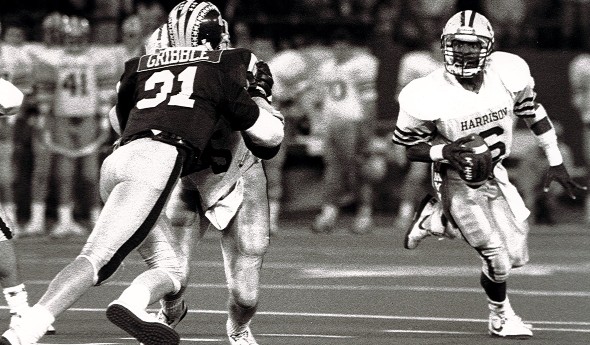
Farmington Hills Harrison and DeWitt. The powerful, dominant Hawks and even legendary at that time coach John Herrington – and the All-America quarterback in Mill “The Thrill” Coleman; against the pride of the Ingham County League, the Panthers of DeWitt, from what was an old farming bedroom community north of Lansing transforming into a new money suburb of the Capitol City.
The Hawks, the reigning Class B champs after winning the third of their state-record 13 titles against St. Joseph the previous November, were heavy favorites. DeWitt was making its fourth Playoff appearance and moving up in class after reaching the Semifinals in 1988, only to lose to powerhouse Detroit St. Martin dePorres.
The underdogs used an efficient running attack to take a 21-14 halftime lead on Harrison. John Telford, who rushed for 153 yards in the game, had two of the scores. Harrison tied the game early in the final period on the first of two scoring runs by Coleman, this one from 19 yards out.
DeWitt then put together a grinding drive, culminated by quarterback Chris Berkimer sneaking it from one yard out. Harrison blocked the extra point and DeWitt led 27-21 with 2:20 on the clock.
That left way too much time for Coleman. He engineered a 67-yard, five-play drive to tie the game. It didn’t even take a minute off the clock.
“When they scored I looked at the clock and knew we had enough time and all three of our time outs,” Coleman told the Detroit Free Press after the game. “I kept thinking back to that drive John Elway had against the Browns a couple of years ago in the playoffs when he had to go 98 yards.”
Three straight passes to Mike Saputo, Steve Hill and Greg Piscopink got Harrison down to the DeWitt 16; and Coleman then rolled out on a Student Body Right for another seven yards.
At the DeWitt 9, Coleman dropped back for what appeared to be another pass, but the Panthers' pressure forced The Thrill to run. Coleman eluded five tacklers along the way, finally diving into the end zone to score.
“We knew he (Coleman) was good, and we just tried to contain him,” DeWitt coach Gail Thornton told the Lansing State Journal after the game. “But every once in a while he would get loose for a big one.”
Steve Hill kicked the extra point and Harrison was back in the lead, 28-27. Hill would then intercept Berkimer on DeWitt’s first play after the ensuing kickoff to seal the deal.
PHOTO: Farmington Hills Harrison's Mill Coleman rolls left at the start of what would be the game-winning run for his team in the 1989 Class B Football Final. (Photo by Gary Shook).