


Add, Subtract, Divide, Multiply: MHSAA Not Alone
July 25, 2017
By Rob Kaminski
MHSAA benchmarks editor
This is the third part in a series on MHSAA tournament classification, past and present, that will be published over the next two weeks. This series originally ran in this spring's edition of MHSAA benchmarks.
As the MHSAA faces its most recent classification task with 8-Player Football, and opinions continue to swirl about as to the method, timeframe, location and other procedures, a look around the country provides plenty of company among state association brethren factoring variables into their own equations.
In the Pacific Northwest, the Oregon School Activities Association Football Playoffs are under public scrutiny as leadership ponders a five or six classification format beginning with the 2018-19 school year.
The OSAA has crowned six champions on the gridiron since 2006-07. Many of the state’s smaller schools would like to keep it that way, while larger schools lean toward a five-classification system, citing larger leagues, ease of travel and credibility to state championships as the advantages.
Still others would prefer more than six classes, pointing to safety issues and the opportunity to increase participation numbers as positives.
Moving southeast of Oregon, the Nevada Interscholastic Activities Association recently voted to hold serve on a classification proposal that was volleyed to the membership.
However, changes still could be forthcoming by as early as the 2018-19 season which would add a fifth classification in more populated southern Nevada while allowing northern schools to participate in four classifications. Such divisions could mean no state championship for the fifth class in southern Nevada.
Because of that, the NIAA wants equal numbers of schools in each classification on both ends of the state. Complicating the issue is the fact that the 24 largest schools in the state, by enrollment, are all in Clark County in Southern Nevada.
Across Nevada’s border into Arizona, charter schools are asking the Arizona Interscholastic Association to reconsider classification that was voted upon and approved in September 2015. That agreement called for the largest 33 percent of charter schools by enrollment to be placed in the state’s largest school classification, 3A, the middle 33 percent into 2A, and the smallest 33 percent into 1A.
Less than two years later the charter schools have had a change of heart and have asked to be considered the same as other Arizona public schools and be placed appropriately by enrollment beginning with the 2018-19 school year.
The situation in Arizona further illustrates how the public/private debate that all state associations have faced throughout existence now has the added dynamic of rapidly growing charter schools in today’s educational system, along with virtual school enrollment.
In the nation’s heartland, Nebraska has retooled its football classifications by using enrollment of boys students only in its schools rather than total enrollment. The Nebraska School Activities Association football-playing schools will kick off the 2018 season using this alignment.
Nebraska has three classes of 11-player football, with the smallest class divided in two, Class C-1 and C-2. The state also will have 8-player football for boys enrollments under 47, and the NSAA will sponsor a new 6-player tournament in 2018 for schools with 27 or fewer boys.
“This is a good proposal because some schools have a sizable imbalance between the number of boys and girls, and there’s a large gap (in enrollment) between the largest and smallest schools in Classes A and B,” NSAA executive director Jim Tenopir said. “I think this addresses both of those concerns.”
Swimmers in Georgia, meanwhile, will feel like they are moving with the current, rather than upstream in 2017-18, as the Georgia High School Association recently doubled the number of team championship events from two to four.
Swim enthusiasts can also count on longer days at the finals, as the top 30 finishers from the prelims will advance to the finals instead of 20, and all championship events will have three heats versus two.
Ottawa Hills Strides into Title Contention
November 12, 2020
By Dean Holzwarth
Special for Second Half
GRAND RAPIDS – The Ottawa Hills girls cross country team was hoping for a lofty finish at last Friday’s MHSAA Lower Peninsula Division 1 Finals.
 The Bengals, however, suffered a bump in the road.
Ottawa Hills recorded a program-best 10th-place finish at Michigan International Speedway, but was hampered by a late arrival to the race due to an unfortunate situation.
“Things went a little sideways for us on the way there,” Bengals coach Dan Ebright said. “On I-96, right before the Lowell exit, there was a humongous accident and they were stuck in traffic for over an hour.
“Instead of arriving an hour and 45 minutes prior to the meet, they arrived 40 minutes prior to the meet and we had to scramble like crazy to get them to the starting line on time.”
The accident shut down the highway, and Ebright said the team was forced to sit in the car for nearly three hours.
It made their preparation for the biggest race of the season chaotic and hurried.
“We warmed up in the parking lot, and their warm-up run was to jog through the field to quickly change their spikes and get on the starting line,” Ebright said. “That’s how rushed it was, and the warm-up was not an ideal warm-up for us.”
The delay affected several of the Bengals’ runners, including senior Madison Ebright.
Ebright, coach Dan’s daughter and an all-stater last year with a 12th-place finish, ended up taking 50th (19:26.54) and was bothered by cramping two miles in.
“We got there late, and it was kind of stressful,” Madison Ebright said. “And then my stomach didn’t feel well and I thought I might be in trouble. I was going good through two miles, but then I cramped up and it was hard to breathe so it was a tough finish.
“It was disappointing, but once I thought about it, it was a great season leading up to that point and I was consistent all year.”
Ebright ran a personal-best time at the Pre-Regional, which Ottawa Hills won, and helped lead the team to a school-best runner-up finish at Regionals. The Bengals finished runner-up to top-ranked Traverse City Central.
“While our 10th-place finish was our best finish as a team, we really didn't run like we had the three meets prior simply for the fact that we didn't get the chance to warm up properly,” Dan Ebright said. “And my daughter had cramps getting out of the car and could not work it out in the short time we had to warm up.”
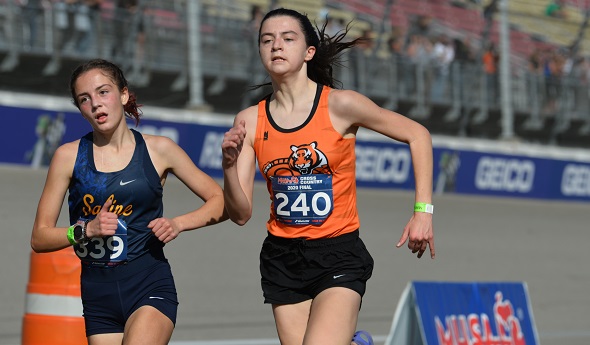
 The Bengals’ top-10 Finals finish was led by freshman Selma Anderson, who garnered all-state honors crossing the line 27th individually. She clocked a time of 19:00.59.
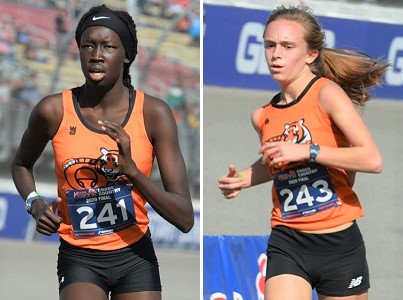
Junior Adit Dau, who battled through a knee injury most of the season, was 37th (19:16.42), while senior Naomi Dykstra was 89th (20:02.54).
The remainder of the team included senior Ella Posthumus, sophomore Kira Smith and freshman Campbell Hudson.
“Selma had a PR and was all-state and Adit had a solid race for us coming back from injury,” Dan Ebright said. “We really looked at the results and felt like we could’ve finished as high as sixth if everything had gone like the prior weeks at the conference meet, Pre-Regionals and Regionals.
“Sometimes that stuff happens and there was nothing we could really do about it. We were excited because we thought it might be worse than that.”
It was the full team’s second appearance at the Finals in the last three years, as Ottawa Hills took 23rd in 2018 in its first trip ever and also won the school’s first conference crown that same year.
Last season, the Bengals didn’t have a full team.
Ebright, Dau and Dykstra competed as individuals at the Finals.
“We had three girls lined up, and they didn’t run,” Dan Ebright said. “If they would've run, we would’ve had a good chance of winning the state finals. If the season goes perfectly smoothly those three girls make all-state, but sometimes things don’t go perfectly. You take the good with the bad.”
The success of the program has been a work in progress. The groundwork was laid years ago with the implementation of an elementary program in 2010.
Ebright took over the program at Ottawa Hills after previously coaching at Creston High School before it closed.
“It was something that started way back when, and it’s been building since that point,” Dan Ebright said. “It hasn’t been an overnight thing, and it’s something we’ve worked very hard at and developed our runners. We lost a few good ones along the way who didn’t care to run, but it was the kids showing up every day and not only during the season, but the offseason, too. Putting in the miles to get ready.”
The improvement and dedication of a solid core helped the Bengals become competitive on a statewide level.
“We felt like we had a real talented bunch come through, and this year’s team was the most talented group we’ve had,” Dan Ebright said.
Madison Ebright, who will run at Grand Valley State next season, was thrilled with her high school experience.
“It’s been a lot of fun, and we had a great coach who knows what he’s doing,” she said. “Great friendships were made with the girls on the team, and we did a lot of team building. It’s the most important part of my life, and the girls I did it with made it fun.”
 Dean Holzwarth has covered primarily high school sports for Grand Rapids-based WOOD-TV for four years after serving at the Grand Rapids Press and MLive for 16 years along with shorter stints at the Ionia Sentinel and WZZM. Contact him at [email protected] with story ideas for Allegan, Kent and Ottawa counties.
PHOTOS: (Top) Selma Anderson (240) leads the way for Ottawa Hills at Friday’s Lower Peninsula Division 1 Finals at MIS. (Middle) Adit Dau (241) and Madison Ebright (243) crossed next for the Bengals with top-50 finishes to contribute to the team overall 10th place. (Click for more from RunMichigan.com.)