


Add, Subtract, Divide, Multiply: MHSAA Not Alone
July 25, 2017
By Rob Kaminski
MHSAA benchmarks editor
This is the third part in a series on MHSAA tournament classification, past and present, that will be published over the next two weeks. This series originally ran in this spring's edition of MHSAA benchmarks.
As the MHSAA faces its most recent classification task with 8-Player Football, and opinions continue to swirl about as to the method, timeframe, location and other procedures, a look around the country provides plenty of company among state association brethren factoring variables into their own equations.
In the Pacific Northwest, the Oregon School Activities Association Football Playoffs are under public scrutiny as leadership ponders a five or six classification format beginning with the 2018-19 school year.
The OSAA has crowned six champions on the gridiron since 2006-07. Many of the state’s smaller schools would like to keep it that way, while larger schools lean toward a five-classification system, citing larger leagues, ease of travel and credibility to state championships as the advantages.
Still others would prefer more than six classes, pointing to safety issues and the opportunity to increase participation numbers as positives.
Moving southeast of Oregon, the Nevada Interscholastic Activities Association recently voted to hold serve on a classification proposal that was volleyed to the membership.
However, changes still could be forthcoming by as early as the 2018-19 season which would add a fifth classification in more populated southern Nevada while allowing northern schools to participate in four classifications. Such divisions could mean no state championship for the fifth class in southern Nevada.
Because of that, the NIAA wants equal numbers of schools in each classification on both ends of the state. Complicating the issue is the fact that the 24 largest schools in the state, by enrollment, are all in Clark County in Southern Nevada.
Across Nevada’s border into Arizona, charter schools are asking the Arizona Interscholastic Association to reconsider classification that was voted upon and approved in September 2015. That agreement called for the largest 33 percent of charter schools by enrollment to be placed in the state’s largest school classification, 3A, the middle 33 percent into 2A, and the smallest 33 percent into 1A.
Less than two years later the charter schools have had a change of heart and have asked to be considered the same as other Arizona public schools and be placed appropriately by enrollment beginning with the 2018-19 school year.
The situation in Arizona further illustrates how the public/private debate that all state associations have faced throughout existence now has the added dynamic of rapidly growing charter schools in today’s educational system, along with virtual school enrollment.
In the nation’s heartland, Nebraska has retooled its football classifications by using enrollment of boys students only in its schools rather than total enrollment. The Nebraska School Activities Association football-playing schools will kick off the 2018 season using this alignment.
Nebraska has three classes of 11-player football, with the smallest class divided in two, Class C-1 and C-2. The state also will have 8-player football for boys enrollments under 47, and the NSAA will sponsor a new 6-player tournament in 2018 for schools with 27 or fewer boys.
“This is a good proposal because some schools have a sizable imbalance between the number of boys and girls, and there’s a large gap (in enrollment) between the largest and smallest schools in Classes A and B,” NSAA executive director Jim Tenopir said. “I think this addresses both of those concerns.”
Swimmers in Georgia, meanwhile, will feel like they are moving with the current, rather than upstream in 2017-18, as the Georgia High School Association recently doubled the number of team championship events from two to four.
Swim enthusiasts can also count on longer days at the finals, as the top 30 finishers from the prelims will advance to the finals instead of 20, and all championship events will have three heats versus two.
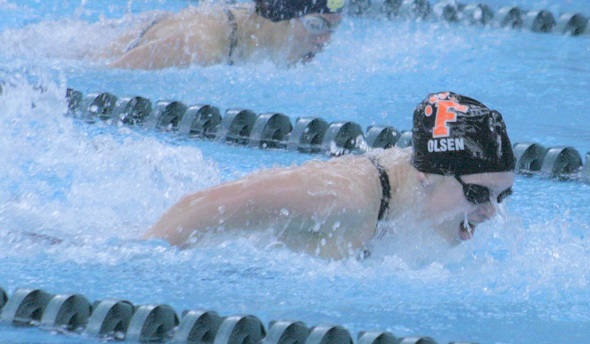
Olsen Rewriting Fenton Record Board
By
Paul Costanzo
Special for MHSAA.com
October 27, 2020
The Fenton High School swimming pool isn’t named after Gracie Olsen. The program’s record board only makes it look that way.
 Olsen, a junior, owns seven of the eight individual school records at Fenton, and she has her eyes on the eighth -- the 100-yard backstroke, which was set at 57 seconds by Haley Shaw in 2012.
“That one is frustrating, just 0.24 (seconds away from breaking it),” Olsen said with a laugh. “I would say I probably swim that event the least. I didn’t really start to get into it until a couple years ago.
“I do think about that a lot. It’s something I thought would be super cool if I could do. Obviously, that wasn’t my main goal going into high school, but I thought it would be super cool if I could be able to (own every record). If I don’t, that’s totally fine.”
Olsen will likely claim that record eventually – she's already beaten the time outside of high school competition – but even without it, she’s left an indelible mark on the Fenton program in 2½ years, and that goes beyond the number of times they’ve had to print her name on the board.
A three-time MHSAA Finals champion and Indiana University commit, Olsen is among the state’s best swimmers, and a sterling example for her teammates to follow.
“Her attention to detail and her dedication has put her above most swimmers,” Fenton coach Brad Jones said. “She’s absolutely one of the most coachable athletes I’ve ever had, and this is my 32nd year coaching.”
It was cold feet – or a dislike for them – that put Olsen on a path to swimming glory. She said she was an ice skater with an eye on playing hockey, like her father, when she was young. But her feet getting cold turned her off to the idea. While she experimented with several other activities, it was her mother’s sport, swimming, that stuck.
 Gracie took up the sport competitively at 7. By the time she was swimming in the 10-and-under state finals, coaches could see great things ahead.
“We had this coach, his name was (Dave) Seagraves, and he always told me when I was younger, ‘I just know there is something about you – you're going to be so special,” Olsen said. “He passed away a couple years ago (in 2017). When I was 8, he was that factor that always made me stick to it. When he passed, I kind of started swimming for him.”
Seagraves’ influence on Olsen can still be seen – and not just in the pool. When she was young, he told her to tap the starting block 10 times prior to a race to help her focus. While it’s not an every-race occurrence, she said she does it often, and it frequently results in her best swims.
“I’d stand behind the blocks and tap it with my left and right hand 10 times, kind of like playing the piano,” she said. “I don’t usually forget.”
In the pool, Olsen’s greatest influence is likely her mother, Stephanie, who herself was a standout swimmer before a shoulder injury derailed a possible collegiate career. Stephanie coached the Fenton Area Swim Team with Seagraves, and is an assistant on the varsity team. She is also the one that pushed her daughter to be an all-around swimmer, rather than focusing on one stroke or a single distance.
That’s resulted in personal best times that would have been good enough to finish all-state in all eight individual events at the 2019 Finals. She can’t swim all eight, of course, so she swam in two – the 200-yard freestyle and 100-yard butterfly – and won both. She was also part of Fenton’s 400 freestyle and 200 medley relay teams, which placed third and fifth, respectively.
The year before, she won the 200 IM and was second in the 100 butterfly.
“We highly anticipate that she will repeat as a double winner in whatever events we put her in,” Jones said. “One of the things that makes Gracie so special is that she’s good at all the events. She doesn’t have a weak stroke. … In coaching, you don’t have athletes like Gracie very often. It’s fun to have people call you and say, ‘Where is Gracie going to be, because we don’t want our kids there.’ When the state Finals come around, we start getting calls. That’s a lot of fun.”
Jones joked that the only thing Olsen isn’t elite at is diving – although she hasn’t tried it.
“I’m afraid to let her,” he said. “She might be good at it.”
Both Jones and Olsen expect she will start to specialize a bit more when she goes to Indiana, and that butterfly will be her main stroke, along with freestyle. Her versatility gives the Hoosiers plenty of options, though.
For now, she’s focused on improving each stroke every day, and her motivation to do so goes well beyond chasing records.
“Just thinking about where I am now tends to be a huge motivation for me,” she said. “I’m very thankful, personally, for what I have. It just makes me so happy that I get to be with a team like this and have the coaches that I do. I could not be more fortunate.”
 Paul Costanzo served as a sportswriter at The Port Huron Times Herald from 2006-15, including three years as lead sportswriter, and prior to that as sports editor at the Hillsdale Daily News from 2005-06. He can be reached at [email protected] with story ideas for Genesee, Lapeer, St. Clair, Sanilac, Huron, Tuscola, Saginaw, Bay, Arenac, Midland and Gladwin counties.
PHOTOS: (Top) Fenton’s Gracie Olsen races to the butterfly championship at the 2019 Lower Peninsula Division 2 Finals. (Middle) Olsen has committed to sign to swim at Indiana University. (Top photo courtesy of the Tri-County Times; middle courtesy of Gracie Olsen.)