


Add, Subtract, Divide, Multiply: MHSAA Not Alone
July 25, 2017
By Rob Kaminski
MHSAA benchmarks editor
This is the third part in a series on MHSAA tournament classification, past and present, that will be published over the next two weeks. This series originally ran in this spring's edition of MHSAA benchmarks.
As the MHSAA faces its most recent classification task with 8-Player Football, and opinions continue to swirl about as to the method, timeframe, location and other procedures, a look around the country provides plenty of company among state association brethren factoring variables into their own equations.
In the Pacific Northwest, the Oregon School Activities Association Football Playoffs are under public scrutiny as leadership ponders a five or six classification format beginning with the 2018-19 school year.
The OSAA has crowned six champions on the gridiron since 2006-07. Many of the state’s smaller schools would like to keep it that way, while larger schools lean toward a five-classification system, citing larger leagues, ease of travel and credibility to state championships as the advantages.
Still others would prefer more than six classes, pointing to safety issues and the opportunity to increase participation numbers as positives.
Moving southeast of Oregon, the Nevada Interscholastic Activities Association recently voted to hold serve on a classification proposal that was volleyed to the membership.
However, changes still could be forthcoming by as early as the 2018-19 season which would add a fifth classification in more populated southern Nevada while allowing northern schools to participate in four classifications. Such divisions could mean no state championship for the fifth class in southern Nevada.
Because of that, the NIAA wants equal numbers of schools in each classification on both ends of the state. Complicating the issue is the fact that the 24 largest schools in the state, by enrollment, are all in Clark County in Southern Nevada.
Across Nevada’s border into Arizona, charter schools are asking the Arizona Interscholastic Association to reconsider classification that was voted upon and approved in September 2015. That agreement called for the largest 33 percent of charter schools by enrollment to be placed in the state’s largest school classification, 3A, the middle 33 percent into 2A, and the smallest 33 percent into 1A.
Less than two years later the charter schools have had a change of heart and have asked to be considered the same as other Arizona public schools and be placed appropriately by enrollment beginning with the 2018-19 school year.
The situation in Arizona further illustrates how the public/private debate that all state associations have faced throughout existence now has the added dynamic of rapidly growing charter schools in today’s educational system, along with virtual school enrollment.
In the nation’s heartland, Nebraska has retooled its football classifications by using enrollment of boys students only in its schools rather than total enrollment. The Nebraska School Activities Association football-playing schools will kick off the 2018 season using this alignment.
Nebraska has three classes of 11-player football, with the smallest class divided in two, Class C-1 and C-2. The state also will have 8-player football for boys enrollments under 47, and the NSAA will sponsor a new 6-player tournament in 2018 for schools with 27 or fewer boys.
“This is a good proposal because some schools have a sizable imbalance between the number of boys and girls, and there’s a large gap (in enrollment) between the largest and smallest schools in Classes A and B,” NSAA executive director Jim Tenopir said. “I think this addresses both of those concerns.”
Swimmers in Georgia, meanwhile, will feel like they are moving with the current, rather than upstream in 2017-18, as the Georgia High School Association recently doubled the number of team championship events from two to four.
Swim enthusiasts can also count on longer days at the finals, as the top 30 finishers from the prelims will advance to the finals instead of 20, and all championship events will have three heats versus two.
Brighton Coach's Impact 'Immeasurable'
By
Tim Robinson
Special for MHSAA.com
October 7, 2020
By Tim Robinson
Special for Second Half
Paul Moggach has never been much for looking back.
 And as he begins his first season away from the Brighton hockey program in more than three decades, he’s still looking ahead.
“I’m thinking about what I’m going to miss more than the mark I left,” he said in a phone conversation last week. “I guess I enjoyed so much of the time I had, the opportunity to coach at Brighton, I’m thinking more how I fill the time and the things I'll miss.”
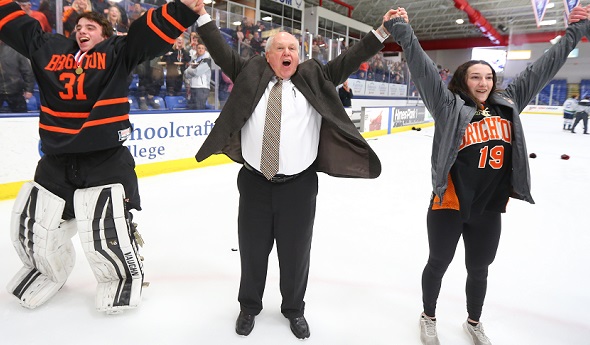
Moggach (pronounced MUG-uth) retired as Brighton’s coach this past summer after 25 seasons and having led five teams to MHSAA Division 1 championships. He compiled a record of 466-172-47 during that period.
But that’s not what he remembers most, nor why he wants people to remember him.
“I would like them to remember the teams and players who played for me and my assistants, more than me,” Moggach said. “We have so many blessings and opportunities in our lives, and hockey was one for me and hopefully for the players and assistants I worked with.”
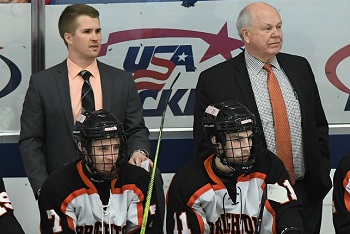
One of those assistants was Kurt Kivisto, who joined the Bulldogs originally as a team manager more than 20 years ago and was a player at Brighton. He eventually won a national championship at Michigan State before rejoining the program as an assistant coach a decade ago.
“The No. 1 thing I’ll take from him is sticking by your beliefs and not sacrificing those beliefs for the team,” said Kivisto, who was named Moggach’s successor in September. “He sticks by those beliefs and ... he’s not willing to sacrifice that even if it could hurt the team. The character and integrity he has, how he treats people with fairness and what he believes is right is the biggest thing I’ll take.”
A stepson, Damon Whitten, played for Moggach at Brighton and at MSU before becoming an assistant coach and eventually the head coach at Lake Superior State, where he is in his eighth season.
Asked about Moggach’s impact at Brighton, Whitten said, “I’m not sure you can measure it. Your mind goes to the hockey players who have come to Brighton, and that’s a big part. But I think it goes beyond that. The money they’ve raised over the years for different families in need, for example. He’s had a big impact, and the players he had were a big part of that, but it goes well beyond that, and he did it the right way. Thirty-plus years (in the program), and I’m not sure you can count more than a handful of times where he made a bad decision or handled things poorly. He did things the right way, every day, all of the time, and I think it’s why he was so successful for so long.”
 The team’s charitable works were mostly kept under the radar – Moggach’s reasoning being his players had been given much, it was their turn to give back, and he didn’t want people thinking they did those things for publicity.
Moggach joined Rick Bourbonais as an assistant at Brighton in the mid-1980s, then switched roles with him for the 1996-97 season.
He realized Brighton’s potential in the 1992-93 season, when the Bulldogs upset perennial state power Trenton in the Class A Quarterfinals before losing to Detroit Catholic Central in a Semifinal.
“That, to me, said, at least in my mind, that we can do this,” Moggach said. “It’s not impossible.”
He slowly began to build the program, getting good players and a schedule that would challenge them.
“You get the players by building a good culture,” he said. “Back in the day, when I started, we weren’t very disciplined and our league wasn’t very disciplined. So I think we realized we had to build that, and I could have an influence on building that in Brighton.”
Along with the culture, Moggach looked for an edge whenever he could find it. He was talked into making a trip to the Keweenaw Peninsula by one of his player’s parents, and found enormous benefits for his team, both competitively and in team bonding.
“It’s a lot about the little things we do,” he said, “that we find joy in, and create those opportunities. Creating the little moments really can build to bigger moments. We played capture the flag one day in about two feet of snow.
“Almost killed them,” he added, chuckling. The exhausted players didn’t have much left for the game that night, but spending time together for four days in a bus and hotel room always brought the team closer on and off the ice.
That first UP expedition also led to more teams making the trip, for team bonding and a glimpse of a part of the state, and themselves, they might never have seen otherwise.
“We didn’t do that for long,” he said. “But we always came back saying we were better together because of that experience.”
Bob Nelson had three sons play for Moggach, and Nelson’s wife, Kris, was president of the team’s booster club during their involvement over nearly a decade in Brighton hockey. Nelson also coached the program’s younger players for five seasons.
“We got to know the Moggachs really well,” he said. “It was a good experience, both as a coach and as a parent as well.”
Moggach introduced other things, including an emphasis on nutrition and off-ice training, that players resisted at first until they saw the benefits.
 He savored conversations with referees and opposing coaches before the games and even the occasional reporter after games.
But his first priority was the players. At times he would erupt in practice at a player or, more commonly, the team, and the boys soon learned to hear the message, not the volume. But for a couple of seasons, they also wrote some of his wilder statements down in a notebook after practice.
One year, they read some of them at the banquet, and after each one, Moggach’s wife, Sharon, would look at him and ask, “Did you really say that?”
Moggach would laugh and confess to remembering he had actually done so, then laughing.
“He knew part of what made the program good was his relationship to the players,” Nelson said. “If it was a good time, he wanted to enjoy it, even at his own expense at times.”
Moggach has staying in the background this offseason, letting Kivisto shape the team.
Asked if he were willing to fully switch coaching roles, as he and Bourbonais did a quarter-century ago, Moggach laughed.
“No,” he said emphatically. “Rick wasn’t in his 70s when we made the switch. Kurt needs his time. I’ll be there if he needs me.”
Moggach, who is 74, still works fulltime as the University of Michigan’s director of risk management.
He plans to spend more time with his wife and watch his grandsons play hockey, as well as catching some Lake Superior State games.
“I was really blessed to have Rick and Brownie (longtime assistant Mike Brown) along for the ride, and then to get Kurt involved,” Moggach said. “They weren’t the only ones, but they were the kids for me.
“The other thing is the support from the Brighton (High School) administration, the teachers, and our community. There are more people to thank than I could ever bring up. I do think that, all together, it was a great run. It couldn’t have been any better.”
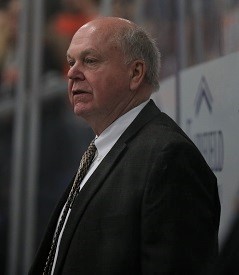
PHOTOS: (Top) Recently-retired Brighton hockey coach Paul Moggach celebrates the 2018 Division 1 championship game win over Saginaw Heritage at USA Hockey Arena. (Middle) Former player Kurt Kivisto, left of Moggach during the 2018 Semifinal win over Detroit Catholic Central, served as an assistant before assuming the head coaching job in September. (Below) Brighton's 2018 championship was its fifth under Moggach. (Photos by Hockey Weekly Action Photos.)