

Add, Subtract, Divide, Multiply: MHSAA Not Alone
July 25, 2017
By Rob Kaminski
MHSAA benchmarks editor
This is the third part in a series on MHSAA tournament classification, past and present, that will be published over the next two weeks. This series originally ran in this spring's edition of MHSAA benchmarks.
As the MHSAA faces its most recent classification task with 8-Player Football, and opinions continue to swirl about as to the method, timeframe, location and other procedures, a look around the country provides plenty of company among state association brethren factoring variables into their own equations.
In the Pacific Northwest, the Oregon School Activities Association Football Playoffs are under public scrutiny as leadership ponders a five or six classification format beginning with the 2018-19 school year.
The OSAA has crowned six champions on the gridiron since 2006-07. Many of the state’s smaller schools would like to keep it that way, while larger schools lean toward a five-classification system, citing larger leagues, ease of travel and credibility to state championships as the advantages.
Still others would prefer more than six classes, pointing to safety issues and the opportunity to increase participation numbers as positives.
Moving southeast of Oregon, the Nevada Interscholastic Activities Association recently voted to hold serve on a classification proposal that was volleyed to the membership.
However, changes still could be forthcoming by as early as the 2018-19 season which would add a fifth classification in more populated southern Nevada while allowing northern schools to participate in four classifications. Such divisions could mean no state championship for the fifth class in southern Nevada.
Because of that, the NIAA wants equal numbers of schools in each classification on both ends of the state. Complicating the issue is the fact that the 24 largest schools in the state, by enrollment, are all in Clark County in Southern Nevada.
Across Nevada’s border into Arizona, charter schools are asking the Arizona Interscholastic Association to reconsider classification that was voted upon and approved in September 2015. That agreement called for the largest 33 percent of charter schools by enrollment to be placed in the state’s largest school classification, 3A, the middle 33 percent into 2A, and the smallest 33 percent into 1A.
Less than two years later the charter schools have had a change of heart and have asked to be considered the same as other Arizona public schools and be placed appropriately by enrollment beginning with the 2018-19 school year.
The situation in Arizona further illustrates how the public/private debate that all state associations have faced throughout existence now has the added dynamic of rapidly growing charter schools in today’s educational system, along with virtual school enrollment.
In the nation’s heartland, Nebraska has retooled its football classifications by using enrollment of boys students only in its schools rather than total enrollment. The Nebraska School Activities Association football-playing schools will kick off the 2018 season using this alignment.
Nebraska has three classes of 11-player football, with the smallest class divided in two, Class C-1 and C-2. The state also will have 8-player football for boys enrollments under 47, and the NSAA will sponsor a new 6-player tournament in 2018 for schools with 27 or fewer boys.
“This is a good proposal because some schools have a sizable imbalance between the number of boys and girls, and there’s a large gap (in enrollment) between the largest and smallest schools in Classes A and B,” NSAA executive director Jim Tenopir said. “I think this addresses both of those concerns.”
Swimmers in Georgia, meanwhile, will feel like they are moving with the current, rather than upstream in 2017-18, as the Georgia High School Association recently doubled the number of team championship events from two to four.
Swim enthusiasts can also count on longer days at the finals, as the top 30 finishers from the prelims will advance to the finals instead of 20, and all championship events will have three heats versus two.
As Adams' Fu Closes Career On Top, Northville May Be Starting Championship Era
By
Keith Dunlap
Special for MHSAA.com
May 31, 2025
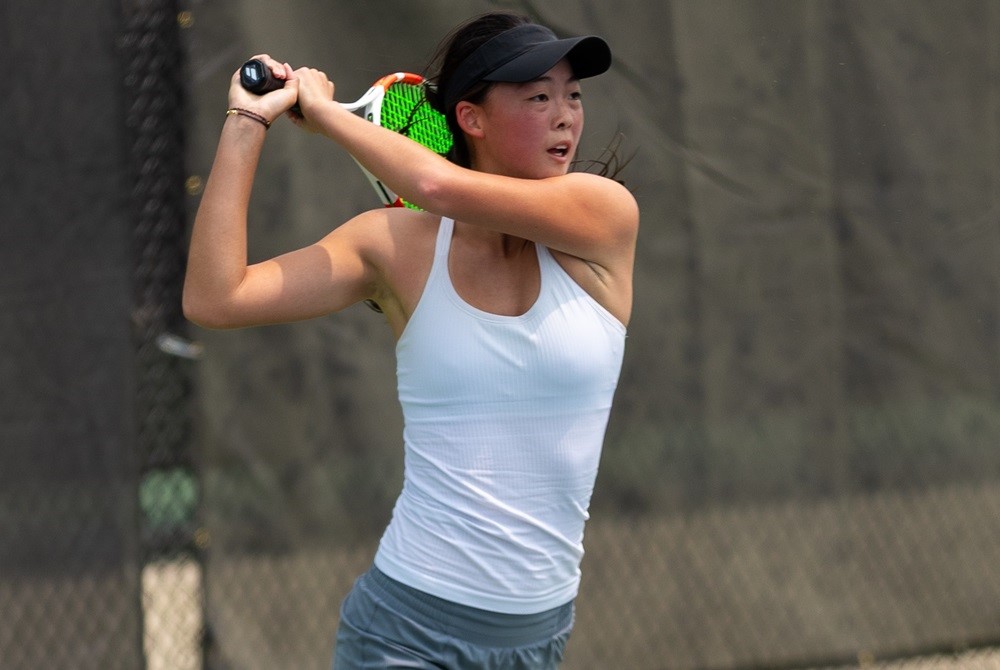
BYRON CENTER – The fourth time turned out to be the charm for Rochester Adams senior Nicole Fu at Saturday’s MHSAA Lower Peninsula Division 1 Girls Tennis Finals.
She entered this weekend’s tournament having finished No. 1 singles runner-up all of her first three seasons of high school, including a year ago with a loss to Utica Eisenhower’s Gabby Sadowski in the deciding match.
But given another chance and a rematch with Sadowski, Fu wasn’t going to be denied.
Fu, who will play collegiately for the U.S. Naval Academy, ended her high school career on top with a 7-5, 6-2 victory over Sadowski.
“I think over the last three years, I’ve matured a lot as a player,” Fu said. “Freshman year, I was more of an underdog. The last two years, I was a favorite. I’ve learned how to manage the pressure this season, and it was really helpful coming into states to just trust my shots, trust my game and stick to my gameplan.”
Fu obviously had familiarity with Sadowski having played her before, including three weeks ago when Fu won in two sets. She said the biggest keys this time were staying on the baseline, not letting Sadowski dictate play and simply going for it on each shot.
 “I didn’t want to finish the match, then look back, see I was nervous and then have any regrets,” Fu said. “I just wanted to come in, play as freely as possible and go for my shots. Being aggressive for sure was the game plan.”
Fu advanced to the final via a 6-1, 6-1 quarterfinal win over Aarna Betala of Portage Central and a 3-6, 6-1, 6-2 semifinal victory over Isabella Barretto of Rochester Hills Stoney Creek, who handed Fu her only defeat this season April 22.
Saturday’s team championship came down to the very last points, and a young Northville lineup including five sophomores capitalized.
The Mustangs captured their first Finals team title since 2018 with 23 points, just one more than Eisenhower – which was runner-up last year too and aiming for its first title in school history as well.
“We thought all along at the beginning the season that we were special,” Northville head coach Brenda Lionas said. “We started believing it and coming together as a young team. We called it a reload. We just started working together and getting them to believe how special they were.”
Northville won on the strength of its doubles, which produced two champions and a runner-up. Sravya Doppalapudi and Francine Ong won at No. 3 doubles despite entering seeded fifth, while Emma Murphy and Sophie Ong won at No. 4 while seeded fourth. Murphy and Ong defeated the top-seeded Adams pair of Joanna Ouyang and Monika Camaj in their semifinal.
Northville’s Lucia Lachapelle and Aadya Pullalarevu advanced to the championship match at No. 2 doubles but lost to Eisenhower’s Alexis Gabriel and Alayna Aamodt. Northville also saw Emmi Dober earn points by advancing to the final at No. 3 singles before losing to Arella He of Ann Arbor Pioneer.
“We talked about staying in every point,” Lionas said. “Staying in, staying in, and staying in, being patient and working the points as long as we could in both singles and doubles.”
Eisenhower freshman Morgan Emerick won the title at No. 2 singles, while Novi junior Rebecca Liu won at No. 4 singles. Rockford’s Alayna Gee and Avery Marchlewski won the championship at No. 1 doubles.
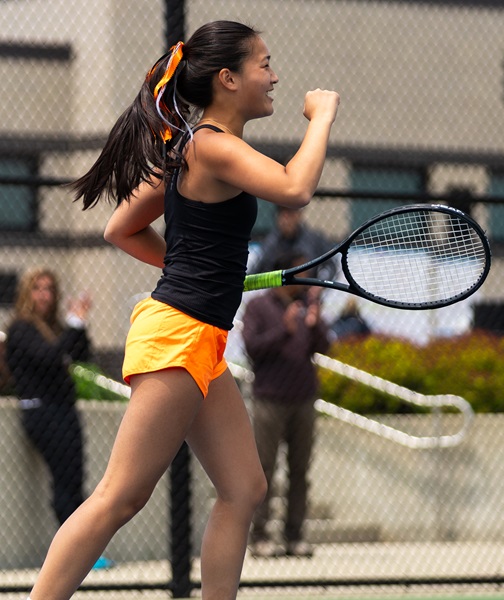
PHOTOS (Top) Rochester Adams' Nicole Fu returns a volley during her No. 1 singles championship match Saturday at Byron Center West Sports Complex. (Middle) Northville celebrates during its march to the team championship. (Click for more from High School Sports Scene.)