


Add, Subtract, Divide, Multiply: MHSAA Not Alone
July 25, 2017
By Rob Kaminski
MHSAA benchmarks editor
This is the third part in a series on MHSAA tournament classification, past and present, that will be published over the next two weeks. This series originally ran in this spring's edition of MHSAA benchmarks.
As the MHSAA faces its most recent classification task with 8-Player Football, and opinions continue to swirl about as to the method, timeframe, location and other procedures, a look around the country provides plenty of company among state association brethren factoring variables into their own equations.
In the Pacific Northwest, the Oregon School Activities Association Football Playoffs are under public scrutiny as leadership ponders a five or six classification format beginning with the 2018-19 school year.
The OSAA has crowned six champions on the gridiron since 2006-07. Many of the state’s smaller schools would like to keep it that way, while larger schools lean toward a five-classification system, citing larger leagues, ease of travel and credibility to state championships as the advantages.
Still others would prefer more than six classes, pointing to safety issues and the opportunity to increase participation numbers as positives.
Moving southeast of Oregon, the Nevada Interscholastic Activities Association recently voted to hold serve on a classification proposal that was volleyed to the membership.
However, changes still could be forthcoming by as early as the 2018-19 season which would add a fifth classification in more populated southern Nevada while allowing northern schools to participate in four classifications. Such divisions could mean no state championship for the fifth class in southern Nevada.
Because of that, the NIAA wants equal numbers of schools in each classification on both ends of the state. Complicating the issue is the fact that the 24 largest schools in the state, by enrollment, are all in Clark County in Southern Nevada.
Across Nevada’s border into Arizona, charter schools are asking the Arizona Interscholastic Association to reconsider classification that was voted upon and approved in September 2015. That agreement called for the largest 33 percent of charter schools by enrollment to be placed in the state’s largest school classification, 3A, the middle 33 percent into 2A, and the smallest 33 percent into 1A.
Less than two years later the charter schools have had a change of heart and have asked to be considered the same as other Arizona public schools and be placed appropriately by enrollment beginning with the 2018-19 school year.
The situation in Arizona further illustrates how the public/private debate that all state associations have faced throughout existence now has the added dynamic of rapidly growing charter schools in today’s educational system, along with virtual school enrollment.
In the nation’s heartland, Nebraska has retooled its football classifications by using enrollment of boys students only in its schools rather than total enrollment. The Nebraska School Activities Association football-playing schools will kick off the 2018 season using this alignment.
Nebraska has three classes of 11-player football, with the smallest class divided in two, Class C-1 and C-2. The state also will have 8-player football for boys enrollments under 47, and the NSAA will sponsor a new 6-player tournament in 2018 for schools with 27 or fewer boys.
“This is a good proposal because some schools have a sizable imbalance between the number of boys and girls, and there’s a large gap (in enrollment) between the largest and smallest schools in Classes A and B,” NSAA executive director Jim Tenopir said. “I think this addresses both of those concerns.”
Swimmers in Georgia, meanwhile, will feel like they are moving with the current, rather than upstream in 2017-18, as the Georgia High School Association recently doubled the number of team championship events from two to four.
Swim enthusiasts can also count on longer days at the finals, as the top 30 finishers from the prelims will advance to the finals instead of 20, and all championship events will have three heats versus two.
Preview: Past Multi-Race Champs Highlight Impressive Field Returning to Kingsford
By
Geoff Kimmerly
MHSAA.com senior editor
May 30, 2025
Plenty of candidates appear prepared to step into the spotlight at this weekend’s Upper Peninsula Boys Track & Field Finals.
Several returning champions return across the three divisions to be hosted Saturday at Kingsford High School, including distance standouts Luke Hill of Houghton, Dan Goss of Munising and Kalvin Kytta of Chassell after all three won multiple Finals titles a year ago. Pickford’s Gunner Bennin also is back after winning multiple races in 2024, and Menominee’s Darrent Butler joins Kytta as past champs looking to win for the third-straight year.
Preliminaries will begin the day at 9 a.m. local (Central) time. Tickets cost $11 and are available digitally only via GoFan.
MHSAA.tv will live-stream the meets beginning at 9 a.m. (CDT)/10 a.m. (EDT), viewable with subscription. Check out the Boys Track & Field page for meet information and lists of all qualifiers. Those described as "seeded" below have received those seeds based on Regional performances or early qualification during the regular season.
Following is a glance at team contenders and individuals to watch in all three divisions:
Division 1
Team forecast: Marquette has won the last four Division 1 championships and all but one since 2015. Kingsford has finished runner-up the last three seasons, but Houghton and Negaunee might have the most opportunities to make a push this weekend although the Sentinels’ immense talent and depth again will make them difficult to catch.
Lucas Ballard, Marquette sophomore: He’s expected to take a much larger scoring role after finishing fourth in the 400 and running on a winning relay as a freshman. He’s seeded first in the 800 (1:59.87) and 1,600 (4:36.82) and slated to run on the top-seeded 1,600 relay (3:30.41).
Darrent Butler, Menominee junior: The two-time reigning high jump champion won by four inches last season and is seeded first at that same height (6-2) while also seeded sixth in long jump and set to run on the third-seeded 1,600 relay.
Mathew Frantti, Calumet senior: He’s looking at a potential big finish to his high school career as the top seed in both the shot put (46-3½) and discus (143-9) after finishing third in the shot last season.
Luke Hill, Houghton senior: He won the 800, 1,600, finished third in the 3,200 and ran on the champion 3,200 relay last season. He returns seeded second in the 1,600 (4:38.08) and fifth in the 800 and 3,200, and running on the top-seeded 3,200 relay (8:46.55).
Gabe Litzner, Sault Ste. Marie junior: One of the most highly-regarded distance runners statewide, Litzner won the 3,200 and finished second in the 1,600 last season. He’s seeded second in the 3,200 (9:34.88) and third in the 1,600 (4:40.44) this weekend.
Jacob MacPhee, Marquette junior: He’s back after winning the 400, finishing second in the 200 and running on two championship relays in 2024. He’s seeded first in the 200 (22.53), 400 (51.17) and will run on the top-seeded 800 (1:33.23) and 1,600 relays.
Kyler Sager, Marquette senior: He’s the reigning long jump champ and ran on a winning relay as well last spring. He’s seeded first in long jump (19-11¾), third in the 100 dash (11.32) and will run on the second-seeded 400 relay (45.14).
Division 2
Team forecast: Pickford has won the last two Division 2 titles, with Munising last season’s runner-up and those two also finishing first and second, respectively, at their Regional earlier this month. West Iron County won the other Division 2 Regional and could make a nice jump from ninth at last year’s Final.
John Anderson, Pickford junior: Last season’s high jump champion is seeded first (6-0) with a jump four inches higher than his winner a year ago. Anderson also finished fourth in the 110 hurdles, seventh in the 300 and ran on a runner-up relay in 2024, and he returns top-seeded in the 110 (16.86) and third-seeded in the 300 (46.63).
Gunner Bennin, Pickford junior: He’s looking to add to his 200 and 400 titles and fourth place in long jump from last season, seeded second in the 100 (12.01) and first in the 200 (24.37) and 400 (54.71) and running on the top-seeded 800 relay (1:37.91).
Dan Goss, Munising senior: The reigning champion in the 1,600 and 3,200 is seeded second in the 3,200 (10:57.73), fourth in the 1,600 and 800, and also third in the 400 (55.61).
Jayden Niemi-Alcorn, Rudyard senior: He won the pole vault last season by 1½ feet and has the top seed in that event by six inches this weekend.
Division 3
Team forecast: Newberry rose from runner-up in 2023 to champion last year, but won its Regional this month by only two points ahead of Brimley. Engadine also was a Regional champ by two points, while Lake Linden-Hubbell and Crystal Falls Forest Park won theirs by larger margins. Engadine and Lake Linden-Hubbell are seeking first Finals team titles, and Forest Park is seeking its first since 2010.
Vic Giuliani, Crystal Falls Forest Park sophomore: He debuted last season with a high jump championship and also finished fifth in both the long jump and 100 dash. He’s seeded fourth in the high jump this time and also will run the 200 and 400.
Kalvin Kytta, Chassell senior: He’s won the 3,200 the last two seasons and added 800 and 1,600 championships last year. He enters Saturday seeded second in the 800 (2:09.37) and 1,600 (4:47.27) and third in the 3,200 (11:16.88).
Matthew Rahilly, Newberry senior: After finishing second in the long jump, third in the high jump and running on two top-three relays a year ago, Rahilly is seeded first in the 200 (24.06) and long jump (20-1) and tied for second in the high jump (5-10). He won the long jump and ran on a winning relay as a sophomore.
Michael Rexford, Escanaba Holy Name junior: The reigning long jump champion is seeded second in that event (19-8), tied for the fourth seed in the high jump and expected to run on the second-seeded 3,200 relay (9:11.29).
Ethan Snyder, Cedarville sophomore: He finished second in the 1,600 as a freshman and returns top-seeded in that race (4:44.45), the 800 (2:08.14) and second-seeded in the 3,200 (11:01.70).
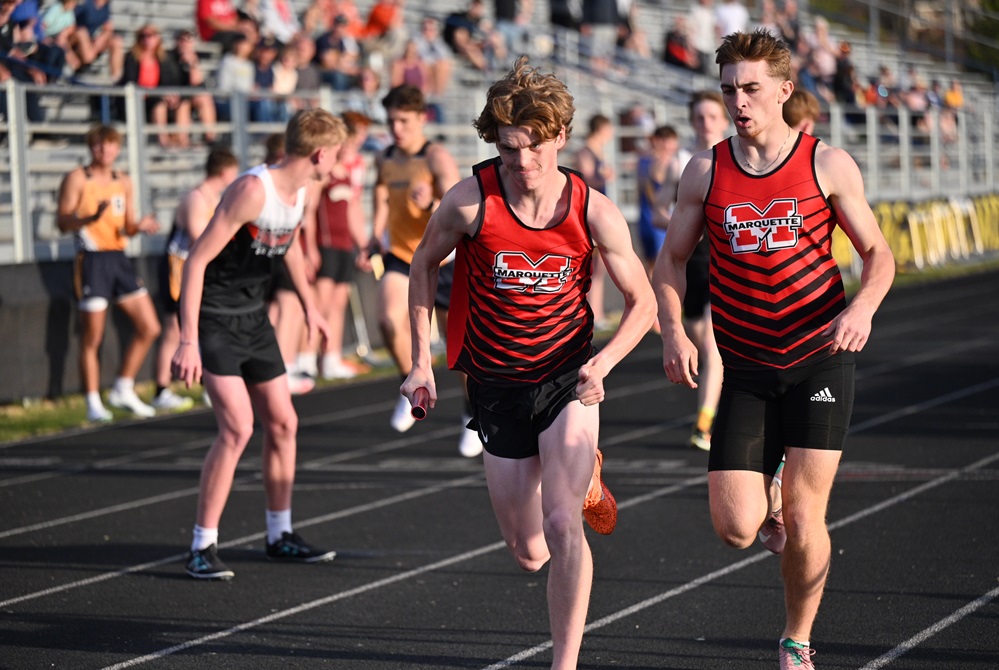
PHOTO Marquette's Ford Richardson hands off the baton to Evan Balko in the 1,600 relay on May 9 at the Negaunee Lions Invitational. The Sentinels broke the meet record in the race they had set the previous season. (Photo by Cara Kamps.)