

Add, Subtract, Divide, Multiply: MHSAA Not Alone
July 25, 2017
By Rob Kaminski
MHSAA benchmarks editor
This is the third part in a series on MHSAA tournament classification, past and present, that will be published over the next two weeks. This series originally ran in this spring's edition of MHSAA benchmarks.
As the MHSAA faces its most recent classification task with 8-Player Football, and opinions continue to swirl about as to the method, timeframe, location and other procedures, a look around the country provides plenty of company among state association brethren factoring variables into their own equations.
In the Pacific Northwest, the Oregon School Activities Association Football Playoffs are under public scrutiny as leadership ponders a five or six classification format beginning with the 2018-19 school year.
The OSAA has crowned six champions on the gridiron since 2006-07. Many of the state’s smaller schools would like to keep it that way, while larger schools lean toward a five-classification system, citing larger leagues, ease of travel and credibility to state championships as the advantages.
Still others would prefer more than six classes, pointing to safety issues and the opportunity to increase participation numbers as positives.
Moving southeast of Oregon, the Nevada Interscholastic Activities Association recently voted to hold serve on a classification proposal that was volleyed to the membership.
However, changes still could be forthcoming by as early as the 2018-19 season which would add a fifth classification in more populated southern Nevada while allowing northern schools to participate in four classifications. Such divisions could mean no state championship for the fifth class in southern Nevada.
Because of that, the NIAA wants equal numbers of schools in each classification on both ends of the state. Complicating the issue is the fact that the 24 largest schools in the state, by enrollment, are all in Clark County in Southern Nevada.
Across Nevada’s border into Arizona, charter schools are asking the Arizona Interscholastic Association to reconsider classification that was voted upon and approved in September 2015. That agreement called for the largest 33 percent of charter schools by enrollment to be placed in the state’s largest school classification, 3A, the middle 33 percent into 2A, and the smallest 33 percent into 1A.
Less than two years later the charter schools have had a change of heart and have asked to be considered the same as other Arizona public schools and be placed appropriately by enrollment beginning with the 2018-19 school year.
The situation in Arizona further illustrates how the public/private debate that all state associations have faced throughout existence now has the added dynamic of rapidly growing charter schools in today’s educational system, along with virtual school enrollment.
In the nation’s heartland, Nebraska has retooled its football classifications by using enrollment of boys students only in its schools rather than total enrollment. The Nebraska School Activities Association football-playing schools will kick off the 2018 season using this alignment.
Nebraska has three classes of 11-player football, with the smallest class divided in two, Class C-1 and C-2. The state also will have 8-player football for boys enrollments under 47, and the NSAA will sponsor a new 6-player tournament in 2018 for schools with 27 or fewer boys.
“This is a good proposal because some schools have a sizable imbalance between the number of boys and girls, and there’s a large gap (in enrollment) between the largest and smallest schools in Classes A and B,” NSAA executive director Jim Tenopir said. “I think this addresses both of those concerns.”
Swimmers in Georgia, meanwhile, will feel like they are moving with the current, rather than upstream in 2017-18, as the Georgia High School Association recently doubled the number of team championship events from two to four.
Swim enthusiasts can also count on longer days at the finals, as the top 30 finishers from the prelims will advance to the finals instead of 20, and all championship events will have three heats versus two.
West Iron County Continues Reign Among UP Tennis Elite with Finals Repeat
By
Jerry DeRoche
Special for MHSAA.com
May 29, 2025
KINGSFORD – In the years 2022 and 2023, a strange event occurred in recent Upper Peninsula boys tennis history. One of the strongest programs above the Mackinac Bridge, West Iron County, failed to finish either first or second in the annual contest for Upper Peninsula Division 2 supremacy.
But the last two seasons have brought a return to normality.
With four flight championships, West Iron repeated as Division 2 champion by fending off Munising and three other opponents in Wednesday's Finals hosted by Iron Mountain and played at Kingsford High School.
The Wykons recorded 17 points to finish three in front of the runner-up Mustangs. Ishpeming placed third with 13 points, Iron Mountain finished fourth with 11 and Gwinn wound up fifth with one.
“There were a lot of long matches today,” West Iron coach Jim Anderson said. “A lot of them went to three sets or tiebreakers. I’m really happy with the kids’ focus to stay on track and accomplish our goal.”
The highlight of West Iron’s win came at No. 1 doubles where second-seeded Elijah Oberlin and Jackson Strom knocked off top-seeded Oskar Kangas and Evan Copley of Iron Mountain 6-2, 6-4.
Oberlin and Strom got off to a flying start, capturing the opening five games. Kangas, a University of Wisconsin-Oshkosh basketball recruit, and Copley steadied the ship a bit by taking the next two games, but the West Iron duo held firm to finish off the opening set.
The second set went back-and-forth until the Wykons broke serve in the 10th game to complete the victory.
“We talked about it before the match that we just needed to stay consistent,” said Oberlin, who started playing tennis just last season. “Nothing fancy, nothing special, just be consistent and stay focused.”
 That no-frills approach worked wonders against the Iron Mountain duo, which featured Kangas, a returning No. 1 doubles champion from last year.
Anderson said he knew his doubles team could hang with the Mountaineers physically.
“We’ve got some really good athletes at one doubles,” the third-year varsity coach said. “Elijah was an amazing basketball player for West Iron County, and Jackson is a complete athlete who can do it all.
“So, they are able to handle other athletes across the net without any issues.”
Oberlin and Strom didn’t fare well in the U.P. Finals at No. 2 doubles last season but roared back with a memorable finish this time.
“Last year our team ended up winning, but we came up short,” Strom said. “But this year we were able to contribute to the team win, and it’s a great feeling.”
West Iron claimed another doubles title at the No. 4 flight where Cayden Holm and Carson Aldegarie upended Ishpeming’s Ethan DeMarios and David Hyatt 6-3, 6-2.
West Iron also posted wins at No. 3 and No. 4 singles. In the three singles match, No. 2 seed James White outlasted top-seed Seth Greenleaf of Iron Mountain 3-6, 7-6 (12-10), 7-6 (7-5). At No. 4 singles, freshman Casey Clisch knocked off Ishpeming’s Gideon Krook 7-6 (7-3), 6-1.
Individually, the star of the show was Munising senior Carson Kienitz, who won his fourth U.P. Finals championship with a 6-0, 6-0 win over Iron Mountain’s Malakai Broersma.
Broersma came into the championship match with a blister on his foot after defeating last year’s No. 2 singles champion Zander Birmingham of West Iron 7-5, 7-6 (7-5). Nevertheless, Kienitz showcased his all-around game which took him to a No. 2 doubles title his freshman season, a No. 1 doubles championship his sophomore year and now two No. 1 singles titles.
“I’ve put in a lot of time ever since my freshman year coming up to this moment,” Kienitz said. “So obviously (winning four titles) is really awesome.”
The 6-foot-5 Kienitz, who was an all-U.P. first-team basketball selection this season, said he enjoys the more laid-back atmosphere of tennis as opposed to basketball and football.
“You’ve got a lot less people watching you, and it’s just you versus the other kid,” said Kienitz, who is off to Michigan State University in the fall to study electrical engineering. “And I’ve always tried to be nice to my opponents, and I love when they’re nice to me, so it’s a really friendly gentleman’s sport.”
Munising also won the No. 2 singles flight, as Danny Goss recorded a 6-3, 6-4 triumph over West Iron’s Dominick Brunswick, and the No. 3 doubles championship where Nolan Dolaskie and Blake Tyner fought through a second-set hiccup to defeat Ishpeming’s Luke Laitinen and Dax Kakkuri 6-1, 3-6, 6-3.
The Hematites took home the other flight championship as No. 2 doubles team Ethan Corp and Levi Nicholls upended Iron Mountain’s Ben Truong and Dylan Lindgren 6-4, 1-6, 6-2.
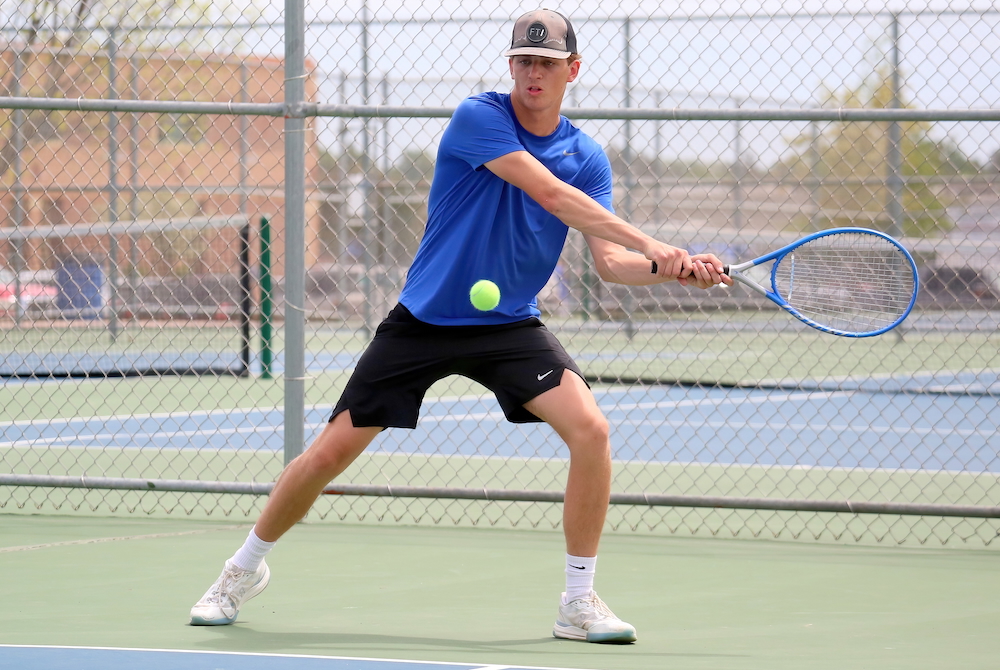
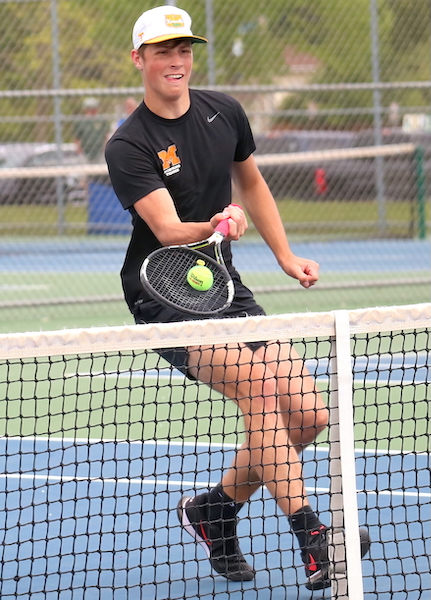
PHOTOS (Top) West Iron County's Elijah Oberlin returns a volley during a No. 1 doubles match Wednesday. (Middle) Munising's Carson Kienitz comes to the net to return a shot at No. 1 singles. (Photos by Terry Raiche.)