

Add, Subtract, Divide, Multiply: MHSAA Not Alone
July 25, 2017
By Rob Kaminski
MHSAA benchmarks editor
This is the third part in a series on MHSAA tournament classification, past and present, that will be published over the next two weeks. This series originally ran in this spring's edition of MHSAA benchmarks.
As the MHSAA faces its most recent classification task with 8-Player Football, and opinions continue to swirl about as to the method, timeframe, location and other procedures, a look around the country provides plenty of company among state association brethren factoring variables into their own equations.
In the Pacific Northwest, the Oregon School Activities Association Football Playoffs are under public scrutiny as leadership ponders a five or six classification format beginning with the 2018-19 school year.
The OSAA has crowned six champions on the gridiron since 2006-07. Many of the state’s smaller schools would like to keep it that way, while larger schools lean toward a five-classification system, citing larger leagues, ease of travel and credibility to state championships as the advantages.
Still others would prefer more than six classes, pointing to safety issues and the opportunity to increase participation numbers as positives.
Moving southeast of Oregon, the Nevada Interscholastic Activities Association recently voted to hold serve on a classification proposal that was volleyed to the membership.
However, changes still could be forthcoming by as early as the 2018-19 season which would add a fifth classification in more populated southern Nevada while allowing northern schools to participate in four classifications. Such divisions could mean no state championship for the fifth class in southern Nevada.
Because of that, the NIAA wants equal numbers of schools in each classification on both ends of the state. Complicating the issue is the fact that the 24 largest schools in the state, by enrollment, are all in Clark County in Southern Nevada.
Across Nevada’s border into Arizona, charter schools are asking the Arizona Interscholastic Association to reconsider classification that was voted upon and approved in September 2015. That agreement called for the largest 33 percent of charter schools by enrollment to be placed in the state’s largest school classification, 3A, the middle 33 percent into 2A, and the smallest 33 percent into 1A.
Less than two years later the charter schools have had a change of heart and have asked to be considered the same as other Arizona public schools and be placed appropriately by enrollment beginning with the 2018-19 school year.
The situation in Arizona further illustrates how the public/private debate that all state associations have faced throughout existence now has the added dynamic of rapidly growing charter schools in today’s educational system, along with virtual school enrollment.
In the nation’s heartland, Nebraska has retooled its football classifications by using enrollment of boys students only in its schools rather than total enrollment. The Nebraska School Activities Association football-playing schools will kick off the 2018 season using this alignment.
Nebraska has three classes of 11-player football, with the smallest class divided in two, Class C-1 and C-2. The state also will have 8-player football for boys enrollments under 47, and the NSAA will sponsor a new 6-player tournament in 2018 for schools with 27 or fewer boys.
“This is a good proposal because some schools have a sizable imbalance between the number of boys and girls, and there’s a large gap (in enrollment) between the largest and smallest schools in Classes A and B,” NSAA executive director Jim Tenopir said. “I think this addresses both of those concerns.”
Swimmers in Georgia, meanwhile, will feel like they are moving with the current, rather than upstream in 2017-18, as the Georgia High School Association recently doubled the number of team championship events from two to four.
Swim enthusiasts can also count on longer days at the finals, as the top 30 finishers from the prelims will advance to the finals instead of 20, and all championship events will have three heats versus two.
Wilk Inspires - Again - as 2nd Injury Comeback Helps Spark Historic Midland Run
By
Paul Costanzo
Special for MHSAA.com
May 28, 2025
The physical feeling of tearing her ACL was familiar to Theresa Wilk.
 She tore the ligament in her right knee while playing soccer not long before starting her freshman year at Midland. So, when she suffered the same injury, to the same knee, in the same fashion, during the District Final her sophomore year, there was little doubt in her mind what had happened.
What was unfamiliar, however, was the feeling that came along with it.
“As soon as I felt the buckle, I knew,” Wilk said. “Honestly, I didn’t think I would ever come back to soccer. I really wanted to quit everything. I didn’t want to go out and see people. It was definitely a lot harder than the first time around. The first time, I was able to think, ‘I still have three more years after this.’”
Those injuries cost Wilk two full high school seasons, but not, as she had feared, her career. After a second long rehabilitation process, and nearly two full years away from the field, she’s back in the Chemics’ midfield and has helped lead her team to a 19-0 record heading into Friday night’s Division 1 District Final against Midland Dow.
It’s a comeback that required special types of resilience and determination – and anyone who has watched Wilk play is well aware she possesses both.
“It’s unbelievable, for the size of her, how much of a scrapper she is,” Midland coach Rico Barassi said. “She’s great at stealing balls. She will see the player, and they’ll try to shield the ball, and she’ll just take it, then the other player will push her and we’ll get a foul. It’s uncanny. She also sees the field very well and is very unselfish. She’s very often the assist behind the assist. But with Theresa, you just let her float on the field. She always finds the ball and finds the player. She will chase somebody down. She could be on the 18 (yard box) on the other side of the field, and she will chase a player down.”
Barassi has always seen the potential in Wilk, so much so that despite her suffering her first injury seven months prior to what would have been her freshman season, he saved her No. 20 jersey and a spot for her on the varsity team.
 Saving a jersey and spot is something Barassi said he does for all players on his team when they suffer a serious injury, but it’s still a massive statement for a freshman who has yet to play a high school game, and one that meant a lot to Wilk.
“That was the biggest part – I had my number, he gave me a jersey, a bag and everything,” Wilk said. “He told me that in my sophomore year, when you’re ready, you have a spot on the team. That really pushed me through.”
Wilk was one of several freshmen to earn a spot on the varsity team their first year, as nine were brought up and made an immediate impact. That year, while Wilk served as a team manager, the Chemics finished 7-7-4 – and Barassi knew the future was bright.
“I thought they’re small, they’re little, but they’re very good,” Barassi said. “Wait until they get to be juniors and seniors, they’re going to make history.”
The following two seasons resulted in District titles for Midland, including with a shootout victory over Dow in 2023.
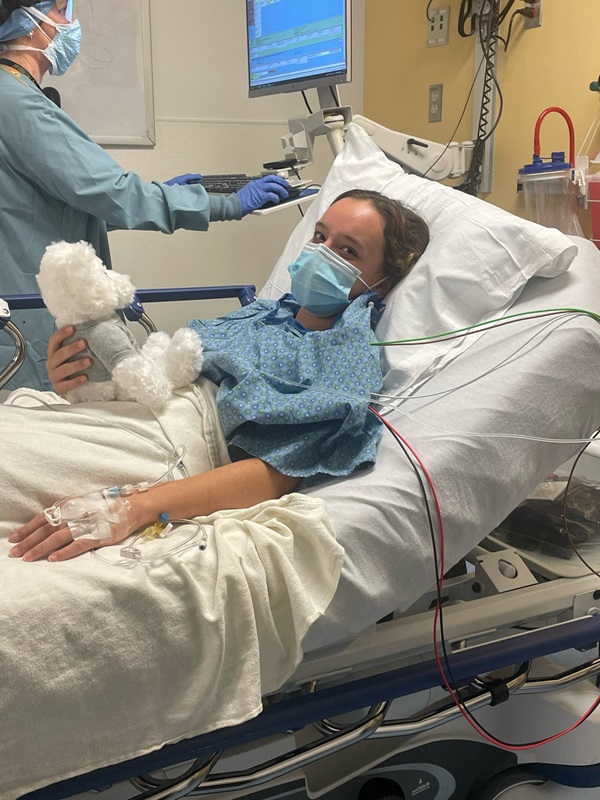
Wilk’s second ACL tear came during the second overtime of that game, on a cross she played with her left foot. The familiar buckle was enough to tell her what had happened, even if the initial MRI results were inconclusive.
Due to her familiarity with the injury, Wilk said she recovered more quickly the second time. She was even given clearance to return to action in March of her junior year. But knowing that she still had a ways to go to build up her strength and be the player she was capable of being, she decided to keep working on her recovery and sit out last season.
Once again, her spot and her number were safe, and she served as a team manager while the Chemics went 16-2-3, claimed a second-straight District title and advanced to the Regional Final where they lost 3-2 to eventual Finals champion Spring Lake.
Watching it all happen without being on the field was difficult for Wilk, but the support system around her helped get her through.
“I think the biggest thing was they didn’t treat me any differently than if I wasn’t injured,” she said. “My family still had me do my chores, they let me be independent and only came (to help) if I asked. Same as my team, they didn’t constantly bring it up and talk about it, or be like, ‘Oh man, that’s really sad.’ I think they knew I didn’t want that. Everyone was so amazing and nice, and I didn’t ever feel like I wasn’t part of the team.”
 On March 19 of this year, Wilk returned to the field for the Chemics in a 2-1 win against Grand Ledge. She admits there’s a bit of a difference in how she plays, and that she isn’t always as aggressive as she used to be. But her game has evolved, and while she continues to be a defensive force in the midfield, her ability as a passer has shined through, leading her to first-team all-Saginaw Valley League honors.
It also helped her to feel like her return to action was complete.
“The biggest moment for me that was like, ‘I’m back,’ was during the Dow game (April 28) when I had an assist to Alahna Beckett,” Wilk said. “She scored our second goal, and that got us up a little bit and we got the momentum. That was a really big moment where I was proud of myself. That’s when I felt I was fully back.”
This past week, Wilk graduated summa cum laude from Midland, and she will attend Grand Valley State University in the fall, where she plans to study nursing.
“I think that I kind of knew before my experience that I wanted to do healthcare,” she said. “But my experience set in stone what I wanted to do.”
Before she leaves for Allendale, there’s more work to be done on the soccer field, starting with Friday night’s match against Dow which will be a bit of a full-circle moment for Wilk.
As it approaches, though, she’s more focused on what she and her teammates have been able to accomplish together, and what could still be ahead.
“I’m really proud of the team,” she said. “I’ve known all these girls basically my whole life, and seeing us all grow up together and all accomplishing this amazing task together is wonderful to see. I think we can (make a postseason run), we just have to play our style and continue doing what we do, and work together. We have an amazing connection on the team, and I feel like it really shows on the field.”
 Paul Costanzo served as a sportswriter at The Port Huron Times Herald from 2006-15, including three years as lead sportswriter, and prior to that as sports editor at the Hillsdale Daily News from 2005-06. He can be reached at [email protected] with story ideas for Genesee, Lapeer, St. Clair, Sanilac, Huron, Tuscola, Saginaw, Bay, Arenac, Midland and Gladwin counties.
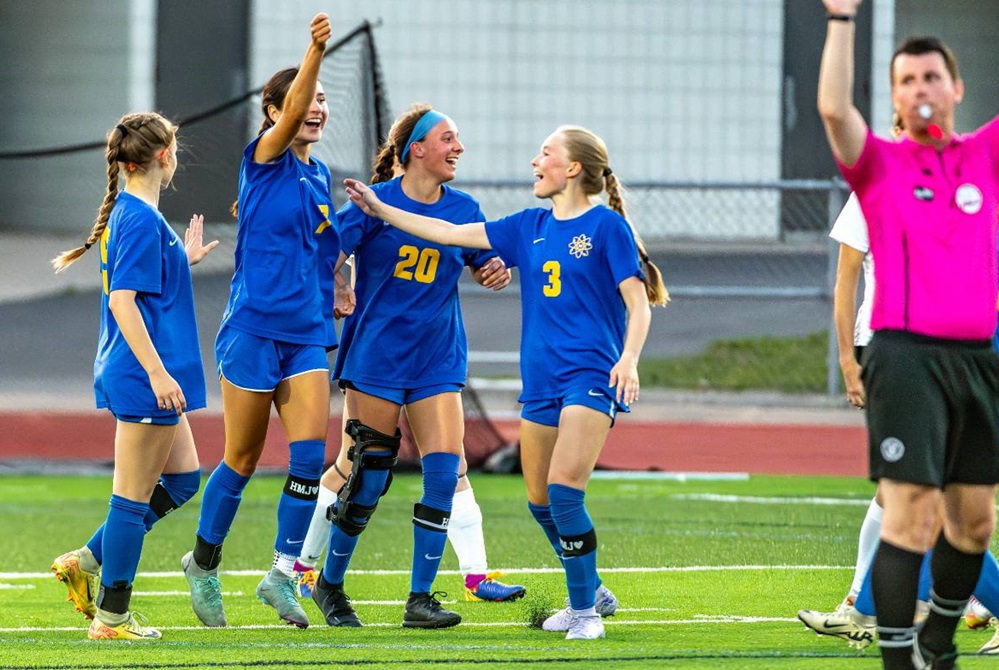
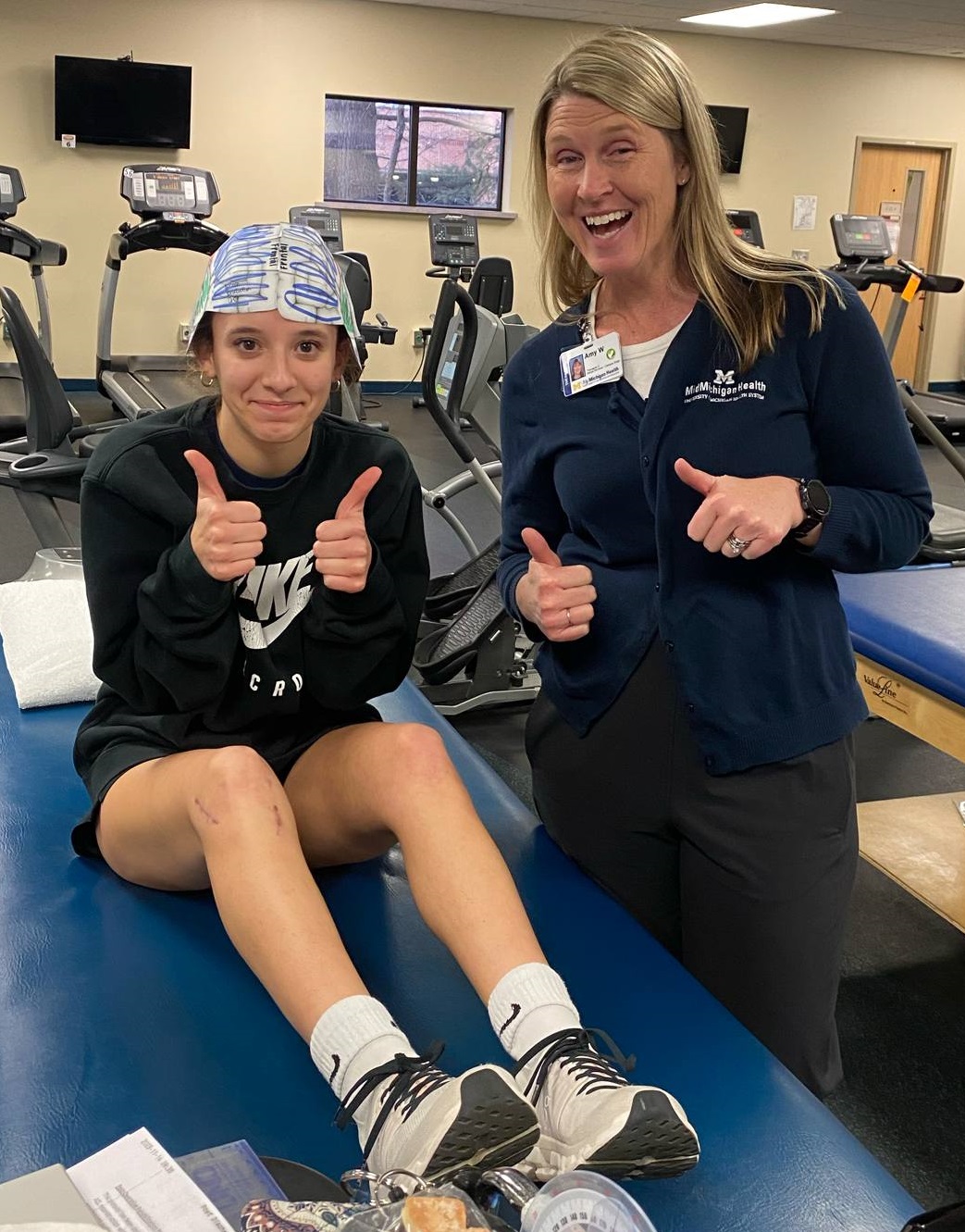
PHOTOS (Top) Midland's Theresa Wilk (20) and her teammates celebrate during a game this season. (Middle) Wilk takes a quick photo from her hospital bed after her second ACL tear. (Below) Wilk, left, shares a positive moment during physical therapy. (Soccer photo provided by the Midland athletic department; hospital and therapy photos courtesy of the Wilk family.)