


Add, Subtract, Divide, Multiply: MHSAA Not Alone
July 25, 2017
By Rob Kaminski
MHSAA benchmarks editor
This is the third part in a series on MHSAA tournament classification, past and present, that will be published over the next two weeks. This series originally ran in this spring's edition of MHSAA benchmarks.
As the MHSAA faces its most recent classification task with 8-Player Football, and opinions continue to swirl about as to the method, timeframe, location and other procedures, a look around the country provides plenty of company among state association brethren factoring variables into their own equations.
In the Pacific Northwest, the Oregon School Activities Association Football Playoffs are under public scrutiny as leadership ponders a five or six classification format beginning with the 2018-19 school year.
The OSAA has crowned six champions on the gridiron since 2006-07. Many of the state’s smaller schools would like to keep it that way, while larger schools lean toward a five-classification system, citing larger leagues, ease of travel and credibility to state championships as the advantages.
Still others would prefer more than six classes, pointing to safety issues and the opportunity to increase participation numbers as positives.
Moving southeast of Oregon, the Nevada Interscholastic Activities Association recently voted to hold serve on a classification proposal that was volleyed to the membership.
However, changes still could be forthcoming by as early as the 2018-19 season which would add a fifth classification in more populated southern Nevada while allowing northern schools to participate in four classifications. Such divisions could mean no state championship for the fifth class in southern Nevada.
Because of that, the NIAA wants equal numbers of schools in each classification on both ends of the state. Complicating the issue is the fact that the 24 largest schools in the state, by enrollment, are all in Clark County in Southern Nevada.
Across Nevada’s border into Arizona, charter schools are asking the Arizona Interscholastic Association to reconsider classification that was voted upon and approved in September 2015. That agreement called for the largest 33 percent of charter schools by enrollment to be placed in the state’s largest school classification, 3A, the middle 33 percent into 2A, and the smallest 33 percent into 1A.
Less than two years later the charter schools have had a change of heart and have asked to be considered the same as other Arizona public schools and be placed appropriately by enrollment beginning with the 2018-19 school year.
The situation in Arizona further illustrates how the public/private debate that all state associations have faced throughout existence now has the added dynamic of rapidly growing charter schools in today’s educational system, along with virtual school enrollment.
In the nation’s heartland, Nebraska has retooled its football classifications by using enrollment of boys students only in its schools rather than total enrollment. The Nebraska School Activities Association football-playing schools will kick off the 2018 season using this alignment.
Nebraska has three classes of 11-player football, with the smallest class divided in two, Class C-1 and C-2. The state also will have 8-player football for boys enrollments under 47, and the NSAA will sponsor a new 6-player tournament in 2018 for schools with 27 or fewer boys.
“This is a good proposal because some schools have a sizable imbalance between the number of boys and girls, and there’s a large gap (in enrollment) between the largest and smallest schools in Classes A and B,” NSAA executive director Jim Tenopir said. “I think this addresses both of those concerns.”
Swimmers in Georgia, meanwhile, will feel like they are moving with the current, rather than upstream in 2017-18, as the Georgia High School Association recently doubled the number of team championship events from two to four.
Swim enthusiasts can also count on longer days at the finals, as the top 30 finishers from the prelims will advance to the finals instead of 20, and all championship events will have three heats versus two.
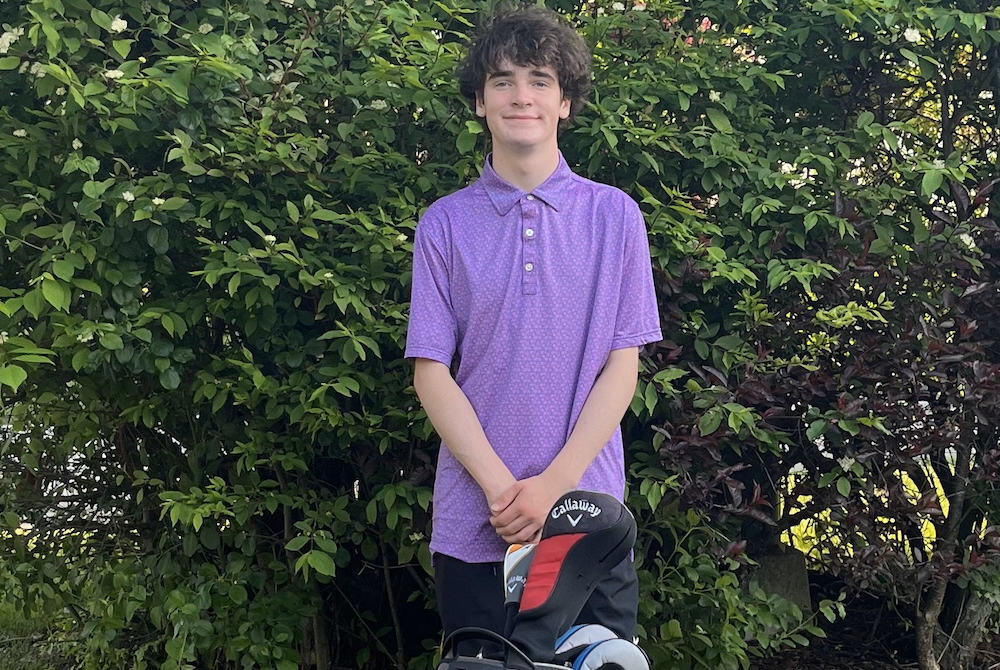
Powered by Transplanted Heart, Pioneer's Williams Relishing Return to Golf Team
By
Doug Donnelly
Special for MHSAA.com
May 16, 2025
Brady Williams knew something was wrong.
 The then-freshman at Ann Arbor Pioneer was in class when he texted his parents that something wasn’t right. His mom, Tiffany, rushed to the school, got Brady into the car and drove straight to the emergency room in Ann Arbor.
His father, Greg, arrived a few minutes later.
“He was in heart failure,” said one of the doctors who was caring for Brady, then 14.
When he went home from C.S. Mott Children’s Hospital nearly six weeks later, Brady was the proud owner of a new heart.
“It was really random,” Williams recalled. “One day I wasn’t feeling good at school, so I left and went to the doctors. They kept me for a couple of days and told me I needed to get a heart transplant.”
It’s been an incredible journey for the Pioneer sophomore, who returned to school last fall and is now on the Pioneers junior varsity golf team.
“I can do basically everything now,” he says. “I’m back up to normal for sure.”
Normal is something Williams had rarely known. Even as a young boy he would occasionally get tired from doing simple things. As the family learned to deal with it, they decided at one point to seek more medical advice. After genetic testing, at the age of 7 he was diagnosed with a rare neuromuscular disease, known as limb-girdle muscular dystrophy.
“It basically makes the muscles weak, especially your heart,” he said.
As he got older, he was would sometimes struggle with the effects.
“We carried an AED (automated external defibrillator) with us everywhere,” Tiffany Williams said.
He tried playing sports, including basketball, and golfed regularly. In the months leading up to the heart transplant, though, Brady had slowed down.
“I was playing basketball and golfing four times a week,” Brady said. “Slowly I stopped playing basketball and even golf because I was getting really tired.”
Under the care of Dr. Mark Russell, Dr. Aaron Stern – a professor of pediatric cardiology at University of Michigan – and Dr. Kurt Robert Schumacher, the medical director for the pediatric heart transplant program at C.S. Mott Children’s Hospital, Brady at first had a temporary device installed in his heart, but it was quickly determined that a heart transplant was needed – and fast.
“They didn’t think it would be this bad, but it ended up hurting my heart so bad that I had to get a new one,” Williams said.
After the decision was made to move forward with the heart transplant, he waited only two days for the new heart.
“They put me at the top of the list, and they got it there quick, thankfully,” Williams said.
His passion for sports has always been a driving force. A football fanatic, he is a die-hard Cleveland Browns fan. His favorite quarterback, former Browns signal-caller Baker Mayfield, sent him a video message while he was recovering. Former Eastern Michigan University and current Las Vegas Raiders star Maxx Crosby also reached out to him.
In the hospital, Williams was glued to the television.
“Everyone took to Brady,” Tiffany Williams said. “He helped everyone with fantasy football teams while he was in the hospital, plus Michigan won the national championship. So that was a good year.”
His recovery included several months of physical therapy and doctor visits. At first, Brady had to attend school virtually, but returned to the halls of Pioneer in the fall.
“I feel like honestly better than I ever have,” Williams said. “This is a really good heart, a lot better than the one I was born with. This is like 100 percent. My old one, I never lived at like a 100-percent level. It was always low.
“I don’t even notice anything. It’s just normal all of the time.”
This spring he was cleared to golf after a physical. He is able to use a cart during his matches and tournaments, something he said helps him a lot.
“This is what I really wanted – just to join the team and get back to how I used to be – hanging out with friends and making new ones,” Brady said. “That’s the best part about being on a team.”
Being part of a team was at one point something Brady didn’t think he would get to experience. He knows how fortunate he is to have that opportunity again.
“I realize that everything can get taken away from you easily,” he said. “One second you can be at the highest point and the next you can be at the lowest. I’m definitely at the highest right now after making the golf team, being on it and having a lot of fun with it.”
 Doug Donnelly has served as a news and sports reporter at the Adrian Daily Telegram and the Monroe News for 30 years, including 10 years as city editor in Monroe. He's written a book on high school basketball in Monroe County and compiles record books for various schools in southeast Michigan. He is now publisher and editor of The Blissfield Advance, a weekly newspaper. E-mail him at [email protected] with story ideas for Jackson, Washtenaw, Hillsdale, Lenawee and Monroe counties.