


Add, Subtract, Divide, Multiply: MHSAA Not Alone
July 25, 2017
By Rob Kaminski
MHSAA benchmarks editor
This is the third part in a series on MHSAA tournament classification, past and present, that will be published over the next two weeks. This series originally ran in this spring's edition of MHSAA benchmarks.
As the MHSAA faces its most recent classification task with 8-Player Football, and opinions continue to swirl about as to the method, timeframe, location and other procedures, a look around the country provides plenty of company among state association brethren factoring variables into their own equations.
In the Pacific Northwest, the Oregon School Activities Association Football Playoffs are under public scrutiny as leadership ponders a five or six classification format beginning with the 2018-19 school year.
The OSAA has crowned six champions on the gridiron since 2006-07. Many of the state’s smaller schools would like to keep it that way, while larger schools lean toward a five-classification system, citing larger leagues, ease of travel and credibility to state championships as the advantages.
Still others would prefer more than six classes, pointing to safety issues and the opportunity to increase participation numbers as positives.
Moving southeast of Oregon, the Nevada Interscholastic Activities Association recently voted to hold serve on a classification proposal that was volleyed to the membership.
However, changes still could be forthcoming by as early as the 2018-19 season which would add a fifth classification in more populated southern Nevada while allowing northern schools to participate in four classifications. Such divisions could mean no state championship for the fifth class in southern Nevada.
Because of that, the NIAA wants equal numbers of schools in each classification on both ends of the state. Complicating the issue is the fact that the 24 largest schools in the state, by enrollment, are all in Clark County in Southern Nevada.
Across Nevada’s border into Arizona, charter schools are asking the Arizona Interscholastic Association to reconsider classification that was voted upon and approved in September 2015. That agreement called for the largest 33 percent of charter schools by enrollment to be placed in the state’s largest school classification, 3A, the middle 33 percent into 2A, and the smallest 33 percent into 1A.
Less than two years later the charter schools have had a change of heart and have asked to be considered the same as other Arizona public schools and be placed appropriately by enrollment beginning with the 2018-19 school year.
The situation in Arizona further illustrates how the public/private debate that all state associations have faced throughout existence now has the added dynamic of rapidly growing charter schools in today’s educational system, along with virtual school enrollment.
In the nation’s heartland, Nebraska has retooled its football classifications by using enrollment of boys students only in its schools rather than total enrollment. The Nebraska School Activities Association football-playing schools will kick off the 2018 season using this alignment.
Nebraska has three classes of 11-player football, with the smallest class divided in two, Class C-1 and C-2. The state also will have 8-player football for boys enrollments under 47, and the NSAA will sponsor a new 6-player tournament in 2018 for schools with 27 or fewer boys.
“This is a good proposal because some schools have a sizable imbalance between the number of boys and girls, and there’s a large gap (in enrollment) between the largest and smallest schools in Classes A and B,” NSAA executive director Jim Tenopir said. “I think this addresses both of those concerns.”
Swimmers in Georgia, meanwhile, will feel like they are moving with the current, rather than upstream in 2017-18, as the Georgia High School Association recently doubled the number of team championship events from two to four.
Swim enthusiasts can also count on longer days at the finals, as the top 30 finishers from the prelims will advance to the finals instead of 20, and all championship events will have three heats versus two.
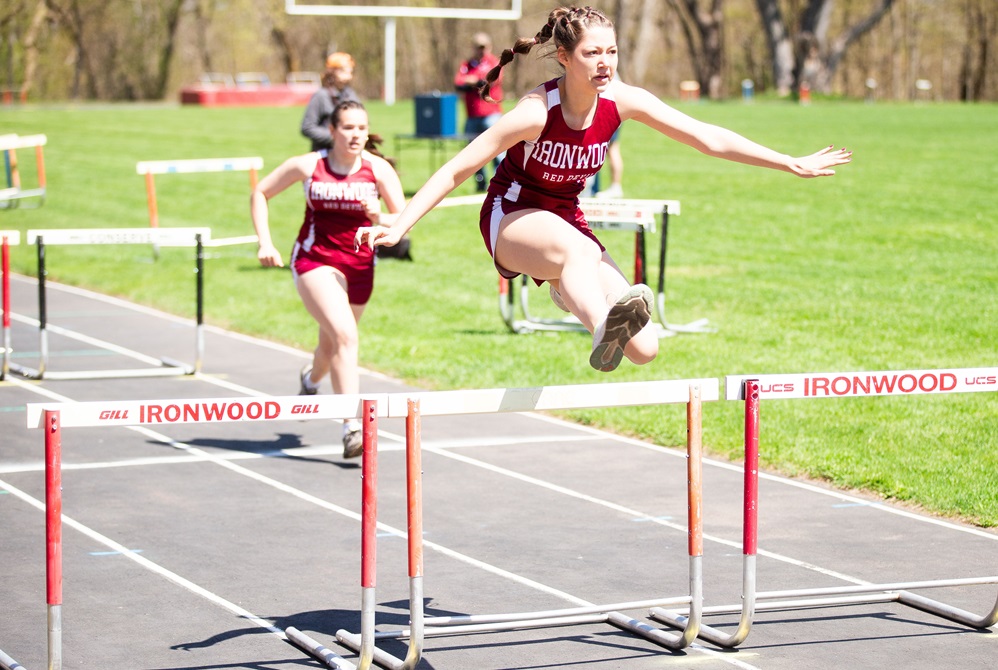
Ironwood Savors Home-Track Advantage in LaBlonde Memorial Invitational Sweep
By
John Vrancic
Special for MHSAA.com
May 15, 2025
IRONWOOD — Most high school tracks have at least six lanes and are 400 meters.
 But there’s an exception to every rule.
That’s the case at Ironwood, where the Red Devils run on a 350-meter, five-lane asphalt surface.
“That’s something we’ve addressed,” Ironwood coach Cecilia Aho said “We’re probably the last ones who have a track this small, although the distances are the same. When we do mile repeats the kids don’t like it, but it’s better than not having a track. We make it work. Some of the smaller schools don’t have a track.”
Both Ironwood teams retained their titles Saturday afternoon at the Jim LaBlonde Memorial Invitational at Longyear Field, with the boys scoring 74 points to stay ahead of Hurley, Wis., at 57, and the Ironwood girls collecting 104 points to pull away from the field.
“The kids come here and have fun,” Aho said. “We have a nice group of kids who are working real hard.”
Ironwood junior Talon Hughes, who had a hand in four meet records, said the smaller track provides some challenges.
“It’s a pretty unique track,” he added. “We have different lanes and it’s hard to switch lanes. It can be intimidating for visiting teams. It’s sometimes hard for them to adapt, although we get used to it through practice. The biggest adjustment for us on 400-meter tracks is they have longer straightaways.”
Hughes won the 100-meter dash in 11.74 seconds and also took first in the 200 (24.42), 110 hurdles (16.84) and helped the Red Devils take the 800 relay (1:40.37).
“It’s a great feeling to win at home,” he said. “Many of your friends are here to cheer you on. We’re looking forward to our last few meets.”
The different exchange zones appeared to affect the Bessemer girls 800 relay the most. After a fast start, the Speedgirls struggled with all three handoffs, dropping them to third place (2:06.05), fewer than two seconds behind the winning team from Ironwood.
“I think it has a mental block on you,” Bessemer sophomore Sarah Hoffenberg said. “It really depends on the person. In my opinion, I think it helps if you don’t think about it. It’s really a learning experience.”
Hoffenberg later helped the Speedgirls bounce back with a victory in the 400 relay (1:01.38).
Ironwood senior Aubrey Smith, who will be attending classes at University of Michigan this fall, said it’s like having a homecourt advantage.
“It’s a little confusing,” she added. “It’s a little less than 4½ laps for a mile. It’s hard to tell where everyone is.”
Smith dominated the distances, taking the 800 (2:38.84), 1,600 (5:59.53) and 3,200 (11:58.87).
The Red Devils also ran in Wednesday’s Upper Peninsula Division 2 Regional at West Iron County, the boys team winning and the girls finishing runner-up to the host Wykons. Ironwood travels to Lake Linden-Hubbell for the Copper Mountain Conference meet Monday before ending the season at the Upper Peninsula Finals on May 31 at Kingsford.
“Our seniors are looking forward to their last couple meets,” Aho said. “I’m going to miss them. Our school is 100 years old. We started celebrating our centennial last July. We’re in the process of finishing up our celebration.”
 John Vrancic has covered high school sports in the Upper Peninsula since joining the Escanaba Daily Press staff in 1985. He is known most prominently across the peninsula for his extensive coverage of cross country and track & field that frequently appears in newspapers from the Wisconsin border to Lake Huron. He received the James Trethewey Award for Distinguished Service in 2015 from the Upper Peninsula Sportswriters and Sportscasters Association.
PHOTO Skyla Ballew clears a hurdle during a race at Ironwood High School. (Photo by Jason Juno/Ironwood Daily Globe.)