


Add, Subtract, Divide, Multiply: MHSAA Not Alone
July 25, 2017
By Rob Kaminski
MHSAA benchmarks editor
This is the third part in a series on MHSAA tournament classification, past and present, that will be published over the next two weeks. This series originally ran in this spring's edition of MHSAA benchmarks.
As the MHSAA faces its most recent classification task with 8-Player Football, and opinions continue to swirl about as to the method, timeframe, location and other procedures, a look around the country provides plenty of company among state association brethren factoring variables into their own equations.
In the Pacific Northwest, the Oregon School Activities Association Football Playoffs are under public scrutiny as leadership ponders a five or six classification format beginning with the 2018-19 school year.
The OSAA has crowned six champions on the gridiron since 2006-07. Many of the state’s smaller schools would like to keep it that way, while larger schools lean toward a five-classification system, citing larger leagues, ease of travel and credibility to state championships as the advantages.
Still others would prefer more than six classes, pointing to safety issues and the opportunity to increase participation numbers as positives.
Moving southeast of Oregon, the Nevada Interscholastic Activities Association recently voted to hold serve on a classification proposal that was volleyed to the membership.
However, changes still could be forthcoming by as early as the 2018-19 season which would add a fifth classification in more populated southern Nevada while allowing northern schools to participate in four classifications. Such divisions could mean no state championship for the fifth class in southern Nevada.
Because of that, the NIAA wants equal numbers of schools in each classification on both ends of the state. Complicating the issue is the fact that the 24 largest schools in the state, by enrollment, are all in Clark County in Southern Nevada.
Across Nevada’s border into Arizona, charter schools are asking the Arizona Interscholastic Association to reconsider classification that was voted upon and approved in September 2015. That agreement called for the largest 33 percent of charter schools by enrollment to be placed in the state’s largest school classification, 3A, the middle 33 percent into 2A, and the smallest 33 percent into 1A.
Less than two years later the charter schools have had a change of heart and have asked to be considered the same as other Arizona public schools and be placed appropriately by enrollment beginning with the 2018-19 school year.
The situation in Arizona further illustrates how the public/private debate that all state associations have faced throughout existence now has the added dynamic of rapidly growing charter schools in today’s educational system, along with virtual school enrollment.
In the nation’s heartland, Nebraska has retooled its football classifications by using enrollment of boys students only in its schools rather than total enrollment. The Nebraska School Activities Association football-playing schools will kick off the 2018 season using this alignment.
Nebraska has three classes of 11-player football, with the smallest class divided in two, Class C-1 and C-2. The state also will have 8-player football for boys enrollments under 47, and the NSAA will sponsor a new 6-player tournament in 2018 for schools with 27 or fewer boys.
“This is a good proposal because some schools have a sizable imbalance between the number of boys and girls, and there’s a large gap (in enrollment) between the largest and smallest schools in Classes A and B,” NSAA executive director Jim Tenopir said. “I think this addresses both of those concerns.”
Swimmers in Georgia, meanwhile, will feel like they are moving with the current, rather than upstream in 2017-18, as the Georgia High School Association recently doubled the number of team championship events from two to four.
Swim enthusiasts can also count on longer days at the finals, as the top 30 finishers from the prelims will advance to the finals instead of 20, and all championship events will have three heats versus two.
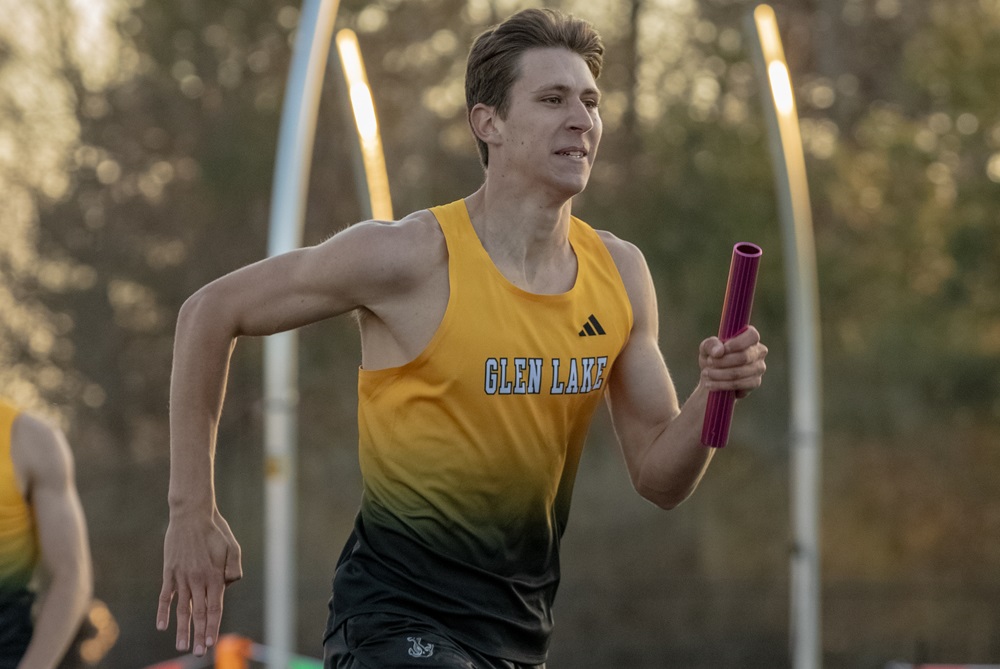
Record-Setting Sutherland Focused on Final Goals as Glen Lake Career Winds Down
By
Tom Spencer
Special for MHSAA.com
May 9, 2025
All that’s left in a stellar athletic career for Colebrook Sutherland is a sprint to the finish line.
 There isn’t much he hasn’t done for Maple City Glen Lake. But the four-sport standout and record-setting distance runner does have a few things he’d yet like to accomplish before commencements June 1.
For starters, he’d like to lead his team to a Regional championship next week at East Jordan and maybe set another school record.
But topping his list is to win an individual championship at the Lower Peninsula Division 4 Finals on May 31 at Hudsonville Baldwin Middle School.
“That’s for sure a goal,” Glen Lake track coach Jason Bradford said. “Any sport the does, he does well. From fall tennis and cross country and then basketball and now track, he’s just one of those athletes that can do anything.”
Sutherland is going into next week’s Regional as the school record holder in four events. One record – in the 800-meter run – was set this year; he ran a 1:57.61 at the Bruce Garland Invitational. The other three were set last year.
Sutherland ran a 4:25.60 to set the 1,600 record and finish fourth at the LPD4 Finals last June. He entered the record books in the 3,200 last year, too, with a 9:50.9 at the Northwest Conference championships. He’s also a member of the school’s 3,200 relay record-setting team along with Dylan Bixby, Dylan Cundiff and Abraham Feeney.
Sutherland had five school records on his mind when this season started. Actually, he’s been thinking about those five since the end of his sophomore year.
 With the help of distance coaches George Drown and Jim Harrelson, Sutherland has only the 400 school record left on that list. The 400 belongs to Finn Hogan, who set it at 49.68 seconds in 2021, and Sutherland has clocked a 51.79 but may not run the race again this season. The Lakers have only one more meet before the Regional – this weekend’s Frankfort Invitational.
“I was thinking about five, but I think I want to just focus on the 800 run and continue to improve that instead of using all my time trying to get another,” Sutherland said. “I’d rather try to win states in the 800.”
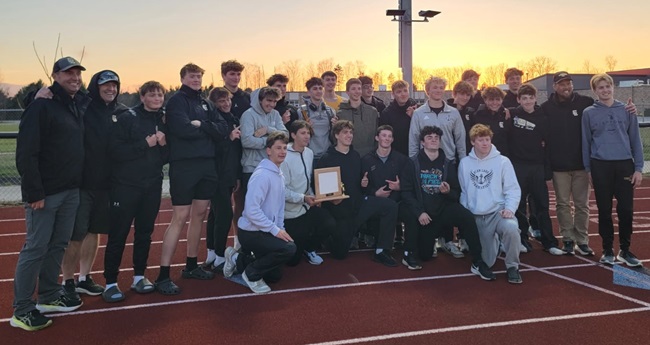
While Hogan, too, continues to own four school records, Sutherland also now has been part of a coveted and long-sought team accomplishment. He led the Lakers to their first Northwest Conference track & field championship earlier this week, which also was high among Sutherland’s goals for the season as the conference has been dominated by Benzie Central and Kingsley over the years.
Sutherland ran away with the conference championships in the 800 and 1,600 to lead the Lakers, who were followed by Benzie Central, Frankfort, Leland, Buckley, Brethren and Onekama.
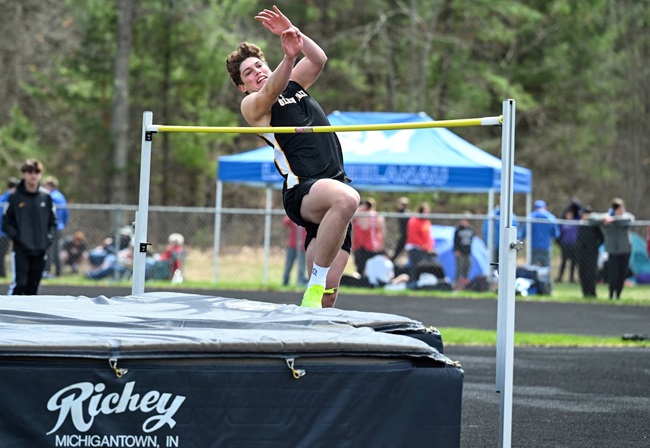
Also helping lead the way in the Lakers’ conference title pursuit was Boden Fisher, who won the 100-meter and long jump championships and finished second in the 200, which was won by his teammate Nolan Bretzke. Jacob Plamondon won the high jump for the Lakers, topping the bar at 6 feet, and Dominic Stein won the discus.
The Lakers also won three relay titles. Samuel Dykstra, Hunter Cox, Fisher, Daniels, Noah Scott, Cox, Liam Palmer, Feeney, Eli Maule, Liam McCaw and Lincoln Bailey ran those relays.
“We haven’t always had the depth of some of the other teams in our conference,” Sutherland said. “This year, we actually do have a lot of depth and talent.”
The Lakers do boast a larger roster this spring and often have multiple top-three placers in running events. They’ll lose just five seniors and plan to carry on the success next season with an influx of current eighth graders to go with the current load of sprinters and freshmen.
 “We have someone in each event that can compete,” Bradford said. “It helps build a good program.”
The Lakers have a shot at winning the Regional, Bradford acknowledged. A lot depends on individual efforts of many, he said, as the Lakers could place in every event.
“We have a whole week to prepare after Frankfort, and we need to find a happy medium of pushing the kids and keeping them going so they reach their top potential,” Bradford said. “It is going to be a team effort just like the conference meet. It is the interesting thing about track. As a team, we’re always looking to where can we come up with some extra points.”
Bradford, who also coaches the Lakers’ boys basketball team, believes all sports at the school contribute to the success Glen Lake is finding on the track. Growth in the school’s weightlifting program, led by past St. Ignace multi-sport and Central Michigan football standout Gage Kreski, has also been a big factor.
“Every program here contributes to track,” Bradford said. “We see the benefits that start with our lifting program.”
While the Lakers will attempt to advance several to the Finals, Sutherland is assured of being there. He already has met qualification standards in the 400, 800 and 1,600.
Sutherland is looking forward to the competitors ahead as he expects them to bring out his best. He hopes to better his own marks.
“If I actually have people around me, I am faster than 1:57 (his 800-meter school record),” Sutherland said. “I rarely have competition.”
 Tom Spencer is a longtime MHSAA-registered basketball and soccer official, and former softball and baseball official, and he also has coached in the northern Lower Peninsula area. He previously has written for the Saginaw News, Bay County Sports Page and Midland Daily News. He can be reached at [email protected] with story ideas for Manistee, Wexford, Missaukee, Roscommon, Ogemaw, Iosco, Alcona, Oscoda, Crawford, Kalkaska, Grand Traverse, Benzie, Leelanau, Antrim, Otsego, Montmorency, Alpena, Presque Isle, Cheboygan, Charlevoix and Emmet counties.
PHOTOS (Top) Glen Lake’s Colebrook Sutherland runs his leg of a relay. (Middle) Sutherland, holding the trophy, and his teammates take a photo to celebrate their Northwest Conference championship. (Below) Jacob Plamondon approaches the high jump bar. (Running photo by Meredith McNabb. Team photo by Donna King. Jumping photo by Jill Plamandon.)