

Add, Subtract, Divide, Multiply: MHSAA Not Alone
July 25, 2017
By Rob Kaminski
MHSAA benchmarks editor
This is the third part in a series on MHSAA tournament classification, past and present, that will be published over the next two weeks. This series originally ran in this spring's edition of MHSAA benchmarks.
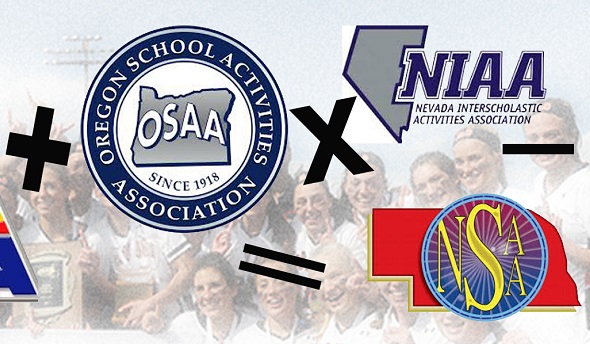
As the MHSAA faces its most recent classification task with 8-Player Football, and opinions continue to swirl about as to the method, timeframe, location and other procedures, a look around the country provides plenty of company among state association brethren factoring variables into their own equations.
In the Pacific Northwest, the Oregon School Activities Association Football Playoffs are under public scrutiny as leadership ponders a five or six classification format beginning with the 2018-19 school year.
The OSAA has crowned six champions on the gridiron since 2006-07. Many of the state’s smaller schools would like to keep it that way, while larger schools lean toward a five-classification system, citing larger leagues, ease of travel and credibility to state championships as the advantages.
Still others would prefer more than six classes, pointing to safety issues and the opportunity to increase participation numbers as positives.
Moving southeast of Oregon, the Nevada Interscholastic Activities Association recently voted to hold serve on a classification proposal that was volleyed to the membership.
However, changes still could be forthcoming by as early as the 2018-19 season which would add a fifth classification in more populated southern Nevada while allowing northern schools to participate in four classifications. Such divisions could mean no state championship for the fifth class in southern Nevada.
Because of that, the NIAA wants equal numbers of schools in each classification on both ends of the state. Complicating the issue is the fact that the 24 largest schools in the state, by enrollment, are all in Clark County in Southern Nevada.
Across Nevada’s border into Arizona, charter schools are asking the Arizona Interscholastic Association to reconsider classification that was voted upon and approved in September 2015. That agreement called for the largest 33 percent of charter schools by enrollment to be placed in the state’s largest school classification, 3A, the middle 33 percent into 2A, and the smallest 33 percent into 1A.
Less than two years later the charter schools have had a change of heart and have asked to be considered the same as other Arizona public schools and be placed appropriately by enrollment beginning with the 2018-19 school year.
The situation in Arizona further illustrates how the public/private debate that all state associations have faced throughout existence now has the added dynamic of rapidly growing charter schools in today’s educational system, along with virtual school enrollment.
In the nation’s heartland, Nebraska has retooled its football classifications by using enrollment of boys students only in its schools rather than total enrollment. The Nebraska School Activities Association football-playing schools will kick off the 2018 season using this alignment.
Nebraska has three classes of 11-player football, with the smallest class divided in two, Class C-1 and C-2. The state also will have 8-player football for boys enrollments under 47, and the NSAA will sponsor a new 6-player tournament in 2018 for schools with 27 or fewer boys.
“This is a good proposal because some schools have a sizable imbalance between the number of boys and girls, and there’s a large gap (in enrollment) between the largest and smallest schools in Classes A and B,” NSAA executive director Jim Tenopir said. “I think this addresses both of those concerns.”
Swimmers in Georgia, meanwhile, will feel like they are moving with the current, rather than upstream in 2017-18, as the Georgia High School Association recently doubled the number of team championship events from two to four.
Swim enthusiasts can also count on longer days at the finals, as the top 30 finishers from the prelims will advance to the finals instead of 20, and all championship events will have three heats versus two.
Eastern Upper Peninsula Power Reigns in Girls Distance Races
By
John Vrancic
Special for MHSAA.com
May 8, 2025
PICKFORD — Girls distance runners don’t have to look far to find competition in the Eastern Upper Peninsula.
 That’s especially true in Division 3, where Pickford junior Talya Schreiber is setting the pace.
Last fall, Eastern U.P. runners grabbed the top four places at the U.P. Division 3 Cross Country Final at Munising. Schreiber won that race for the first time in 2023, followed by Newberry’s Samantha and Abby Taylor, then retained her title in October.
Abby Taylor was runner-up, with Samantha placing third and Engadine eighth-grader Molly NcNamara taking fourth in that most recent championship race.
“I started at a younger age,” Schreiber said after the Web Morrison Invite at Pickford on April 26. “I ran my first cross country meet in sixth grade. That was definitely a learning curve, but I got hooked on that feeling. The first meet went well.
“Once I got into seventh grade, I knew I wanted to make a future of it. In my freshman year, we moved from Cedarville to Pickford. It was quite an adjustment with new coaches and athletic program and being a bigger school.”
Schreiber won three individual events April 12 at the Yooper Indoor Invitational at Lake Superior State University in Sault Ste. Marie. She was clocked at 2:30.64 in the 800-meter run and took the 1,600 (5:15.55) and 3,200 (11:16.96), well ahead of her nearest competitor, Escanaba senior and Northern Michigan University recruit Alisha Mabie.
“That was a good experience,” Schreiber said. “Alisha is doing real well.
“After cross country, I started my track and field training. Every week I worked out at the LSSU track. I’m hoping to break five minutes in the 1,600 and go under 11 in the 3,200.”
At Pickford, Schreiber again posted winning times in the 800 (2:30.32), 1,600 (5:21.49) and 3,200 (11:27.79).
Abby Taylor was runner-up in the 400 (1:09.6) and 800 (2:41.01) and Samantha took second in the 1,600 (5:31.77) and 3,200 (11:52.25).
 “Abby and Sam are good athletes,” Schreiber said. “They push me and it results in better times, and Molly is going to be something special. Sam ran a nice 3,200 on our track, and Abby had some nice races.”
The Taylor sisters dominated last Thursday’s Rapid River Invitational, placing 1-2 in the 3,200. Samantha won in 12:12.59, and Abby was runner-up (12:29.35) in a steady cold rain.
Sam also won the 1,600 (5:28.44) and Abby finished first in the 800 (2:26.45). Both were also part of the winning 3,200 relay (10:39.42).
“It’s a family tradition,” Abby Taylor said. “I became interested in eighth grade. I knew it was something I wanted to do. There’s a lot more competition in our area. Although anywhere you go, you have competition.”
She said she trains about 30-40 miles a week.
“Running with these girls in cross country was good preparation for track,” she added. “Running with Talya helps a lot. She makes you better, and Molly draws the best out of you. Molly has a good future.”
They also train together quite often.
“We push each other in practice,” Samantha said. “I try to give Abby advice. She sometimes has a problem with that, but I see the potential in her. I want to see her do well.
“Talya is also a very good runner. We look up to her, and Molly is really good. We enjoy the competition.”
How did the Taylors overcome the elements at Rapid River?
“We went inside the school to do some stretching and stay warm between races,” Abby said. “Our team did really well. … The distances are a big part of our team.”
McNamara, who’s still doing middle school track, could compete with the varsity at the Regional at Rapid River on May 14. Engadine is headed to St. Ignace for an invitational tonight.
Newberry travels to Munising for Friday’s ‘Under the Lights’ Invitational.
 John Vrancic has covered high school sports in the Upper Peninsula since joining the Escanaba Daily Press staff in 1985. He is known most prominently across the peninsula for his extensive coverage of cross country and track & field that frequently appears in newspapers from the Wisconsin border to Lake Huron. He received the James Trethewey Award for Distinguished Service in 2015 from the Upper Peninsula Sportswriters and Sportscasters Association.
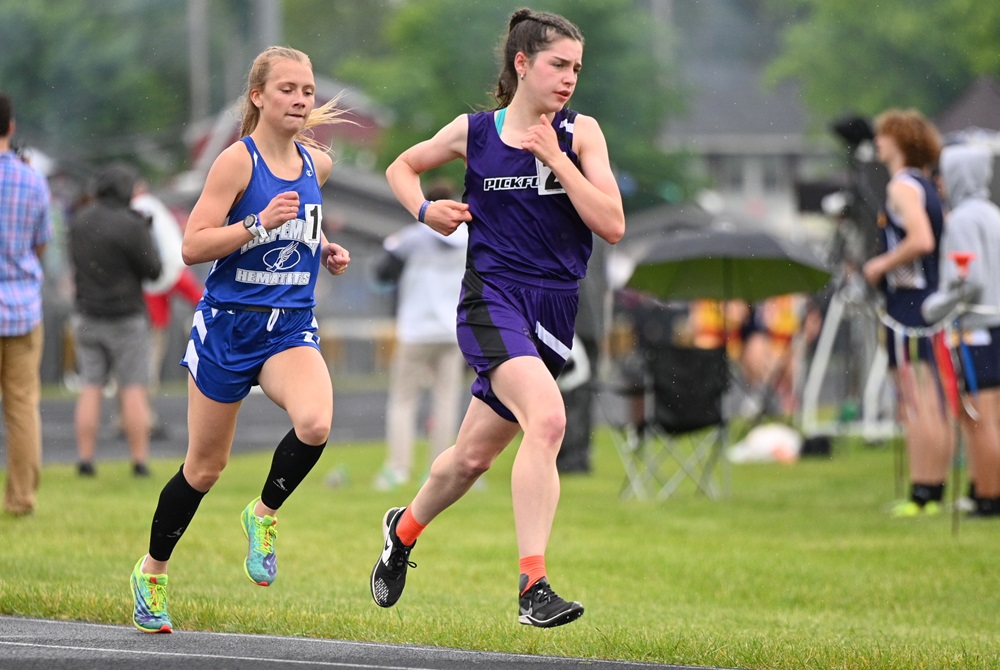
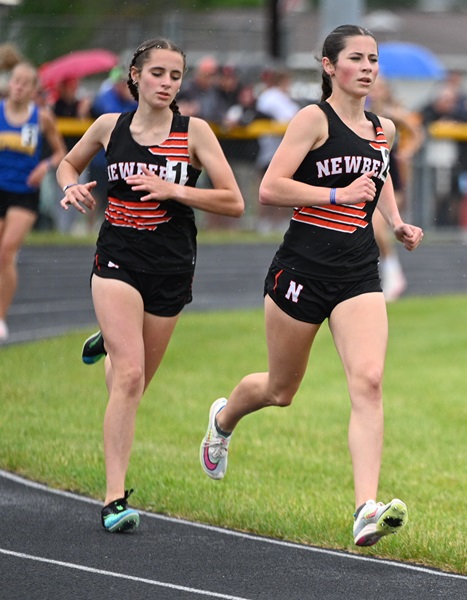
PHOTOS Pickford's Talya Schreiber leads Ishpeming's Lola Korpi on the way to winning the 1,600 during last season’s Upper Peninsula Division 2 Finals. (Middle) Newberry's Samantha Taylor leads sister Abby Taylor during last season’s 1,600 championship race in Division 3. (Photos by Cara Kamps.)