

Add, Subtract, Divide, Multiply: MHSAA Not Alone
July 25, 2017
By Rob Kaminski
MHSAA benchmarks editor
This is the third part in a series on MHSAA tournament classification, past and present, that will be published over the next two weeks. This series originally ran in this spring's edition of MHSAA benchmarks.
As the MHSAA faces its most recent classification task with 8-Player Football, and opinions continue to swirl about as to the method, timeframe, location and other procedures, a look around the country provides plenty of company among state association brethren factoring variables into their own equations.
In the Pacific Northwest, the Oregon School Activities Association Football Playoffs are under public scrutiny as leadership ponders a five or six classification format beginning with the 2018-19 school year.
The OSAA has crowned six champions on the gridiron since 2006-07. Many of the state’s smaller schools would like to keep it that way, while larger schools lean toward a five-classification system, citing larger leagues, ease of travel and credibility to state championships as the advantages.
Still others would prefer more than six classes, pointing to safety issues and the opportunity to increase participation numbers as positives.
Moving southeast of Oregon, the Nevada Interscholastic Activities Association recently voted to hold serve on a classification proposal that was volleyed to the membership.
However, changes still could be forthcoming by as early as the 2018-19 season which would add a fifth classification in more populated southern Nevada while allowing northern schools to participate in four classifications. Such divisions could mean no state championship for the fifth class in southern Nevada.
Because of that, the NIAA wants equal numbers of schools in each classification on both ends of the state. Complicating the issue is the fact that the 24 largest schools in the state, by enrollment, are all in Clark County in Southern Nevada.
Across Nevada’s border into Arizona, charter schools are asking the Arizona Interscholastic Association to reconsider classification that was voted upon and approved in September 2015. That agreement called for the largest 33 percent of charter schools by enrollment to be placed in the state’s largest school classification, 3A, the middle 33 percent into 2A, and the smallest 33 percent into 1A.
Less than two years later the charter schools have had a change of heart and have asked to be considered the same as other Arizona public schools and be placed appropriately by enrollment beginning with the 2018-19 school year.
The situation in Arizona further illustrates how the public/private debate that all state associations have faced throughout existence now has the added dynamic of rapidly growing charter schools in today’s educational system, along with virtual school enrollment.
In the nation’s heartland, Nebraska has retooled its football classifications by using enrollment of boys students only in its schools rather than total enrollment. The Nebraska School Activities Association football-playing schools will kick off the 2018 season using this alignment.
Nebraska has three classes of 11-player football, with the smallest class divided in two, Class C-1 and C-2. The state also will have 8-player football for boys enrollments under 47, and the NSAA will sponsor a new 6-player tournament in 2018 for schools with 27 or fewer boys.
“This is a good proposal because some schools have a sizable imbalance between the number of boys and girls, and there’s a large gap (in enrollment) between the largest and smallest schools in Classes A and B,” NSAA executive director Jim Tenopir said. “I think this addresses both of those concerns.”
Swimmers in Georgia, meanwhile, will feel like they are moving with the current, rather than upstream in 2017-18, as the Georgia High School Association recently doubled the number of team championship events from two to four.
Swim enthusiasts can also count on longer days at the finals, as the top 30 finishers from the prelims will advance to the finals instead of 20, and all championship events will have three heats versus two.
Football Future Awaits, but Mayne Focused First on Finishing Track Finals Sweep
By
Pam Shebest
Special for MHSAA.com
April 22, 2025
LAWTON — One inch. One lousy inch.
 That was the difference between a championship and second place for Mason Mayne in the shot put at last year’s MHSAA Lower Peninsula Division 3 Track & Field Finals.
One year later, it is still fresh in the mind of the personable Lawton senior as he begins his quest for more hardware.
“That one hurt,” said Mayne, whose best attempt finished second to a 60-foot, 2-inch toss by Pewamo-Westphalia’s Gavin Nurenberg.
“That really burned. You start to wonder, did they measure it wrong? What if I just literally put a little more into it? It drove me to work harder toward it.”
That harder work paid off during the second event that day as Mayne defeated the then-senior Nurenberg 166-6 to 165-11 in the discus to claim Lawton’s first-ever track & field state championship in that event.
Besides taking home that Finals title last year, Mayne holds school records with an indoor-season shot of 62-6 and outdoor of 60-9, as well as a discus toss of 178 feet.
An all-state football player and outstanding student as well, Mayne had opportunities to continue his athletic careers in both sports before signing with Northwestern University. But he also made the decision to compete for his high school one more time this spring instead of graduating early to begin his college career – much to the delight of Lawton track & field coach Mike Meyer.
“He’s been nothing but a joy ever since his freshman year,” Meyer said. “He’s a good, hard worker, obviously a great athlete. All his talent is definitely a nice problem to have.
“He’s been a two-year captain for us, so a good leader, (he) does everything and more than what we ask. That’s why he has the success that he has.”
All-around talent
Mayne said coaching is one big crossover from football to track & field.
“Listening to someone tell you what to do and then do it, I think that’s a super big part of throwing,” he said. “If someone tells you how to do something better in your throw to make it technically better, and you can’t do it, then you can’t get better.
“Playing football for so long, I’ve had so many coaches tell me to do this just a little bit different. And being able to flip that and make that change and adjustment, that’s what makes me able to get better at throwing.”
Mayne said hurling the disc takes more finesse than the shot.
“Technical-wise, the shot put (12 pounds) is easier because I can base it more on how much muscle I can put into it,” he said. “Discus is lighter, (3.5 pounds) but you also have to use your technique a lot more.
“Also, you have to push your body to a point of really stretching it back, allowing it to create a lot of torque into the disc to be able to throw it far enough for it to be worth anything.”
As for those windy days competing in field events, “A lot of people think that the wind behind you helps you,” Mayne said. “That’s actually not true.
“It actually bats the disc down. In the discus, as a right-handed thrower, you want the wind to come across a little bit from your left to throw into. Think of it as an airplane wing, holding up the airplane, the air coming into it. With the shot, it doesn’t matter. It’s just throwing it.”
Lawton’s athletes who specialize in field events also compete in some running competition. Mayne has run the 200 this season and took a turn running the 100 last spring as well.
 “We usually have our throwers run the 200,” Meyer said. “We like athletes instead of just specializing in just one or two things for the (Southwest Athletic) Conference.
“We have all of our kids run two, three and sometimes four events. It can be a long day at a track meet if your events are done and you have nothing to do.”
Mayne is not only an accomplished athlete, but carries a 4.19 grade-point average.
“With the way my mom (Pat) raised me and my brother (Carter) both, she’s a teacher at Paw Paw in the elementary,” he said. “She raised us with the idea that academics are very important. That’s where I’m academically driven.
“She might get mad at me for saying this, but if I miss an assignment, I’m getting a picture on my phone with a circle around it of the assignment missing in my grade book. It’s very important to me.”
That emphasis motivates Mayne’s advice for freshmen who play sports.
“Stay on top of (academics),” he said. “For so many years my mom kept me on top of things. Now I’m able to stay on top of things better myself.
“Your freshman year is the make-or-break it. Having an older brother helped a lot because without him, he wouldn’t have told me that and I wouldn’t have stayed ahead of it.”
Tough decisions
Mayne’s outstanding performances in throwing events last year attracted several college scholarship offers for track in addition to several he’d received previously for football. Choosing a college was not an easy decision for the defensive lineman, who is a two-time Kalamazoo Gazette Dream Team selection in that sport.
“It’s funny because I was really, really considering track for a while,” said the 6-foot-3, 275-pound Mayne. “After my sophomore year when I had a very successful track season, I started to lean toward track.”
 But a trip to the Big House to watch University of Michigan play tilted the scale to football.
“I was watching and I realized I just couldn’t give it up,” he said. “I love both sports, but something about football, the team atmosphere, just sitting in the stadium gets me antsy, that atmosphere and that vibe. That’s really what flipped me into the football aspect. That electricity from the fans and the guys around you. I haven’t experienced any other sport like it.
“It was a very tough decision. I was sad that I couldn’t go multiple ways. Many fantastic coaches recruited me. It’s unfortunate that you have to tell coaches you can’t go to their program because you’re choosing a different program.”
Mayne said he had specific criteria in mind when choosing a college. “Academics is a priority here,” he said. “I also want to play football at a very high level, and then the last is a family aspect.
“Northwestern just checked all the boxes.”
Before the season, Meyer thought he might lose Mayne to early graduation since “he’s a very, very good student. We chatted and he said, ‘Coach, I definitely want to be throwing. I love throwing,’ and he’s a man of his word.
“Once he told me that, I was more excited for the season.”
At one point, Mayne did indeed consider leaving high school to enroll early at Northwestern, which would have meant missing his final spring throwing season.
However, “my mom wasn’t ready for me to leave, which I’m fine with,” he said. “I understand that. I’m her youngest child, I get it.
“Also, you get to start throwing indoors and it’s like, ‘I don’t want to give this up, either.’”
 Pam Shebest served as a sportswriter at the Kalamazoo Gazette from 1985-2009 after 11 years part-time with the Gazette while teaching French and English at White Pigeon High School. She can be reached at [email protected] with story ideas for Calhoun, Kalamazoo and Van Buren counties.
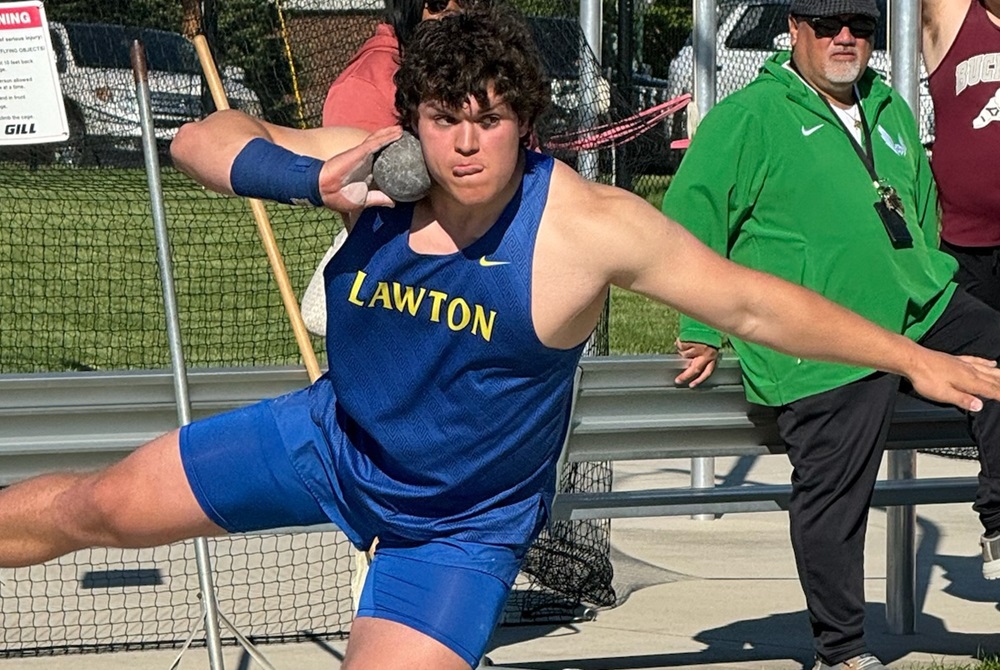
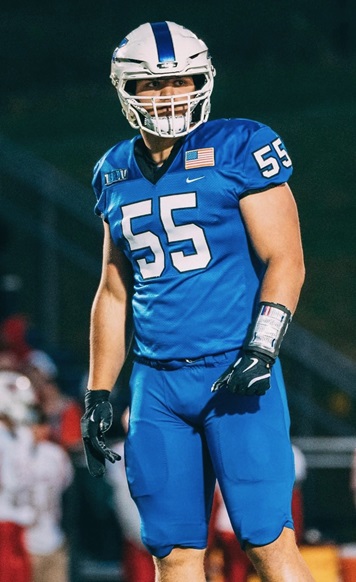
PHOTOS (Top) Lawton’s Mason Mayne begins to unwind while throwing the shot during a meet. (Middle) Lawton track & field coach Mike Meyer. (Below) Mayne stands tall on the football field. (Action photos courtesy of Mason Mayne; headshot by Pam Shebest.)