


All Saints Celebrates on Big Screen
July 31, 2014
By Geoff Kimmerly
Second Half editor
Forty years ago, Bay City All Saints brought its hometown the first of two straight MHSAA boys basketball championships – which continue to stand as the only ones won by a Bay City school.
 As part of the Class of 1974’s 40-year reunion this weekend, organizers will show the broadcast of that 71-59 victory over Detroit Servite in the Class C Final, on Friday at the downtown State Theater.
The team was coached by Russell “Lefty” Franz, who sits 14th in MHSAA boys basketball coaching history with 545 wins (545-215) at All Saints, Bay City St. Stanislaus and Pinconning achieved from 1953-1991. All Saints repeated as Class C champion under Franz in 1975 with a 79-69 win over Cassopolis.
The Bay City Times caught up today with three starters from that team who are expected to return for the showing of the game. Click to read more.
Rooting for Haske
Northern Michigan basketball fans and supporters from all over are cheering on Traverse City St. Francis boys basketball coach Keith Haske, who is battling throat cancer and seeking treatment in Houston, according to a report by the Petoskey News.
Haske has coached three boys teams to MHSAA Class C runner-up finishes – St. Francis in 2012 and Charlevoix in 2004 and 2001, and also coached at St. Johns prior to taking the Rayders job in 1998. He also coached the Charlevoix girls team to a Class C runner-up finish in 2004.
Click to read more about Haske and how to donate to his treatment.
Thanks, Gary Hice
The MHSAA welcomed 43 new athletic directors to East Lansing today for training as they take over their schools’ athletic departments.
An athletic director we’ll certainly miss is Petoskey’s Gary Hice.
Hice – an MHSAA Allen W. Bush Award winner in 2002 for his contributions to high school athletics – has retired after 30 years as his school’s athletic director.
Click to read more, again from the Petoskey News, about Hice’s service to his school and community.
PHOTO: The Bay City All Saints Class of 1974 reunion this weekend will include a showing of the boys basketball team’s Class C championship game win over Detroit Servite.
Century of School Sports: Why Does the MHSAA Have These Rules?
By
Geoff Kimmerly
MHSAA.com senior editor
September 18, 2024
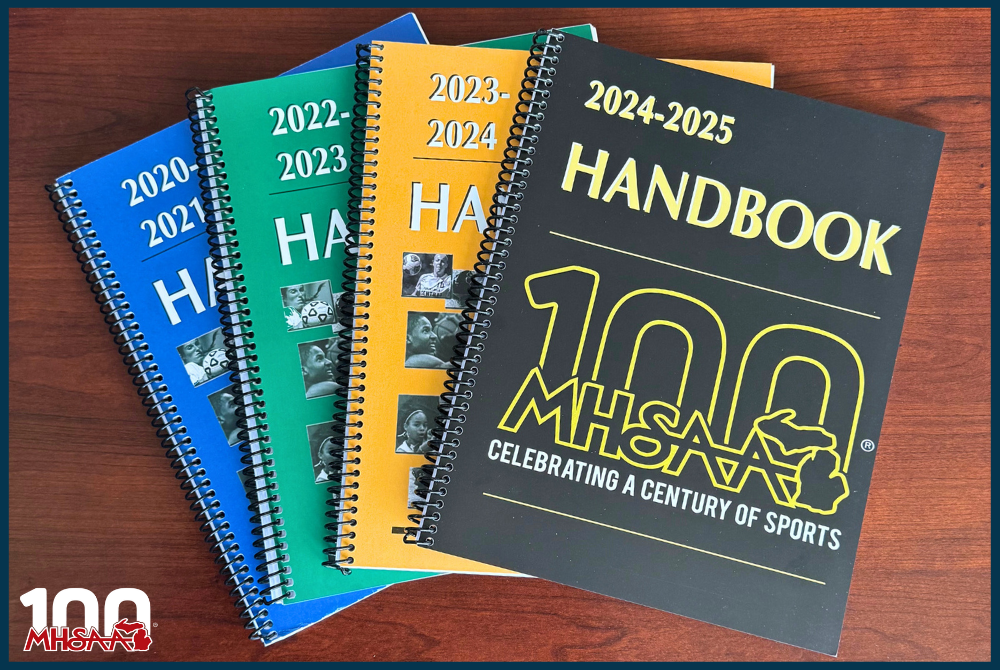
MHSAA administrators are two trips into their annual seven-stop fall tour that has become a tradition during nearly half of the Association’s “Century of School Sports” – and this year, a focus has been on answering a key question at the heart of educational athletics since long before the MHSAA was formed during the 1924-25 school year.
The MHSAA’s Update meeting series is in its 47th year and includes half-day conferences in seven locations – generally in the Kalamazoo, Metro Detroit, Grand Rapids, Saginaw, northern Lower Peninsula and mid-Michigan areas, and at Northern Michigan University in Marquette. The six Lower Peninsula sessions begin with an athletic director in-service during which MHSAA assistant directors explain recent rules changes and discuss challenges our administrators face on a daily basis (with Upper Peninsula athletic directors participating in a similar in-service during the spring).
Those in-services are followed by a session with executive director Mark Uyl, who speaks to athletic directors, superintendents, principals and school board members on a variety of topics including the MHSAA’s current objectives and ideas for the future, while also reinforcing the longstanding values that remain the bedrock of our daily work.
And that leads to the question he’s presenting across the state this fall:
Why does the MHSAA have these rules?
Frankly, the answer goes back to the beginning of school sports in Michigan – all the way back to 1895, when the first MHSAA predecessor organization was formed.
The first MHSAA Representative Council president Lewis L. Forsythe explained in his book “Athletics in Michigan High Schools – The First Hundred Years” how regulations always have been necessary:
“Eligibility rules are a necessity in interscholastic competition. It was common acknowledgement of this fact that led to the first State inter-school organization in 1895. The rules at first were few, simple and liberal. But with the passing of the years they came to be more numerous, more complex, and more restrictive, again through common acknowledgment of desirability if not of necessity.”
That necessity – and the reasoning behind it – has not changed.
Two main points explain why rules are absolutely imperative for educational athletics to thrive.
► 1. Participation – through providing as many opportunities as possible for students to play – has been the mission of school sports since their start. Rules contribute to the value of participation.
If there are requirements for children to participate in athletics – for example, an academic standard or rules that dissuade students from switching schools every year – then school sports programs mean more to all involved.
If we raise the bar, raise the standards of eligibility and conduct, we raise the value of our school sports programs. If we lower the bar, we lower the value of being part of school sports – because without rules, contest results are meaningless, and the value of participating is diminished.
► 2. We have rules where the stakes are higher, and agreement is lower – because where the stakes are highest, there is the greatest tendency for some people to try to gain an unfair advantage, and the greatest need for rules to curb possible dishonest activity.
This statement goes to the heart of the history, rationale and application of MHSAA rules. Obviously and simply put, school sports mean a lot to those who take part, and that significance is high enough to stoke disagreement – and we need rules to govern those disagreements. We have the most rules for high school sports, where championships are at stake and the possibility of disagreement is greatest.
***
Finally – and perhaps providing the strongest reinforcement of the two points above – is this:
Schools choose to make MHSAA rules their own.
Quite literally, school districts vote annually to be part of the MHSAA – and confirming this voluntary membership comes with the requirement to follow all MHSAA rules.
When schools challenge our rules, they literally are seeking to break the rules they already have committed to uphold.
These rules, and this commitment, are the strength of our organization across 752 member high schools and several hundred more middle schools and junior high schools. They have been constructed on a century of precedents and after considerations by representatives of those same member schools – representatives those schools have voted to elect every school year during the MHSAA’s history.
Previous "Century of School Sports" Spotlights
Sept. 10: Special Medals, Patches to Commemorate Special Year - Read
Sept. 4: Fall to Finish with 50th Football Championships - Read
Aug. 28: Let the Celebration Begin - Read