

All Saints Celebrates on Big Screen
July 31, 2014
By Geoff Kimmerly
Second Half editor
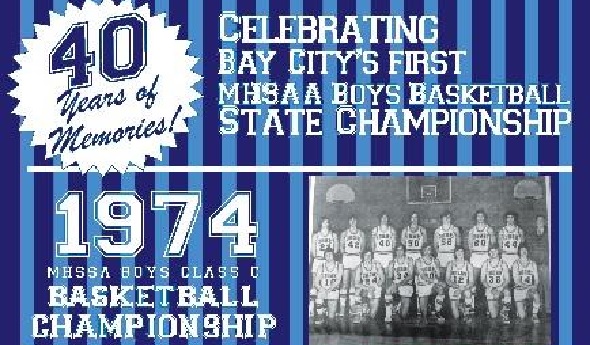
Forty years ago, Bay City All Saints brought its hometown the first of two straight MHSAA boys basketball championships – which continue to stand as the only ones won by a Bay City school.
 As part of the Class of 1974’s 40-year reunion this weekend, organizers will show the broadcast of that 71-59 victory over Detroit Servite in the Class C Final, on Friday at the downtown State Theater.
The team was coached by Russell “Lefty” Franz, who sits 14th in MHSAA boys basketball coaching history with 545 wins (545-215) at All Saints, Bay City St. Stanislaus and Pinconning achieved from 1953-1991. All Saints repeated as Class C champion under Franz in 1975 with a 79-69 win over Cassopolis.
The Bay City Times caught up today with three starters from that team who are expected to return for the showing of the game. Click to read more.
Rooting for Haske
Northern Michigan basketball fans and supporters from all over are cheering on Traverse City St. Francis boys basketball coach Keith Haske, who is battling throat cancer and seeking treatment in Houston, according to a report by the Petoskey News.
Haske has coached three boys teams to MHSAA Class C runner-up finishes – St. Francis in 2012 and Charlevoix in 2004 and 2001, and also coached at St. Johns prior to taking the Rayders job in 1998. He also coached the Charlevoix girls team to a Class C runner-up finish in 2004.
Click to read more about Haske and how to donate to his treatment.
Thanks, Gary Hice
The MHSAA welcomed 43 new athletic directors to East Lansing today for training as they take over their schools’ athletic departments.
An athletic director we’ll certainly miss is Petoskey’s Gary Hice.
Hice – an MHSAA Allen W. Bush Award winner in 2002 for his contributions to high school athletics – has retired after 30 years as his school’s athletic director.
Click to read more, again from the Petoskey News, about Hice’s service to his school and community.
PHOTO: The Bay City All Saints Class of 1974 reunion this weekend will include a showing of the boys basketball team’s Class C championship game win over Detroit Servite.
How To Be Proactive About Concussions In Student Athletes
December 5, 2023
Most people have seen the headlines about concussions as a common sports injury—and it's natural that parents of athletes may have concerns. A large misconception in sports is that previous concussions are to be blamed for ongoing headaches, blurred vision and memory loss, among other symptoms.
 “It’s really important to think about concussions in tandem with overall brain health,” says Jake Carpenter-Thompson, M.D., Ph.D., a board-certified neurologist at the Henry Ford Kutcher Clinic for Concussion and Sports Neurology. “Concussions can be concerning, but they shouldn’t be looked at in a vacuum. It is important to understand an athlete’s overall brain health to help manage recovery after any impact.”
One way to do that is to consult with your child’s doctor or a sports neurologist for an annual evaluation. A sports neurologist focuses on managing sports-related brain and nervous system injuries and conditions in athletes, such as concussions, post-concussion syndrome, peripheral nerve injuries, migraines, epilepsy and more.
“Having an annual evaluation of your athlete’s brain health when they are at their baseline – and uninjured – can help diagnose and treat issues when they arise,” says Dr. Carpenter-Thompson.
A qualified healthcare professional can use the baseline evaluation results as an important comparison tool if an athlete develops a suspected concussion.
Best Practices For Keeping Athletes Safe
Dr. Carpenter-Thompson shares these tips to ensure you keep front of mind your child’s brain health and safety, not just their athletic performance:
- Get a brain health baseline test. This should include a personal and family neurological history, with a focus on current issues. It is important to note any neurological conditions that may influence concussion recovery, such as ADHD, depression, anxiety or migraine headaches.
- Encourage your children to listen to their body. There are risks to playing any sport. Encourage your child to listen to and be honest about how they’re feeling. It’s the best way to prevent and treat injuries.
- In the event of an injury, look for the signs. Within 24 hours after an injury, an athlete should be evaluated if they are experiencing: headaches, fatigue, dizziness and nausea, changes in sleep habits, trouble with memory, confusion, irritability and anxiety, or light sensitivity.
- Know that brain injuries don’t just occur with a blow to the head. They can also occur from falls, car accidents or even whiplash. If your child is experiencing any symptoms, consult your physician.
- Remember that brain health is more than just concussions. If your athlete is complaining of chronic headaches, migraines, dizziness, memory or mood issues, there may be an underlying issue.
“There is no magic number of concussions a brain can sustain. Each person is different,” says Dr. Carpenter-Thompson. “The severity of the impact and recovery time can vary greatly for numerous reasons. By getting a brain health assessment before the injury, we can provide more targeted care to improve an athlete's overall clinical course.”
To find a sports medicine doctor or athletic trainer at Henry Ford, visit henryford.com/athletes.