

4 Thrusts: In Motion, On Track in 2013-14
December 20, 2013
By Jack Roberts
MHSAA Executive Director
During the fall of 2012 at Update meetings across Michigan, we described “Four Thrusts for Four Years” – four health and safety emphases that would help us keep student-athletes healthier and also get a seat for Michigan’s policies and procedures for school sports on the train of best practices – an express train that is moving faster than we've ever seen it toward more cautious practice and play policies and more educational requirements for coaches.
At this December’s meeting, the MHSAA Representative Council examined a first quarter report card – what’s been accomplished during the first year.
It has been a remarkably strong start, but it’s only a start.
The first thrust, improving management of heat and humidity, received a boost last March when the Representative Council adopted a “Model Policy for Managing Heat and Humidity.” It has been promoted in print, online and at face-to-face meetings; and the response of schools has been nothing short of outstanding.
This rapid acceptance by school administrators and coaches reflects their appreciation for a clear policy that identifies the precise conditions that call for adjustments in activities, and lists specific actions to be taken when temperature and humidity combine to reach un-safe levels. Gut and guesswork are gone.
The second thrust, raising expectations for coaches’ preparedness, is being advanced in three ways.
In May, the Representative Council adopted the requirement that by the 2014-15 school year, schools must attest that, prior to established deadlines, all assistant and subvarsity coaches at the high school level have completed annually the same MHSAA rules meeting required by all varsity head coaches or, in the alternative, one of the free online sports safety courses posted on or linked to MHSAA.com and designated to fulfill this requirement. This popular change is only the first component of this critically important second thrust.
The second component is this. The Representative Council voted in December to require by 2015-16 that MHSAA member high schools certify that all of their varsity head coaches of high school teams have a valid (current) CPR certification, with AED training as a recommended component.
As this requirement was discussed at constituent meetings, the question was frequently raised: “Why just head coaches?”
“Why indeed,” is our response. If a school has the will and resources, it most certainly should make CPR a requirement of all its coaches, as some school districts have required for many years.
CPR training is conveniently available near almost every MHSAA member school in Michigan. Still, the MHSAA will begin offering CPR certification (with AED training) on an optional basis as an extension of Level 1 of the Coaches Advancement Program (CAP) during 2014-15.
The third component of this thrust is scheduled to go before the Representative Council in March. The proposal is that all individuals hired for the first time as a varsity head coach of a high school team, to begin those coaching duties after July 31, 2016, must have completed the Coaches Advancement Program (CAP) Level 1 or 2.
The MHSAA will track compliance and prohibit varsity head coaches from attending their teams’ MHSAA tournament contests if they fail to complete this requirement, beginning in the 2016-17 school year.
In cases of very late hiring, schools may substitute two online courses of the National Federation of State High School Associations – “Fundamentals of Coaching” and “First Aid, Health and Safety.” However, that coach must complete CAP Level 1 or 2 within six months of the hiring date.
These feel like big steps to some people in MHSAA member schools – “too expensive” or “another obstacle to finding qualified coaches,” some say; but these are baby steps.
This barely keeps pace with national trends. Michigan’s tradition of local control and its distaste for unfunded mandates has kept Michigan schools in neutral while schools in most other states have made multiple levels of coaching education, and even licensing or certification, standard operating procedure.
The three initiatives to upgrade coaches education in this critical area of health and safety over the next three years only nudges Michigan to a passing grade for what most parents and the public expect of our programs. We will still trail most other states, which continue to advance the grading curve.
And for a state association that is among the national leaders by almost every other measure, it is unacceptable to be below average in what is arguably the most important of all: promoting athlete health and safety by improving the preparation of coaches.
The third health and safety thrust is a focus on practice policies to improve acclimatization and to reduce head trauma; and the fourth thrust is a focus on game rules to reduce head trauma and to identify each sport’s most injurious situations and reduce their frequency.
Because of the critical attention to football on all levels, peewee to pros, our first focus has been to football with the appointment of a football task force which has effectively combined promotion of the sport’s safety record at the school level and its value to students, schools and communities with probing for ways to make the sport still safer.
The task force proposals for practice policies are receiving most attention and will receive Council action in March (and will be published on Second Half over the next few weeks). But the task force also has assisted MHSAA staff in developing promotional materials that are already in use, and the task force pointed MHSAA staff to playing rules that need emphasis or revision to keep school-based football as safe as possible.
During 2013-14, all MHSAA sport committees will be giving unprecedented time to the topics of the third and fourth thrusts and, when necessary, a task force will be appointed to supplement those sport committee efforts.
Frequently Asked Questions About CPR Certification
Q. Who is authorized to provide CPR certification?
A. The MHSAA does not dictate which organization must provide the CPR education and certification. However, the Michigan Department of Human Services lists the following organizations that are approved to provide CPR training:
- American CPR Training: www.americancpr.com
- American Heart Association: www.americanheart.org
- American Red Cross: www.redcross.org
- American Safety and Health Institute: www.hsi.com/ashi/about
- American Trauma Event Management: www.atem.us
- Cardio Pulmonary Resource Center: 517-543-9180
- Emergency Care and Safety Institute: www.ecsinstitute.org
- EMS Safety Services: www.emssafety.com
- Medic First Aid: www.medicfirstaid.com
- National Safety Council: www.nsc.org
- Pro CPR: www.procpr.org
Q.
A. $0 to $75.
Q. How long does certification take?
A. Two to five hours.
Q. How long does the certification last?
A. Generally, two years.
Q. Does the MHSAA specify the age level for the CPR training?
A. No. Generally, the course for adults alerts candidates of the necessary modifications for children and infants, and vice versa.
Jack Roberts, on Tom Rashid: One More Call
By
John E. (Jack) Roberts
MHSAA Executive Director, 1986-2018
December 9, 2021
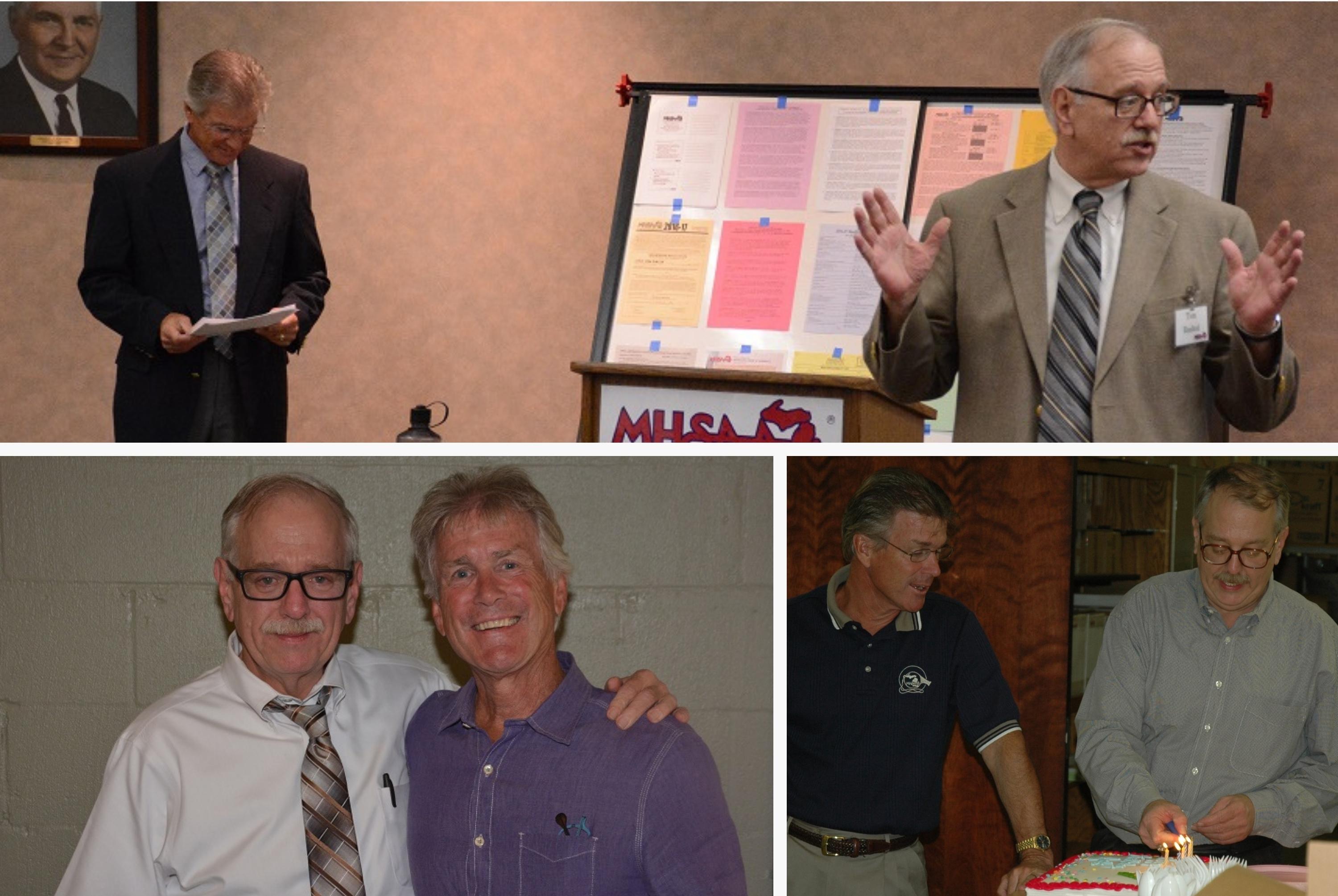
More than a decade ago, with his knowledge, I placed in my “Will & Instructions Upon Death” that Tom Rashid was to be the one and only person to speak at my funeral or memorial service. A short number of years later, Tom told me that I was to do the same for him. Obviously, we knew that we could not both keep our promise to the other. But I must say, if Tom does not actually show up for my funeral, that will be the first time he has not kept a promise to me.
I understand there will be a time in the future, when the weather warms and COVID wanes, when school administrators across Michigan can gather in force to show their respects to Tom, and when I will provide the eulogy that Tom asked of me. But Tom’s recent death reminds us how uncertain life can be and suggests that I say some things now, before it’s too late.
Tom was the unparalleled master of award presentations; and for more than a dozen years he wrote and delivered polished praise on award recipients at the annual conference of the Michigan Interscholastic Athletic Administrators Association. My tribute now isn’t an awards presentation or hall-of-fame induction, so I won’t recount the particulars of Tom’s career; but what you will see here is the importance of Tom’s life … the themes that distinguish him from any other person I’ve known.
Tom comes from a large, complicated and compassionate family of parents, aunts, uncles, brothers, sisters, nephews and nieces who mourn his loss at levels few of us can fathom. Over the years, and for many years, he was the caretaker for several family members; and he was generous with all of them. My hope for each family member now – and for many days, weeks and months to come – is that you are at peace. Tom’s pain is over; and his place in eternity is secure. Tom purchased a reserved seat.
Tom often joked that his only good habit was prayer. That’s not really true, of course. But for as long as I’ve known Tom, he talked to God many times a day; and I’ve always had the feeling that he talked to God the same way he talked to us: bluntly, forcefully, passionately, honestly, loudly, making very plain what he had on his mind.
Tom was a rigorous practitioner of his devout Catholic faith; and, the God whom Tom believed in is a big God … the president, general manager and head coach of a huge, diverse team whose game plan is a large, loving Gospel of limitless parameters and possibilities. I have no doubt that, both in times of need and not, members of the Roberts family – including both my parents, my sister, my wife and our children and grandchildren – have been specific in his petitions to God. I have no doubt that Tom’s daily prayers included many of you, and your loved ones as well.
In addition to Tom’s immediate family is the even larger and even more complicated family Tom developed through a long, illustrious career in Michigan school sports administration: a full 25 years with the Archdiocese of Detroit, until 2003, when I invited him to join me at the MHSAA office in East Lansing.
During my 32 years as the executive director of the MHSAA, I never saw another like Tom … never, anywhere. He talked to anybody, anytime of the day or night, about any question or problem they might have. Usually, Tom didn’t need to give me notes reviewing his telephone conversations. From my adjacent office, and given his forceful voice, I could hear Tom’s every word, very clearly.
Tom had the ability to anticipate what I might need and take care of it without my asking. It is no exaggeration to say that Tom would do anything for me. For example, Tom’s reluctance to travel and his fear of flying are well known to many of you. I believe the one and only time that Tom flew in an airplane was in 2003, when I ordered him to fly to Texas so that he might receive the highest award of the National High School Coaches Association. He had never flown before; he has never flown since.
Most remarkable was not merely Tom’s unselfish, unlimited, legendary availability to athletic administrators at any hour of the day or night, nor his experienced, learned grasp of the subject matter in answering their calls. What was more remarkable was his effort to help school administrators through their hard times. On many occasions these callers had made an error of commission or omission. They had made a mistake or an oversight; and Tom was supremely compassionate in guiding them through the local fallout from disappointed athletes and disgruntled adults. Secure in himself and our mission to be servant-leaders, Tom very often shared or completely shouldered unjustified blame so others would not. He gave cover to countless local school administrators every year of his MHSAA career so that those administrators might survive and even thrive in their careers.
Among my remarkably loyal MHSAA staff, Tom still stands out. And he earned the enduring loyalty of those with whom he worked. I think especially of his successor at the Archdiocese of Detroit, Vic Michaels: I doubt that more than two days ever passed between their almost daily telephone conversations … usually in the morning … for the full 15 years that my office was next to Tom’s at the MHSAA. I have never, ever been witness to anything like that; and I know there is no one in our good work who misses our dear colleague more than Vic.
But most remarkable of all was Tom’s ability to turn an adversary into an ally. He could have a knock-down, drag-out argument with a person one day, and by the next day, and for years to come, that person was Tom’s greatest advocate and admirer.
Well … maybe second-greatest advocate and admirer. Because no one in athletic administration – no one – loved Tom more than I. And no one in our work told him this more than I did.
I have written often about my admiration and affection for Tom. I have spoken both publicly and privately of it, on many occasions. But let me say it one more time, here, as we celebrate his life, and mourn our loss …
Tom and I provide proof that opposites attract, and we tag-teamed MHSAA’s leadership. One of us was very outgoing and vocal, the other more reserved and reticent. One of us was loud, the other more subdued. One of us was more comfortable on the phone, the other with the pen. One of us had no idea what to do with apostrophes, while the other would put them in the correct places. One of us was more spontaneous and extemporaneous, the other a more detailed planner and measurer of consequences. One of us hated to travel, the other sent messages to him from distant oceans and continents every year on Christmas or New Year’s Day to thank him for his life and service. But in our hearts, where one’s core values are harbored, we were almost identical twins.
I doubt that any two people who were side-by-side in the workplace for 15 years expressed their gratitude for each other more than we did, nor any two co-workers who said “I love you” to one another as often as we did. We each felt in deep debt to the other for myriad gifts and gestures that improved our careers and our lives.
Over the years, Tom and I developed the strategy of making one more telephone call before we made a final decision in a difficult matter … making one more call that sometimes made a difference in the controversial decision we had to make or in how that decision was accepted by those it affected. Tom loved to be the one to make those calls. And, sometimes, that “one more call” made all the difference.
Throughout my adult life, whenever I’ve attended a funeral or memorial service, I’ve found myself asking what it is I should learn and try to emulate from the life of the deceased. If you should find your mind and heart doing anything like that now, may I suggest these two answers.
First, Tom’s life and death remind us that we should not delay a single day in telling those with whom we work that we appreciate them and are grateful for what they do. And, if it is true and you are able, say you love them. Tom did this more often than anyone I’ve known.
And the second message is this. Tom’s life stands for faithfulness … faithfulness to his God, faithfulness to his family, faithfulness to his colleagues and friends, and faithfulness to his work and the mission of not just amateur athletics, but particularly school-operated, educational athletics. His was a steadfast faithfulness, never-a-day-off faithfulness, you-come-first faithfulness.
So Tom, my dear friend, once again I say, “I love you.”
And, “Rest in peace, Tom. God knows, you rarely rested in life.”
I would give anything for just one more call.