

Answers from the Athletes
By
Rob Kaminski
MHSAA benchmarks editor
May 22, 2014
By Rob Kaminski
MHSAA benchmarks editor
MHSAA Student Advisory Council members were asked their opinions on several of the current issues facing the MHSAA Junior High/Middle School Committee and the MHSAA JH/MS Task Force. Students also shared experiences from their junior high/middle school days and from participation with non-school teams. Following is a sampling of responses:
Length of Contests and Seasons
Based on your junior high/middle school experiences, would you favor an increase in the number of contests/events that a junior high/middle school is allowed to play? Would you favor longer game times?
Kiersten Mead, Saginaw Swan Valley: “I personally don't believe that longer seasons are necessary. In middle school, student athletes are just starting to learn how to balance sports and school, so I think that the season time is already pretty reasonable.
“I do, however, believe that longer games would be really beneficial to all ages. It would allow more students to play and participate.”
Jonathan Perry, McBain Northern Michigan Christian: “When I was playing, I wish my season would have been longer, but it is at a reasonable length. It would be harder on parents having a middle school player and a high school player, but it would get you more ready for a high school-length schedule.
“The games are at a reasonable length also. The one benefit of having more games and longer games is that more kids get to play who otherwise might not if they had a shorter game or season.”
Connor Thomas, Marlette: “As a player, I would be totally in favor. If I were an adult, I would say no because of the traveling. As for the lengths of games, again, I’d favor it as a player. But with schools that have A and B teams for both grades, that could be a late night.”
Kristen Law, Bloomfield Hills Andover: “I really enjoyed playing in middle school, and I would have loved to be able to play more. Increasing the length of games might depend on the sport. For tennis, from what I remember, the matches were a shortened version of what we play in high school, and I thought they were appropriate given the level of the majority of the players that were competing.”
Zack Nine, Pinconning: “Based on my middle school sports experience, I would favor an increase in the number of contests and a longer game time. These changes would give athletes who do not get much playing time a chance to gain more experience. I also believe that more games and a longer game length would keep our youth in better shape and better prepare them for high school athletics through an easier transition.”
Mandy Paull, Cheboygan: “I think that middle school sports should be allowed to play more games, but I do not think that the length of games should be increased.”
Coby Ryan Manistique: “I would favor an increase in the number of contests. The seasons are quite short and go by too quickly, in my opinion.
“I would also favor longer game times. With this, more kids will get the opportunity to play, and it will also make the travel and the time invested more worthwhile.”
6th-Grade Participation
Is it time to also include 6th-graders at junior high/middle schools under MHSAA guidelines? Consider enrollments, sports and participation with 7th- and 8th-graders.
Eliza Beird, Holland Black River: “I would favor the addition of 6th-graders in all sports. This would allow for the possibility of two teams in some sports and it gets the kids playing with people they might be playing with for the rest of their high school careers.
“It is definitely easier to put 6th-graders with 7th- and 8th-graders at a smaller school because one grade usually won’t out-number another grade. In a big school, a bunch of 8th-graders will try out for the team because more go to a school. In larger schools, 6th-graders would have a chance to make only a 6th-grade team.
Hayden Smith, Hamilton: “I think it’s time for 6th-graders to be included, but not in all sports; just the non-contact ones. The various sizes of schools would make it easier for some to compete and harder for others, but it shouldn’t matter overall. All schools’ 6th-graders should be able to play. I think that would be a great experience for them.”
Mandy Paull, Cheboygan: “I think that 6th-grade students should be able to play middle school sports. Sports are a good way to initiate incoming elementary students to the middle school as well as provide a fun, constructive activity that they can participate in with their friends, and a way to make new ones as well.
“The 6th-grade athletes should only be mixed with the 7th and 8th grade in cross country and track, and have their own teams for sports like volleyball and basketball, just as the 7th- and 8th- graders do. Only non-contact sports should mix all grades.”
Connor Thomas, Marlette: “Coming from a smaller community, I think the MHSAA should include 6th-graders in only the schools that need them, such as small Class D schools. They should be allowed to play with 7th- and 8th-graders as long as the schools need them, and aren't bringing them up to have a ‘dream team.’ Enrollment has to be a factor; the schools should be struggling for numbers in order to have a 6th-grader on a team.”
Zack Nine, Pinconning: “I believe that 6th- graders should not be held accountable to MHSAA regulations. My opinion largely stems from the fact that not every school includes 6th grade as part of its middle school. I know mine does not. It would be difficult to regulate the participation of 6th-graders in some schools (because they're considered middle schoolers) while other schools cannot let their 6th-grade elementary students compete.”
Jonathan Perry, McBain Northern Michigan Christian: “I think all sports should be included if 6th-graders were allowed to play. I think it’s more helpful to small schools, but wouldn’t limit it based on enrollment. I go to a small school; last year my school did not have enough kids for a 7th-grade team.”
Kiersten Mead, Saginaw Swan Valley: “I understand the monetary considerations schools may have with 6th-grade teams through the MHSAA, but I do believe that the MHSAA should start setting guidelines for the schools which see it as feasible. Middle schools don't have to go through the MHSAA, but I believe that by including 6th-graders, it may generate a positive reaction from member schools.
“I feel like as long as the coaches don't see a major physical disadvantage to it, then it would be okay for 6th-graders to participate with the 7th and 8th grade in all sports. Non-contact sports would most definitely be alright, because in high school, you compete against all ages anyways.
Coby Ryan Manistique: “I believe that it is time for 6th-graders to get the chance to participate in athletics, regardless of school size. By choice, a child should always be given the opportunity to be active, stay out of trouble, learn about teamwork and leadership, and build a foundation for fundamentals that will be used for the rest of their athletic careers. Many schools do not have locally run programs, and the MHSAA running it would give thousands more kids a chance to play.”
Kristen Law, Bloomfield Hills Andover: “When I was in 6th grade, I was competing against 7th- and 8th-graders (on community teams), and I probably would have been upset if I couldn't compete against them. Sixth-grade participation should definitely be allowed in non-contact sports, but I don't know too much about contact sports and the risk of injury to 6th-graders if it were to be allowed.
“I don't think the size of the school should determine whether or not 6th-graders can compete against 7th- and 8th-graders.”
Community and Club Sports
If you played community sports during your JH/MS years, how did the experience compare with school sports? If you could have played MHSAA-based sports in 6th grade, would you have done so?
Emileigh Ferguson, Bear Lake: “I played little league softball prior to middle school, until 5th grade. I prefer MHSAA sports over other kinds because they are more serious and organized. My school has basketball for 5th and 6th grade so we don’t play with middle school.”
Eliza Beird, Holland Black River: “I played soccer and basketball from Kindergarten through 6th grade and still play club sports. My outside-of-school sports tended to be a bit better.
“If there were MHSAA sports in 6th grade, I would have definitely played basketball. I already played with a bunch of girls from school so playing for my school would not have been much different. Plus it’s fun to play for my school. I probably would not have played soccer because the club team I was on at the time was quite a bit better than the school team.”
Hayden Smith, Hamilton: “In my experience (community sports) was somewhat similar, but still different. School sports weren't coached by parents anymore; the best players got to start. Also, it was different in that a lot of kids stopped playing; only the ones who really liked it kept playing. However, it was similar because there were always people (parents and kids) complaining about playing time. It was similar in that there was always a strong community at your back.
“If I could have played school sports earlier, I would have done so because of the aspect of representing my community and school. I think I still would have done the travel baseball stuff, but that is always in the summer.”
Mandy Paull, Cheboygan: “I played girls little league softball from 3rd to 5th grade, and house hockey from 1st grade to 9th. In middle school the sports were more serious and I enjoyed them much more. As a team we would dress up for our games, and we got to travel on a bus to away games. There was a much stronger bond and all the players were more serious. The teams were also better in middle school due to tryouts.
“I definitely would have played middle school sports in 6th grade as opposed to community teams.”
Jonathan Perry, McBain Northern Michigan Christian: “I did not notice a huge difference between community sports and school sports. The big difference in community sports is that you get a wide range of kids, not just the kids in your school. I like playing the school sports better because I knew that the kids I was playing with were who I would play high school sports with.
“I would have played school sports in 6th-grade or earlier if the option was there. A lot of community sports I played on (were) all about winning. The school team sports provide learning sessions for both sports and life. It's an extension of the classroom. I saw that more with school sports than community sports.”
Kiersten Mead, Saginaw Swan Valley: “I did not play anything prior to middle school, but in 6th grade I was a part of an AAU volleyball team since my school did not offer a 6th-grade team. I also bowled in leagues at a few different bowling alleys.
“I definitely would have played with my school versus community. We really didn't have a solid AAU program in our area so the school team was much more organized. I found that the volleyball teams through my school were much more beneficial to me. We practiced on a regular basis, and it was nice to play with girls that I was already friends with. We were able to grow more as a team and gain a greater sense of unity. I believe that my school team made me a better athlete as well.”
Kristen Law, Bloomfield Hills Andover: “I enjoyed being able to play sports with my friends in middle school, but I also liked the competitiveness of the community- based sports I participated in. The middle school sports atmosphere didn't feel as competitive.
“When I was in 6th grade, I played tennis on the middle school team, but it was not affiliated with the MHSAA.”
Mackey Leaving Court with 500+ College Hoops Wins, Many More Lessons Shared
By
Jason Juno
Special for MHSAA.com
July 24, 2026
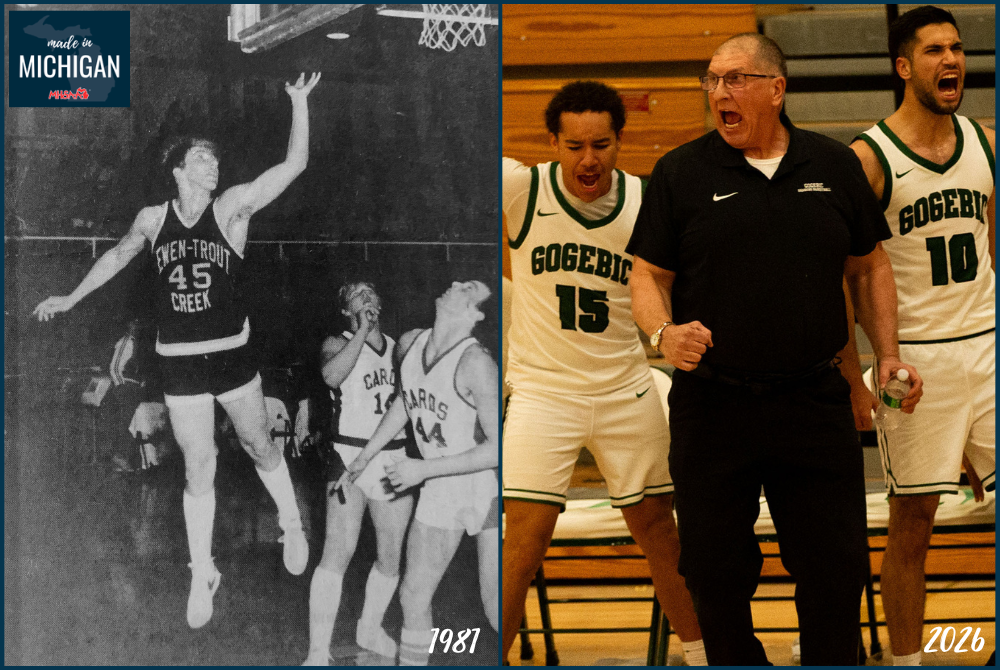
IRONWOOD — Dennis Mackey made a big impact on generations of athletes at Gogebic Community College, so much so that college officials named the basketball court after him while he was still coaching.
 Mackey retired from coaching in April after 38 years at GCC, 19 with the women and 19 with the men. Even after all of those years, and more than 500 wins, the memories and lessons from his playing days at Ewen-Trout Creek still resonate with him.
He was always doing something athletically, football in the fall, baseball in the summer, track & field in the spring. His home being basketball-centered E-TC – the tiny Upper Peninsula school with nine combined boys and girls MHSAA Finals appearances – hoops was always mixed in.
“Basketball was the winter sport, but no matter the season we always found time to get to the gym and shoot hoops,” Mackey said. “Whether it was during the lunch hour, after school, on weekends, or after practices, we seemed to gravitate to the gym for some action.”
And if they didn’t go to the gym, there were outdoor courts in Ewen, Bruce Crossing and Trout Creek to get shots up.
“Basketball was the main sport in those communities and probably is still to this day,” Mackey said. “Looking back now, I must say the experiences growing up playing basketball at E-TC was awesome.”
Mackey, a 1981 graduate, played on the varsity team all four years of high school. The Panthers lost in the Regional Final at Northern Michigan University’s Hedgcock Fieldhouse both his junior and senior seasons.
“We had deep and talented teams but fell short of our goal of reaching the state finals both years,” Mackey said.
He won the Ed Helakoski Award as the most valuable senior in the Porcupine Mountain Conference. Even though he was a 1,000-point scorer, he took pride in other aspects of the game.
“I played the forward position, oftentimes guarding the opposing team’s best inside player,” Mackey said. “I prided myself on being a hardworking and unselfish player. I really enjoyed passing the ball to teammates for their scoring opportunities.”
Mackey went on to play basketball at Gogebic. After graduating from Northern Michigan University, he eventually got a call about an opening for a part-time business instructor and women’s basketball coach at Ironwood’s college.
He was excited to take over the team heading into the 1988-89 season. Six years into his tenure, he led a balanced Samsons team to the program’s first national tournament. They won another Region 13 title three years later.
Another E-TC graduate, Deke Routheaux, retired as men’s coach after the 2005-06 season. Mackey didn’t make the switch, instead opting to coach his daughter Caitlin in her first season at Gogebic. The job opened up again a year later, and he debuted as men’s coach in for 2007-08. They men won Region 13 championships in both 2011 and 2013, just missing trips to the national tournament both years.
He said the goal was to win more games and Region titles, but his teams usually left it all on the court.
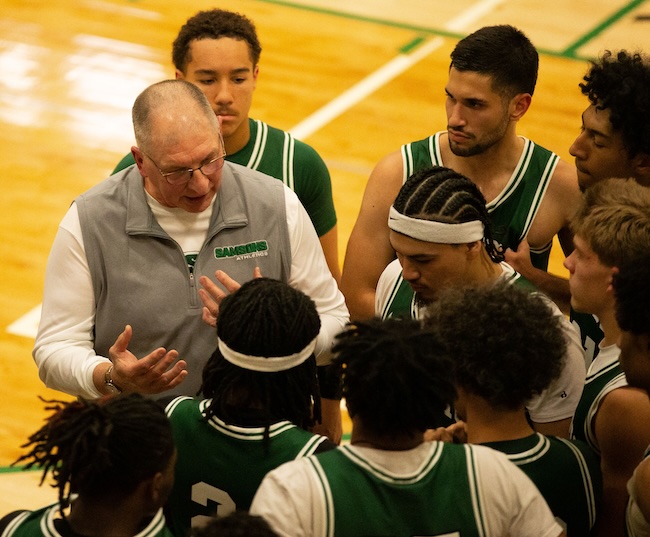 Mackey finished his tenure with the women with a record of 256-227 and a 277-263 record with the men. “It’s often said that teams tend to take on the identity of their coach,” Mackey said. “As I walk out the door, I’ll leave knowing my teams, like their coach, were known as fierce competitors.”
His signature saying is printed on the Lindquist Center court, “Coach Mackey Court,” — ”Once a Samson, Always a Samson.”
He wants the entire college to succeed, beyond just the basketball program. He took a lot of pride in giving local players a chance to play college basketball. He still supports them after they graduate.
Players came back yearly to play in their main fundraiser, the Spring Thaw Classic.
When GCC named the court after him, many of those he left an impact on filled the Lindquist Center gym on a random Tuesday game night in November.
Many appreciate the impact he had on their lives. He knows the importance of sports, whether it’s at the college level that he’s been at the last nearly 40 years, or at E-TC, where he got his start.
“Participation allows many to express themselves in ways that open doors to other life opportunities,” Mackey said. “High school athletics provide opportunities for youth to develop individual skills while learning life lessons at the same time. No matter the sport, learning to be a great teammate is challenging for most young people. Dedicating one’s time and efforts to improving oneself while also helping the team be better can be difficult. We all strive to be the best and win games, but are we willing to do the work to achieve the desired results? Everyone enjoys receiving the accolades, but many are unwilling to sacrifice the time and energy required to improve and develop individual skills, which enables this to happen.”
All three of wife Andrea (who was a big help to the GCC program as well) and his kids, Caitlin, Jesse and Adam, played high school basketball and then for Gogebic as well. Dennis said Adam was a similar player to him but a better scorer — he’s Ironwood’s all-time leader — who also wanted to get his teammates involved. They all teach at Ironwood now; Adam is the boys varsity basketball coach and Jesse the varsity girls coach.
The Mackeys continue to pass on many life lessons via high school sports.
“The thrill of victory and the agony of defeat not only applies to the games we play but to life in general,” Dennis said. “Success in high school is often measured with wins versus losses, but in the game of life the valuable lessons learned from the sports we play provide a platform for future growth. There are many folks employed in a variety of vocations who often credit their youthful days of playing sports as the impetus for their success later in life. The bonds created with teammates and opponents often last a lifetime. These bonds are immeasurable and help many advance in all facets of life.”
2026 Made In Michigan
July 16: Country Day Two-Time Champ Moore Building Perennial Winner at Harvard - Report
July 9: Multi-Sport Career at TC West Helps Gillis Thrive as Pro in Game She Once Left Behind - Report
July 2: Inspired by Home, Eager to Give Back, Spencer Hosts Hoop City Alumni Games - Report
PHOTOS (Top) At left, Dennis Mackey (45) gets up a shot for Ewen-Trout Creek against Wakefield as a senior during the 1980-81 season. At right, Mackey coaches up his Gogebic Community College men’s basketball team this past summer. (Middle) Mackey huddles with his players during a break. (GCC photos by Jason Juno. Ewen-Trout Creek photo courtesy of the Ironwood Daily Globe.)