


Fenton Principal Bakker Selected as MHSAA's Charles E. Forsythe Award Honoree
By
Geoff Kimmerly
MHSAA.com senior editor
March 11, 2026
An educator who has served in several roles – as a teacher, coach, athletic director, assistant principal and for the last four years principal at Fenton High School – Mike Bakker is able to draw from a wealth of experiences as he serves students not only in his school district but as a statewide decision-maker and leader.
In recognition of his several contributions over the last two decades, especially to educational athletics, Bakker has been selected to receive this year’s MHSAA Charles E. Forsythe Lifetime Achievement Award.
The annual award is in its 49th year and named after past MHSAA Executive Director Charles E. Forsythe, the Association's first full-time and longest-serving chief executive. Forsythe Award recipients are selected each year by the MHSAA Representative Council, based on an individual's outstanding contributions to the interscholastic athletics community at the local, regional and statewide levels. Bakker will be honored this weekend during the Michigan Interscholastic Athletic Administrators Association (MIAAA) annual conference in Traverse City.
Bakker began his professional career at Mason High School. He was hired initially as the boys tennis coach while still a junior in college, and then served twice as a long-term substitute teacher before being hired full time and teaching mathematics and statistics, serving as a club advisor and coaching girls and boys swimming & diving in addition to tennis. He moved to Fenton Area Public Schools as the middle and high school athletic director and assistant principal in 2004. Bakker became interim principal midway through the 2021-22 school year, with that promotion made permanent that March.
“I do think that because I’ve held all of those different roles, I still have all of those connections, and there are other athletic directors who have gone on to become principals and those are the people I reach out to – I know they have a passion for making sure everybody, because of the positions they’ve held, has success in different areas,” Bakker said. “Working in athletics so long, and helping those students find success and helping coaches find success, helped me help students who are not in athletics have success. It’s provided a pretty awesome opportunity and perspective to see how the system works and how to help students be successful and help teachers and coaches be successful.”
Bakker’s contributions have long stretched beyond his classroom and office duties as well. Locally, he’s served on the Fenton Education Foundation board of directors for two decades. As athletic director, he hosted more than 125 MHSAA Tournaments over 17 years and served on a dozen MHSAA committees.
Bakker also has been a member of both the MIAAA – the state’s professional organization for athletic administrators – and National Interscholastic Athletic Administrators Association (NIAAA) for 22 years and has served in several leadership roles with the MIAAA including as president during the 2015-16 school year and as assistant executive director since 2018.
Bakker also is serving his second school year as a member of the MHSAA Representative Council.
 “As someone who has dedicated himself to education and served in various roles over the last 25 years, Mike Bakker has gained a broad perspective that has helped shape his leadership – and he continues to give more of himself with his contributions at the MHSAA and MIAAA leadership levels,” MHSAA Executive Director Mark Uyl said. “As a member of the Representative Council, he provides input on how decisions could affect all groups involved, and our schools are fortunate to have his valuable voice and viewpoint.”
Bakker also has been a member of both the Michigan Association of Secondary School Principals (MASSP) and National Association of Secondary School Principals (NASSP) for 15 years. As a coach he was a member of the Michigan Interscholastic Swim Coaches Association (MISCA) and served as a Zone representative from 2001-04.
Bakker was selected as the MIAAA’s Region 9 Athletic Director of the Year in 2010, and as its statewide Tom Rashid Athletic Director of the Year for 2020-21. He also was named Athletic Director of the Year in 2021 by the Michigan High School Coaches Association.
“For me, being an educator, and part of why I went into education and administration, was to help in the education process of the whole student. That doesn’t include just the classroom walls from the first bell to the last bell,” Bakker said. “To really impact kids, you have to build relationships, meet them where they’re at, and you have to help them find success not just in the classroom but out(side it), to help them become better than they thought they could be. … Even when I was athletic director, I still going and seeing kids perform in other things, and I was in charge of clubs as the athletic director, and all of those things allowed me to help meet students where they are and where their needs are as they are figuring out who they want to be when they leave.”
A 1994 graduate of Rochester High School – where he swam and played soccer, tennis and basketball – Bakker earned a bachelor’s degree in mathematics from Michigan State University in 1998 and his secondary teaching certificate from MSU in 2000. He earned a master’s degree in educational leadership from MSU in 2004 and a master’s in sports administration from Eastern Michigan University in 2011. He also received his certified master athletic administrator designation from the NIAAA in 2011.
Bakker and his wife Denise have been married for 23 years and have three children – sons Jasper and Tristan and daughter Paige.
Past recipients of the Charles E. Forsythe Award
1978 - Brick Fowler, Port Huron; Paul Smarks, Warren
1979 - Earl Messner, Reed City; Howard Beatty, Saginaw
1980 - Max Carey, Freesoil
1981 - Steven Sluka, Grand Haven; Samuel Madden, Detroit
1982 - Ernest Buckholz, Mt. Clemens; T. Arthur Treloar, Petoskey
1983 - Leroy Dues, Detroit; Richard Maher, Sturgis
1984 - William Hart, Marquette; Donald Stamats, Caro
1985 - John Cotton, Farmington; Robert James, Warren
1986 - William Robinson, Detroit; Irving Soderland, Norway
1987 - Jack Streidl, Plainwell; Wayne Hellenga, Decatur
1988 - Jack Johnson, Dearborn; Alan Williams, North Adams
1989 - Walter Bazylewicz, Berkley; Dennis Kiley, Jackson
1990 - Webster Morrison, Pickford; Herbert Quade, Benton Harbor
1991 - Clifford Buckmaster, Petoskey; Donald Domke, Northville
1992 - William Maskill, Kalamazoo; Thomas G. McShannock, Muskegon
1993 - Roy A. Allen Jr., Detroit; John Duncan, Cedarville
1994 - Kermit Ambrose, Royal Oak
1995 - Bob Perry, Lowell
1996 - Charles H. Jones, Royal Oak
1997 - Michael A. Foster, Richland; Robert G. Grimes, Battle Creek
1998 - Lofton C. Greene, River Rouge; Joseph J. Todey, Essexville
1999 - Bernie Larson, Battle Creek
2000 - Blake Hagman, Kalamazoo; Jerry Cvengros, Escanaba
2001 - Norm Johnson, Bangor; George Lovich, Canton
2002 - John Fundukian, Novi
2003 - Ken Semelsberger, Port Huron
2004 - Marco Marcet, Frankenmuth
2005 - Jim Feldkamp, Troy
2006 - Dan McShannock, Midland; Dail Prucka, Monroe
2007 - Keith Eldred, Williamston; Tom Hickman, Spring Lake
2008 - Jamie Gent, Haslett; William Newkirk, Sanford Meridian
2009 - Paul Ellinger, Cheboygan
2010 - Rudy Godefroidt, Hemlock; Mike Boyd, Waterford
2011 - Eric C. Federico, Trenton
2012 - Bill Mick, Midland
2013 - Jim Gilmore, Tecumseh; Dave Hutton, Grandville
2014 - Dan Flynn, Escanaba
2015 - Hugh Matson, Saginaw
2016 - Gary Hice, Petoskey; Gina Mazzolini, Lansing
2017 - Chuck Nurek, Rochester Hills
2018 - Gary Ellis, Allegan
2019 - Jim Derocher, Negaunee; Fredrick J. Smith, Stevensville
2020 - Michael Garvey, Lawton
2021 – Leroy Hackley Jr., Byron Center; Patti Tibaldi, Traverse City
2022 – Bruce Horsch, Houghton
2023 – Karen Leinaar, Frankfort
2024 – Sean Jacques, Calumet
2025 – Kris Isom, Adrian
PHOTOS (Top) Fenton's Mike Bakker monitors activities from the field during a Tigers football game. (Middle) Bakker, left, takes a photo with daughter Paige and wife Denise as Paige holds the Flint Metro League volleyball championship trophy. (Photos provided by Mike Bakker.)
Regulation with Roots
December 3, 2015
By Jack Roberts
MHSAA Executive Director
The following is an excerpt from “History, Rationale and Application of the Essential Regulations of High School Athletics in Michigan.”
Throughout the years, schools of this and every other state have identified problems relating to school transfers.
There is recruitment of athletes and undue influence. There is school shopping by families for athletic reasons. There is jumping by students from one school to another for athletic reasons because they couldn't get along with a coach or saw a greater opportunity to play at another school or to win a championship there. There is the bumping of students off a team or out of a starting lineup by incoming transfers, which often outrages local residents. There is the concentration of talent on one team by athletic-motivated transfers. There is friction between schools as one becomes the traditional choice for students who specialize in a particular sport. There is imbalance in competition as a result. And there is always the concern that the athletic-motivated transfer simply puts athletics above academics, which is inappropriate in educational athletics.
All states have developed rules to address the problems related to school transfers. In some states it is called a transfer rule and in other states a residency rule, because linking school attendance to residence is one of the most effective tools for controlling eligibility of transfers. None of the state high school association rules is identical, but all have the intention of preventing recruiting, school shopping and jumping, student bumping, friction, imbalance and overemphasis, as well as the intention of promoting fairness in athletic competition and the perspective that students must go to school first for an education and only secondarily to participate in interscholastic athletics.
The transfer/residency rule is a legally and historically tested but still imperfect tool to control athletic-motivated transfers and other abuses. It is a net which catches some students it should not, and misses some students that should not be eligible. This is why all state high school associations have procedures to review individual cases and grant exceptions; and why all state high school associations have procedures to investigate allegations and to penalize violations where they are confirmed.
Over the years, state high school associations have considered four options to handle transfers. The first two options are the easiest courses: either (1) let schools decide themselves about transfers, as Michigan once did, but this leads to inconsistent applications and few states now subscribe to such an approach; or (2) make no exceptions at all, rendering all transfer students ineligible for a period of time, but this becomes patently unfair for some students and no state high school association subscribes to that extreme, although it would be easy to administer.
The third option – the ideal approach perhaps – would be to investigate the motivation of every transfer and allow quicker eligibility or subvarsity eligibility to those which are not motivated by athletics, but this is very time consuming if not impossible to administer. No state high school association has sufficient staff and money to consider every detail of every transfer.
This is why a fourth option has been most popular with most state high school associations. This is a middle ground which stipulates a basic rule, some exceptions (15 exceptions in Michigan), and procedures to consider and grant waivers (a primary role of the MHSAA Executive Committee).
It is certain that the MHSAA transfer rule is imperfect. However, whatever few imperfections exist are remedied through a process by which member school administrators may make application to the MHSAA Executive Committee to waive the rule if, in the committee's opinion, the rule fails to serve any purpose for which it is intended or in its application creates an undue hardship on the student. In a typical year, the Executive Committee will receive approximately 250 requests to waive the transfer regulation, approving approximately 60 percent of those requests.
The committee brings to its considerations the following rationale, most recently reviewed and reaffirmed on Aug. 5, 2015:
- The rule tends to insure equality of competition in that each school plays students who have been in that school and established their eligibility in that school.
- The rule tends to prevent students from “jumping” from one school to another.
- The rule prevents the “bumping” of students who have previously gained eligibility in a school system by persons coming from outside the school system.
- The rule tends to prevent interscholastic athletic recruiting.
- The rule tends to prevent or discourage dominance of one sport at one school with a successful program, i.e., the concentration of excellent baseball players at one school to the detriment of surrounding schools through transfers and to the detriment of the natural school population and ability mix.
- The rule tends to create and maintain stability in that age group, i.e., it promotes team stability and team work expectation fulfillment.
- The rule is designed to discourage parents from “school-shopping” for athletic purposes.
- The rule is consistent with educational philosophy of going to school for academics first and athletics second.
- It eliminates family financial status from becoming a factor on eligibility, thus making a uniform rule for all students across the state of Michigan (i.e., tuition and millage considerations).
- It tends to encourage competition between nonpublic and public schools, rather than discourage that competition.
- It tends to reduce friction or threat of students changing schools because of problems they may have created or because of their misconduct, etc.
Following the adoption of a more standardized statewide transfer rule in 1982, there were multiple legal challenges. However, in 1986, the Michigan Court of Appeals determined that a rational basis exists for the transfer regulation and that the rule, with its exceptions, is not overbroad and is neither arbitrary nor capricious, noting that neither a fundamental right nor suspect classification is involved. Berschback v. Grosse Pointe Schools 154 Mich App 102 (1986). That decision is also noteworthy for this statement which has halted or decided subsequent legal challenges: “This Court is not the proper forum for making or reviewing decisions concerning the eligibility of transferring students in interscholastic athletics.”
There were two major changes in the MHSAA transfer regulation during the 1980s. The first, the athletic-motivated transfer rule, led to the busiest period of litigation in the MHSAA’s history. The other major change, arguably of equal impact, was implemented without any controversy.
This second subtle but substantial change occurred in 1987 when language was adopted to limit eligibility after a transfer to the non-public school closest to the student’s residence, as opposed to any non-public school in whose service area the student lived. “Service area” did not have a consistent definition and created unnecessary concern that non-public schools had the advantage of huge, undefined attendance areas, compared to public school districts at that time.
Some high school associations prescribe geographic boundaries or mileage limitations for students transferring to non-public schools. Michigan simply says it’s only the non-public school closest to the student’s residence, where eligibility may be immediate.
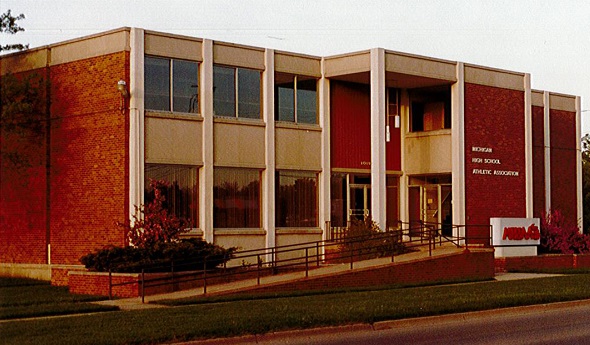
PHOTO: The MHSAA Transfer Regulation dates back to the early 1980s when the Association building stood on Trowbridge Road in East Lansing.