

Former Siena Heights Coach Kohn Excited for Next Phase as Lenawee Christian AD
By
Doug Donnelly
Special for MHSAA.com
June 3, 2026
When Matt Kohn found out that Siena Heights University was closing its doors at the end of the 2025-26 school year, he was on vacation at a southern Indiana campground with his family.
 He got out of the water, answered a call from one of the Siena Heights assistant coaches and was given the shocking news. Within minutes, he dried off and was packed and in his car, making the four-hour drive back to Adrian to meet with his coaching staff and players.
“I did it for my coaches,” Kohn said. “It was important for us to be on the same page and get together a game plan.”
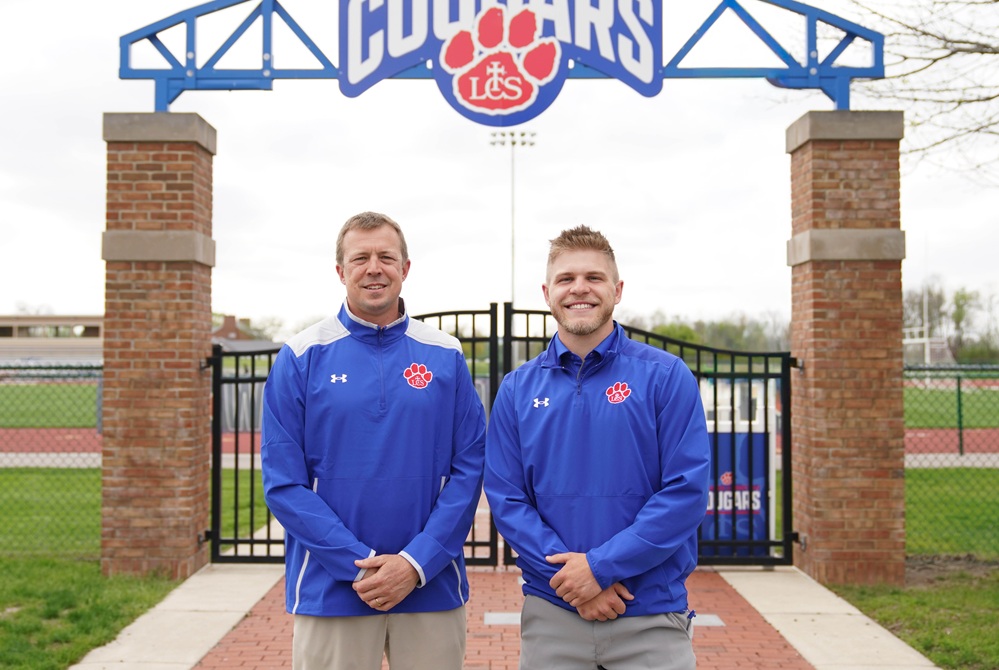
Kohn, 44, is putting together a new game plan these days. The Adrian native began his new job this week as the athletic director at Adrian Lenawee Christian schools.
It’s a significant change from being head coach of the NAIA Saints, a position he held for the past decade. At Siena Heights, his football team typically had 120-130 players. Lenawee Christian, a Class D-size school, will have an enrollment of 114 this fall.
“It’s all relative,” Kohn said.
Instead of overseeing a team with 14 assistant coaches, he will lead an athletic program that has had incredible success over the years. Over the past decade, the Cougars have won two Division 4 girls basketball championships and three 8-Player football title. LCS won two Girls Volleyball Finals in the early 2000s, and the boys basketball program has 11 Regional titles and a Finals appearance since 1998.
The school takes tremendous pride in its athletic program and Kohn, who lives just minutes from campus, is excited to be a part of the LCS family.
“This is a great opportunity for myself and my family, and truly is done by God,” Kohn said. “Being able to stay home and continue into the next phase of my professional career is really all I could have asked for.”
Kohn finished out the school year at Siena Heights, helping find new schools for his remaining football players and new homes for his coaching staff.
“They made a commitment to me by coming to Siena Heights,” he said. “I felt it was important that I remained committed to them.”
As the end of the school year became closer and closer, however, he started searching for his next career move. He didn’t want to move out of the Adrian area but also knew he needed to find a job. When previous LCS athletic director Craig Anderson was promoted to principal, Kohn applied for the administrator position.
 “I have so many connections to LCS,” he said. “I couldn’t be more excited.”
While growing up in Adrian, his dad, Bill Kohn, was a head football coach at multiple schools in Lenawee County, including Morenci, Adrian – and Lenawee Christian.
On its campus on the west side of Adrian off US-223, LCS has what it calls The Centre, which offers fitness and training facilities, youth and adult sports leagues, an indoor pool and outdoor water recreation area. The Centre opened in 1988. Kohn said his parents would drop him off at The Centre when he was a kid to play sports. It’s where he developed his love for athletes.
Eventually he became a record-setting quarterback at Adrian High School and played in the Michigan High School Coaches Association East-West All-Star game. He went on to play quarterback at the University of Indianapolis and spent time with the Ohio Valley Greyhounds of the United Indoor Football Association and two seasons in the Arena Football League with the Nashville Kats and Kansas City Brigade.
He returned to the University of Indianapolis to coach for three seasons before returning to Adrian to join the fledgling Siena Heights football program. In 2016 he was named the interim head coach and took over the job full-time in 2017. Over 10 seasons overall, the Saints won 50 games and had just one sub-.500 finish. They were often ranked nationally and nearly made the NAIA playoffs a couple of times.
“I can honestly say I showed up to work every single day for 15 years, and I gave it everything I had,” Kohn said of being a college head football coach. “There's not a drop of me left that I did not spend in investing in my coaches and investing in my players and getting our guys ready for games and training them and recruiting. That program got every last drop of Matt Kohn. So, I don't have any regrets in that regard.”
Kohn is part of a bit of a transition at Lenawee Christian. The Cougars named a new varsity football coach this week, and with Anderson becoming principal, the school has also hired Noah Beaudrie, an Erie Mason graduate and former quarterback at Adrian College, as the assistant athletic director. Beaudrie comes from a family of athletes. His father is the football head coach at Monroe Jefferson, which had its best season in years last fall, and his sister won a Finals championship in track & field last weekend.
“I’m blessed to have someone like Noah by my side,” Kohn said.
Kohn said in his new role, he will bring his passion for developing student-athletes to the high school level.
“I'm coming into an incredible situation with incredibly strong team members,” he said. “That definitely motivates me every morning, to come to work and just get a little better every day because of the team I have around me.”
 Doug Donnelly has served as a news and sports reporter at the Adrian Daily Telegram and the Monroe News for 30 years, including 10 years as city editor in Monroe. He's written a book on high school basketball in Monroe County and compiles record books for various schools in southeast Michigan. He is now publisher and editor of The Blissfield Advance, a weekly newspaper. E-mail him at [email protected] with story ideas for Jackson, Washtenaw, Hillsdale, Lenawee and Monroe counties.
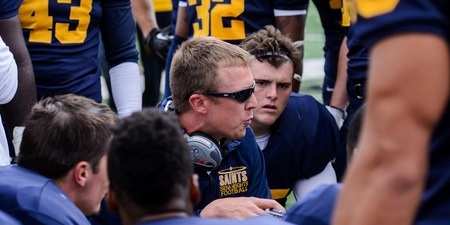
PHOTOS (Top) New Adrian Lenawee Christian athletic director Matt Kohn, left, and assistant Noah Beaudrie post for a photo in front of the school’s stadium gate. (Middle) Kohn huddles with his Siena Heights football team. (Top photo courtesy of Lenawee Christian Schools. Middle photo courtesy of the Siena Heights athletic program.)
Multi-Sport Experience 'Special' for Bronson
By
Wes Morgan
Special for MHSAA.com
February 2, 2016
An increasing number of high-profile athletes and coaches are becoming more vocal about the importance of a well-rounded adolescent athletic experience. More and more parents and athletes, so it seems, are heeding that advice.
 That’s the case in Bronson, a town of fewer than 2,500 residents that manages to keep rolling out successful varsity sports programs. Or perhaps it’s that athletes in Bronson never bought into sports specialization as much as other communities in the first place.
Bronson athletic director and Vikings varsity volleyball coach Jean LaClair, who received the Michigan High School Athletic Association’s 2015 Women in Sports Leadership Award, said it’s critical at a smaller school such as Bronson to emphasize participation in more than one sport.
But, through decades of coaching, she’s seen the effects of athletes choosing a narrow focus.
“I think for most schools and most sports, we’re seeing our numbers dwindle,” she said. “I believe that a lot of parents take their kids to travel ball, and it’s taking them out of high school sports. I think club sports are kind of hindering our high school athletics.”
The National Collegiate Athletic Association reports that six percent of high school athletes go on to play in NCAA programs, and as of 2012 fewer than two percent of high school athletes earned an NCAA Division I scholarship (of any amount), according to a CBS MoneyWatch report. Fewer than eight percent ever play a varsity sport at any collegiate level, according to a study by ScholarshipStats.com.
It’s an admirable dream, but an unlikely one. And along with that gamble comes the great possibility of burnout. Some studies have also suggested that young athletes competing in only one sport year-round are at a higher risk of injury. On top of that, specialization doesn’t seem to improve those odds.
“If you want a (college) coach to know about you, just do some work and they’ll know about you,” LaClair said. “That’s how I look at it. If you’re good enough, a coach is going to see you. You don’t have to go to a club tournament to be seen.”
Though participation in multiple sports is commonplace amongst both genders at Bronson, girls sports in particular have reaped the rewards of such commitment.
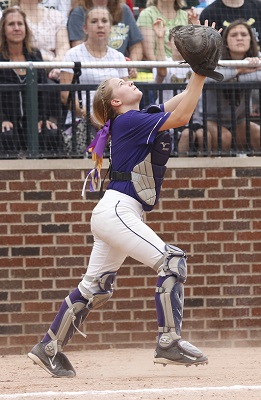 Look no further than the Vikings’ Division 3 runner-up performance in softball last spring (they lost to Monroe St. Mary Catholic Central in the Final), which seemed to fire up the volleyball squad this past fall.
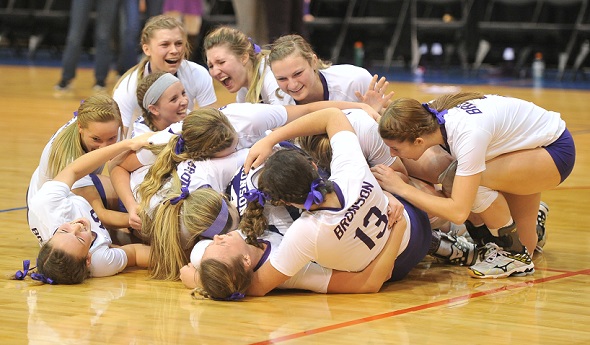
Bronson’s netters tore through the postseason en route to a Class C volleyball championship, earning some revenge by beating Monroe St. Mary Catholic Central in three games.
It was the Vikings second MHSAA title since 2009.
Four athletes who competed on both teams are currently playing basketball: senior Kelsey Robinson, sophomore Adyson Lasky, sophomore Kiana Mayer, and sophomore Payton Robinson. Senior Alexa Ratkowski, an all-state selection in volleyball, also is on the basketball team.
Of the 13 volleyball players who hoisted a trophy at Kellogg Arena in November, six are two-sport athletes and seven are three-sport athletes.
And of the 11 varsity basketball players currently on the Vikings’ girls roster, eight played volleyball and a total of 10 participated in a fall sport.
As Kelsey Robinson’s prep career winds down, she believes playing several sports has made her better at each one. Not to mention she and her classmates find joy in the memories created through a variety of competitive situations.
“It’s just really fun to do different things,” said Robinson, a defensive specialist in volleyball, a former cross country runner, a guard in basketball and a third baseman and centerfielder in softball. “We don’t have a lot of the numbers, but we have the people who are willing to put in the hard work, even if it’s not their best sport. Each season is only three to four months at the most. So it keeps things exciting.”
Some do take part in the club scene on a smaller, more local level. Most take advantage of the coaches at Bronson who are generous with their time.
“I’ll get into the gym with any kid any time they want to,” LaClair said.
 Wes Morgan has reported for the Kalamazoo Gazette, ESPN and ESPNChicago.com, 247Sports and Blue & Gold Illustrated over the last 12 years and is the publisher of JoeInsider.com. He can be reached at [email protected] with story ideas for Berrien, Cass, St. Joseph and Branch counties.
PHOTOS: (Top) Bronson volleyball players celebrate clinching the Class C championship at Kellogg Arena in the fall. (Middle) Then-freshman catcher Payton Robinson prepares to catch a pop fly during last season's Softball Finals weekend at Secchia Stadium.