

Former Siena Heights Coach Kohn Excited for Next Phase as Lenawee Christian AD
By
Doug Donnelly
Special for MHSAA.com
June 3, 2026
When Matt Kohn found out that Siena Heights University was closing its doors at the end of the 2025-26 school year, he was on vacation at a southern Indiana campground with his family.
 He got out of the water, answered a call from one of the Siena Heights assistant coaches and was given the shocking news. Within minutes, he dried off and was packed and in his car, making the four-hour drive back to Adrian to meet with his coaching staff and players.
“I did it for my coaches,” Kohn said. “It was important for us to be on the same page and get together a game plan.”
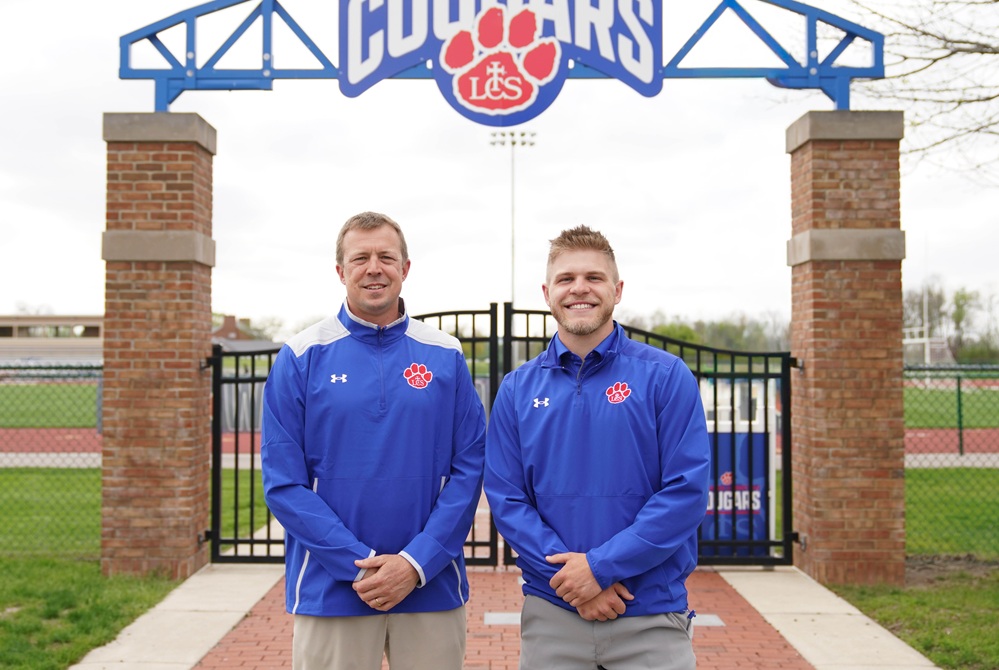
Kohn, 44, is putting together a new game plan these days. The Adrian native began his new job this week as the athletic director at Adrian Lenawee Christian schools.
It’s a significant change from being head coach of the NAIA Saints, a position he held for the past decade. At Siena Heights, his football team typically had 120-130 players. Lenawee Christian, a Class D-size school, will have an enrollment of 114 this fall.
“It’s all relative,” Kohn said.
Instead of overseeing a team with 14 assistant coaches, he will lead an athletic program that has had incredible success over the years. Over the past decade, the Cougars have won two Division 4 girls basketball championships and three 8-Player football title. LCS won two Girls Volleyball Finals in the early 2000s, and the boys basketball program has 11 Regional titles and a Finals appearance since 1998.
The school takes tremendous pride in its athletic program and Kohn, who lives just minutes from campus, is excited to be a part of the LCS family.
“This is a great opportunity for myself and my family, and truly is done by God,” Kohn said. “Being able to stay home and continue into the next phase of my professional career is really all I could have asked for.”
Kohn finished out the school year at Siena Heights, helping find new schools for his remaining football players and new homes for his coaching staff.
“They made a commitment to me by coming to Siena Heights,” he said. “I felt it was important that I remained committed to them.”
As the end of the school year became closer and closer, however, he started searching for his next career move. He didn’t want to move out of the Adrian area but also knew he needed to find a job. When previous LCS athletic director Craig Anderson was promoted to principal, Kohn applied for the administrator position.
 “I have so many connections to LCS,” he said. “I couldn’t be more excited.”
While growing up in Adrian, his dad, Bill Kohn, was a head football coach at multiple schools in Lenawee County, including Morenci, Adrian – and Lenawee Christian.
On its campus on the west side of Adrian off US-223, LCS has what it calls The Centre, which offers fitness and training facilities, youth and adult sports leagues, an indoor pool and outdoor water recreation area. The Centre opened in 1988. Kohn said his parents would drop him off at The Centre when he was a kid to play sports. It’s where he developed his love for athletes.
Eventually he became a record-setting quarterback at Adrian High School and played in the Michigan High School Coaches Association East-West All-Star game. He went on to play quarterback at the University of Indianapolis and spent time with the Ohio Valley Greyhounds of the United Indoor Football Association and two seasons in the Arena Football League with the Nashville Kats and Kansas City Brigade.
He returned to the University of Indianapolis to coach for three seasons before returning to Adrian to join the fledgling Siena Heights football program. In 2016 he was named the interim head coach and took over the job full-time in 2017. Over 10 seasons overall, the Saints won 50 games and had just one sub-.500 finish. They were often ranked nationally and nearly made the NAIA playoffs a couple of times.
“I can honestly say I showed up to work every single day for 15 years, and I gave it everything I had,” Kohn said of being a college head football coach. “There's not a drop of me left that I did not spend in investing in my coaches and investing in my players and getting our guys ready for games and training them and recruiting. That program got every last drop of Matt Kohn. So, I don't have any regrets in that regard.”
Kohn is part of a bit of a transition at Lenawee Christian. The Cougars named a new varsity football coach this week, and with Anderson becoming principal, the school has also hired Noah Beaudrie, an Erie Mason graduate and former quarterback at Adrian College, as the assistant athletic director. Beaudrie comes from a family of athletes. His father is the football head coach at Monroe Jefferson, which had its best season in years last fall, and his sister won a Finals championship in track & field last weekend.
“I’m blessed to have someone like Noah by my side,” Kohn said.
Kohn said in his new role, he will bring his passion for developing student-athletes to the high school level.
“I'm coming into an incredible situation with incredibly strong team members,” he said. “That definitely motivates me every morning, to come to work and just get a little better every day because of the team I have around me.”
 Doug Donnelly has served as a news and sports reporter at the Adrian Daily Telegram and the Monroe News for 30 years, including 10 years as city editor in Monroe. He's written a book on high school basketball in Monroe County and compiles record books for various schools in southeast Michigan. He is now publisher and editor of The Blissfield Advance, a weekly newspaper. E-mail him at [email protected] with story ideas for Jackson, Washtenaw, Hillsdale, Lenawee and Monroe counties.
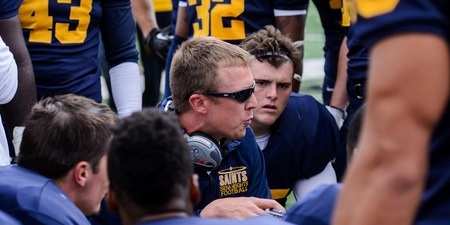
PHOTOS (Top) New Adrian Lenawee Christian athletic director Matt Kohn, left, and assistant Noah Beaudrie post for a photo in front of the school’s stadium gate. (Middle) Kohn huddles with his Siena Heights football team. (Top photo courtesy of Lenawee Christian Schools. Middle photo courtesy of the Siena Heights athletic program.)
Making (Health) Histories Every Year
July 23, 2015
By Rob Kaminski
MHSAA benchmarks editor
Tom Minter, recently retired from the MHSAA as assistant director, wore many hats while serving the Association and donned official’s gear in numerous sports outside of business hours.
But one of his finest refereeing efforts might have come during the 2009-10 and 2010-11 school years when he guided approximately 60 individuals representing 25 medical and professional organizations through an arduous process to upgrade the antiquated Physical Form to what is the standard today: the Pre-participation Physical Examination/Health History Form.
The form highlighted Stage 1 of the MHSAA’s 4 Hs of Health and Safety – Health Histories – and the current form is much more comprehensive, answering questions previously not asked during the quicker, more brief, evaluations.
Sudden cardiac death claims the lives of more than 300 Michigan children and young adults between the ages of 1-39 years annually. Yet, many of these deaths could be prevented through screening, detection, and treatment. One such way to detect high risk conditions that predispose to SCDY is through pre-participation sports screening of student-athletes, and the current physical form provides a mechanism.
While much more detailed, schools report that parents are more than willing to take the extra time and effort to complete the lengthier version.
“When the expanded form came out, people kiddingly made comments about its length; yet in today's day and age everyone understands we need all the information we can cultivate regarding health histories of our student athletes,” said Mark Mattson, athletic director at Traverse City Central.
Down state, feelings have been similar. “We don’t have a problem at all here,” said Anna Devitt, athletic secretary at Hartland High School. “Our parents take care of it, and haven’t balked at the length at all.”
Both agree, and are joined by many others across the state, that the next logical step is for the form to be converted to a fillable, online document so that records can be accessed by those in need via mobile, laptop or desktop.
Thus, in the “No H left behind” mantra that the MHSAA has assumed, an electronic option of the Health History form is in the early planning stages.
“As an increasing number of our schools strive to be ‘paper-free,’ or at least as much so as possible, it is time to re-invent the delivery method for perhaps our most downloaded or distributed document,” MHSAA Executive Director Jack Roberts said. “Once again, as we move forward with our ‘Heart’ initiative for the coming school year, we are also intent on bringing other projects up to speed.”
The masses are certainly enthused.
“That would be heavenly. An online version that would prevent people from submitting the forms until all the required information was in place would be fantastic,” said Mattson, who has had to turn back, or hold out students while waiting for completed forms, whether at Marquette, Maple City Glen Lake, or his current post in Traverse City. “It’s always been the same; people move too quickly and overlook required fields. It would prevent two things: one, having to hold kids out while waiting for a signature, and two, prevent parents from having to drive in to the athletic office to sign or fill in that last field. We’d know we were getting a completed form.”
At Hartland, where athletic director Jason Reck created an online emergency contact form, a system is in place which allows coaches, administrators and trainers to share necessary data for all student-athletes in addition to the MHSAA forms.
“Our parents love the online emergency contact form, and we require them to fill it out every season, not just once a year,” Devitt said. “Sometimes an athlete gets injured during one season and the next season's coach wants to know about it.”
The information on the form is populated into an Excel spreadsheet which Reck, Devitt, the school trainer and all coaches can access. They can tailor the data by sport and pull it to their mobile devices.
“We’re trying to go completely paperless, and the MHSAA physical form would be another step,” Devitt said. “Our parents and doctor’s offices would love it.”