

Gordon to Receive MHSAA Hampton Award for Championing Unified Sports
By
Geoff Kimmerly
MHSAA.com senior editor
February 11, 2026
As athletic director at Novi High School a decade ago, Brian Gordon helped Michigan become a national leader in growing Special Olympics Unified Sports for students with intellectual disabilities. Nearly three years after retiring from school administration, he remains an impassioned advocate helping schools all over the state add these inclusive programs to their athletic offerings.
To recognize his pioneering and now continuing work in expanding these opportunities across the state, Gordon has been selected as the recipient of this year’s Nate Hampton Champion of Progress in Athletics Award by the Michigan High School Athletic Association.
The Hampton Award was created by the MHSAA’s Representative Council to honor Nate Hampton, who retired in 2021 after serving in education and educational athletics for 50 years, including the last 32 as an MHSAA assistant director. Honorees have championed the promotion and advancement of opportunities for women, minorities and other underrepresented groups within interscholastic athletics, while serving as an administrator, coach, official, educator or school sports leader in Michigan.
 Gordon will receive the Hampton Award during the Michigan Interscholastic Athletic Administrators Association (MIAAA) annual conference, March 13-16 in Traverse City.
“To me, (Unified Sports) is absolutely the purest form of sport – what you’re supposed to get out of participating in athletics. Kids that participate in this program get every bit of that – teamwork, camaraderie, adversity, how to win, how to lose, being part of something bigger than yourself. It was, to me, just so impactful,” Gordon said. “The whole idea of more kids being involved in their athletic program, where they have the opportunity to play in front of their parents, being members of an athletic department at their school, to me was just incredible. … And the life lessons that kids learn, families learn, you can’t even measure them.
“It’s just a great, positive experience – for everyone.”
Gordon began his professional career in educational athletics in 1990 as a physical education and health teacher for Royal Oak Schools, and moved into his first athletic director/assistant principal role at Royal Oak in 2010. He left to become the director of athletic and physical education at Novi High School in 2012, retired from Novi at the end of the 2020-21 school year but then returned to Royal Oak as athletic director the following fall for two more years.
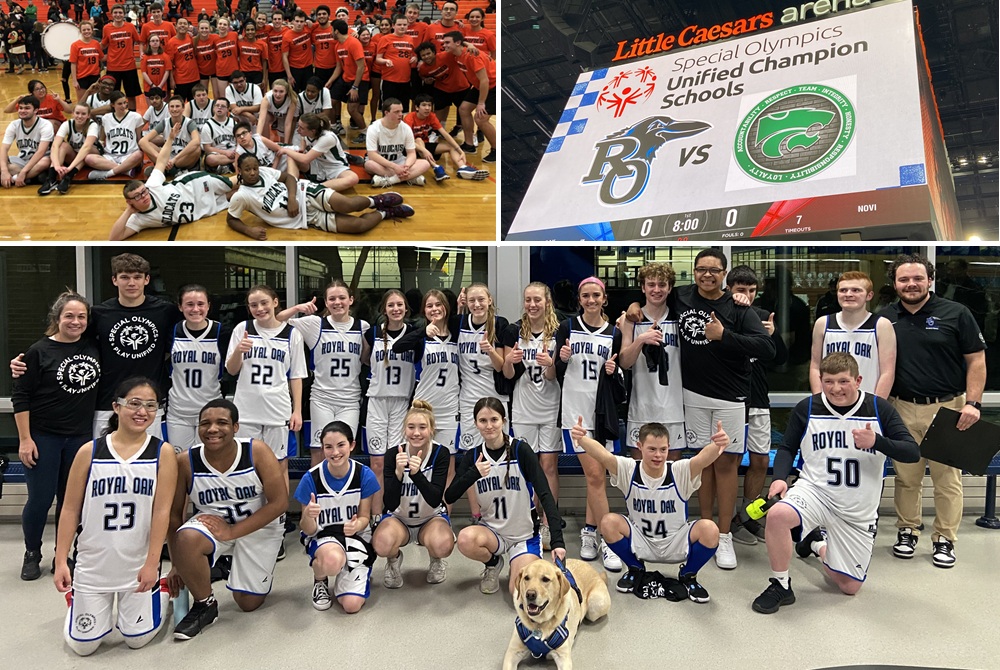
Unified Sports pair students with and without intellectual disabilities as teammates for training and competition. While at Novi, Gordon and Brighton athletic director John Thompson were inspired to bring Unified Sports not only to their schools, but to the Kensington Lakes Activities Association as a whole – and during the 2015-16 school year their schools were joined by Northville, Howell and Hartland in offering Unified teams, with the total soon growing to 13 KLAA schools. The KLAA, at Novi, hosted the first league tournament in the nation for Unified Sports teams – playing 21 basketball games during the inaugural event.
Also following his Novi retirement in 2021, Gordon became a liaison for Special Olympics of Michigan and Unified Sports. He meets with school administrators to promote Unified Sports and help districts build programs, and estimates there are more than 600 elementary, middle and high school Unified Sports teams across the state – with more than 100 high schools playing as part of leagues.
Current Unified offerings in Michigan include basketball, soccer and bocce, with track & field to be introduced this spring. Unified athletes have opportunities to play not just as part of leagues, but during special events like school-day assembly games and at venues like Little Caesars Arena in Detroit.
“Brian Gordon has spent more than 35 years promoting school sports and the athletes they serve, and who better to advocate for Unified Sports than someone who has dedicated his career to championing kids and creating opportunities for them to excel,” MHSAA Executive Director Mark Uyl said. “The MHSAA and the state’s school sports community have long benefitted from Brian’s positive approach and tremendous energy, and he’s poured all of himself into building bridges for Unified Sports in communities all over Michigan.”
In addition to his Special Olympics efforts, Gordon has served as a mentor for the MHSAA’s AD Connection Program since its creation at the start of the 2023-24 school year, working with first-year athletic directors as they transition to that role.
He’s also taught at the elementary and middle school levels, and supervised physical education and served as a health advisory chairperson at the district level. Including a season while still a college student, he has coached baseball, football, basketball and track & field from the junior high to varsity levels, including a stint as Royal Oak Kimball and Royal Oak High varsity baseball coach from 1995-2010. He was inducted into the Michigan High School Baseball Coaches Association Hall of Fame in 2011 and the Michigan High School Coaches Association Hall of Fame in 2021.
Gordon was selected for the MIAAA’s Jack Johnson Distinguished Service Award in 2021 and received an MHSAA Allen W. Bush Award in 2019 for his essential but often “behind-the-scenes” contributions to school sports. Previously, Gordon also was named Oakland County Athletic Director of the Year for 2018-19 by the Oakland County Athletic Directors Association, served as the OCADA president in 2014-15 and on its board from 2010-16, and also served as vice president of the Kensington Lakes Activities Association and president of the Kensington Conference. He has been a member of the MIAAA since 2008 and National Interscholastic Athletic Administrators Association (NIAAA) since 2010, and was named a Regional Athletic Director of the Year by the MIAAA in 2018.
“Being a recipient of the Nate Hampton Award – Nate has made such a difference in educational athletics in our state for so long, that it’s truly an honor to represent him in this award,” Gordon said. “I’m really proud of the fact that we’ve been able to make a difference in the state, just like he did, with Unified Sports.”
Gordon graduated from Clawson High School in 1985 and earned his bachelor’s degree at Central Michigan University – where he also played baseball – and master’s in sports administration and school leadership from Wayne State University. He earned his certified athletic administrator (CAA) designation from the NIAAA.
Prioritizing education and students has been a family focus for the Gordons; Brian’s wife Jill Gordon also is a retired teacher. They have two children – daughter McKenzie Ribbing and son Zachary Gordon, and retirement has allowed for more time with both as well as son-in-law Mike Ribbing and granddaughter Isabel.
The first Nate Hampton Champion of Progress in Athletics Award was presented in 2024.
Past recipients
2024 – Nicole Carter, Novi
2025 – Arnetta Thompson, Wyoming
(Photos courtesy of Brian Gordon.)

MHSAA Halts All Activities Through 4/5
March 13, 2020
By Geoff Kimmerly
Second Half editor
The Michigan High School Athletic Association has directed all member schools to suspend activities in all sports for all seasons – effective Monday, March 16 through at least Sunday, April 5 – to fall in line with Gov. Gretchen Whitmer’s order that all schools close for the next three weeks in order to deter the spread of COVID-19.
All athletic activities to be halted include practices, scrimmages and competitions/games, as well as strength training, conditioning and any other organized sessions and activities in all MHSAA in-season and out-of-season sports.
The suspension of activities applies to sports for all three MHSAA seasons as Spring sports practices have begun, Winter tournaments were suspended Thursday and Fall sports coaches are working with limited numbers of athletes during the offseason.
“By suspending all sports activities for the next three weeks, we are taking an additional step to maintain safety and minimize risk first, and also keep a level playing field for our schools and teams during this time of uncertainty,” MHSAA Executive Director Mark Uyl said. “A number of schools across the state already were making this decision, and setting this as the standard across our membership is appropriate especially given the quick pace with which this situation is continuing to evolve. Given the rapid, fast-moving and unprecedented events of this week, the MHSAA will use the time during this all-sport suspension of activities to evaluate all options and next steps which will be shared with schools in a timely manner.”
Updates will continue to be posted as necessary to the MHSAA Website.
The MHSAA is a private, not-for-profit corporation of voluntary membership by more than 1,500 public and private senior high schools and junior high/middle schools which exists to develop common rules for athletic eligibility and competition. No government funds or tax dollars support the MHSAA, which was the first such association nationally to not accept membership dues or tournament entry fees from schools. Member schools which enforce these rules are permitted to participate in MHSAA tournaments, which attract more than 1.4 million spectators each year.