

Health & Safety: A Look Back, Gallop Ahead
By
John E. (Jack) Roberts
MHSAA Executive Director, 1986-2018
August 7, 2015
We are just completing year six of eight during which we have been addressing the four important health and safety issues that, for ease of conversation, we call the “Four Hs.”
During the 2009-10 and 2010-11 school years, our focus was on Health Histories. We made enhancements in the pre-participation physical examination form, stressing the student’s health history, which we believe was and is the essential first step to participant health and safety.
During the 2011-12 and 2012-13 school years, our focus was on Heads. We were an early adopter of removal-from-play and return-to-play protocols, and our preseason rules/risk management meetings for coaches included information on concussion prevention, recognition and aftercare.
Without leaving that behind, during the 2013-14 and 2014-15 school years, our focus was on Heat – acclimatization. We adopted a policy to manage heat and humidity – it is recommended for regular season and it’s a requirement for MHSAA tournaments. The rules/risk management meetings for coaches during these years focused on heat and humidity management.
At the mid-point of this two-year period, the MHSAA adopted policies to enhance acclimatization at early season practices and to reduce head contact at football practices all season long.
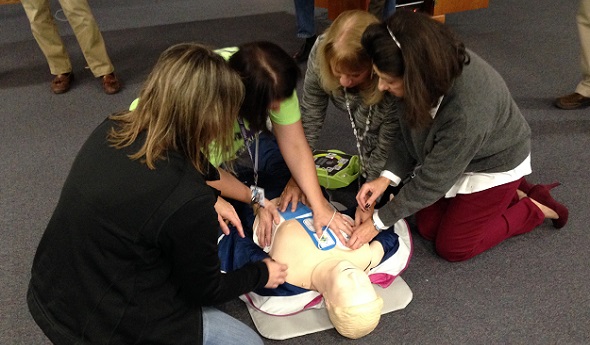
Without leaving any of the three previous health and safety “H’s” behind, during the 2015-16 and 2016-17 school years, our focus will be on Hearts – sudden cardiac arrest and sudden cardiac death.
Coinciding with this emphasis is the requirement that all high school level, varsity level head coaches be CPR certified starting this fall. Our emphasis will be on AEDs and emergency action plans – having them and rehearsing them.
On Feb. 10, bills were introduced into both the U.S. Senate and House of Representatives, together called the “Safe Play Act (see below),” which addressed three of the four health and safety “H’s” just described: Heat, Hearts and Heads.
For each of these topics, the federal legislation would mandate that the director of the Centers for Disease Control develop educational material and that each state disseminate that material.
For the heat and humidity management topic, the legislation states that schools will be required to adopt policies very much like the “MHSAA Model Policy to Manage Heat and Humidity” which the MHSAA adopted in March of 2013.
For both the heart and heat topics, schools will be required to have and to practice emergency action plans like we have been promoting in the past and distributed to schools this summer.
For the head section, the legislation would amend Title IX of the 1972 Education Amendments and eliminate federal funding to states and schools which fail to educate their constituents or fail to support students who are recovering from concussions. This support would require multi-disciplinary concussion management teams that would include medical personnel, parents and others to provide academic accommodations for students recovering from concussions that are similar to the accommodations that are already required of schools for students with disabilities or handicaps.
This legislation would require return-to-play protocols similar to what we have in Michigan, and the legislation would also require reporting and recordkeeping that is beyond what occurs in most places.
This proposed federal legislation demonstrates two things. First, that we have been on target in Michigan with our four Hs – it’s like they read our playbook of priorities before drafting this federal legislation.
This proposed federal legislation also demonstrates that we still have some work to do.
And what will the following two years – 2017-18 and 2018-19 – bring? Here are some aspirations – some predictions, but not quite promises – of where we will be.
First, we will have circled back to the first “H” – Health Histories – and be well on our way to universal use of paperless pre-participation physical examination forms and records.
Second, we will have made the immediate reporting and permanent recordkeeping of all head injury events routine business in Michigan school sports, for both practices and contests, in all sports and at all levels.
Third, we will have added objectivity and backbone to removal from play decisions for suspected concussions at both practices and events where medical personnel are not present; and we could be a part of pioneering “telemedicine” technology to make trained medical personnel available at every venue for every sport where it is missing today.
Fourth, we will have provided a safety net for families who are unable to afford no-deductible, no exclusion concussion care insurance that insists upon and pays for complete recovery from head injury symptoms before return to activity is permitted.
We should be able to do this, and more, without judicial threat or legislative mandate. We won’t wait for others to set the standards or appropriate the funds, but be there to welcome the requirements and resources when they finally arrive.
Safe Play Act — H.R.829
114th Congress (2015-2016) Introduced in House (02/10/2015)
Supporting Athletes, Families and Educators to Protect the Lives of Athletic Youth Act or the SAFE PLAY Act
Amends the Public Health Service Act to require the Centers for Disease Control and Prevention (CDC) to develop public education and awareness materials and resources concerning cardiac health, including:
- information to increase education and awareness of high risk cardiac conditions and genetic heart rhythm abnormalities that may cause sudden cardiac arrest in children, adolescents, and young adults;
- sudden cardiac arrest and cardiomyopathy risk assessment worksheets to increase awareness of warning signs of, and increase the likelihood of early detection and treatment of, life-threatening cardiac conditions;
- training materials for emergency interventions and use of life-saving emergency equipment; and
- recommendations for how schools, childcare centers, and local youth athletic organizations can develop and implement cardiac emergency response plans.
Requires the CDC to: (1) provide for dissemination of such information to school personnel, coaches, and families; and (2) develop data collection methods to determine the degree to which such persons have an understanding of cardiac issues.
Directs the Department of Health and Human Services to award grants to enable eligible local educational agencies (LEAs) and schools served by such LEAs to purchase AEDs and implement nationally recognized CPR and AED training courses.
Amends the Elementary and Secondary Education Act of 1965 to require a state, as a condition of receiving funds under such Act, to certify that it requires: (1) LEAs to implement a standard plan for concussion safety and management for public schools; (2) public schools to post information on the symptoms of, the risks posed by, and the actions a student should take in response to, a concussion; (3) public school personnel who suspect a student has sustained a concussion in a school-sponsored activity to notify the parents and prohibit the student from participating in such activity until they receive a written release from a health care professional; and (4) a public school's concussion management team to ensure that a student who has sustained a concussion is receiving appropriate academic supports.
Directs the National Oceanic and Atmospheric Administration to develop public education and awareness materials and resources to be disseminated to schools regarding risks from exposure to excessive heat and humidity and recommendations for how to avoid heat-related illness. Requires public schools to develop excessive heat action plans for school-sponsored athletic activities.
Requires the CDC to develop guidelines for the development of emergency action plans for youth athletics.
Authorizes the Food and Drug Administration to develop information about the ingredients used in energy drinks and their potential side effects, and recommend guidelines for the safe use of such drinks by youth, for dissemination to public schools.
Requires the CDC to: (1) expand, intensify, and coordinate its activities regarding cardiac conditions, concussions, and heat-related illnesses among youth athletes; and (2) report on fatalities and catastrophic injuries among youths participating in athletic activities.
Longtime Leader Brodie Still Giving Back
February 10, 2016
By Chip Mundy
Special for Second Half
Joe Brodie played basketball for legendary River Rouge coach Loften Greene in the 1940s, he coached Olympic Trials swimmer Ray Martin in the 1950s and coached University of Michigan quarterback Dennis Brown in the 1960s.
 Brodie was the third winner of the MHSAA’s prestigious Vern Norris Award in 1994 for his service as an official.
So it should come as no surprise that Brodie, 87, is enjoying his retirement in Flat Rock with his wife of 62 years, Margo, their son and daughter and eight grandchildren.
There is, however, an impressive twist: Brodie still has an active connection with high school sports as he occasionally serves as a referee for swimming meets in the Downriver area. Forever humble, Brodie has a simple reply to the question, “Why are you still doing that?”
“I just want to give back,” he said. “Maybe it’s in my genes, I don’t know. Maybe it’s my heredity. I think it’s like playing cards; you have to go with the cards you’re dealt with. I still work out about three days a week.”
Early days
Greene built one of the greatest dynasties in the history of Michigan high school basketball. He coached 41 seasons and won 12 MHSAA Finals championships, including five in a row from 1961-65 and four in a row from 1969-72. Brodie, who also played football and ran track in high school, played on Greene’s third team in 1945-46.
Maybe sensing his calling as a coach, Brodie also helped the program by starting a summer league for younger players.
“There was a park that had an asphalt court, and when he won his first state championship team, those were kids I started in seventh grade dribbling around in circles,” Brodie said, “and the eighth-grader on that team was Blanche Martin, who played football at Michigan State. DeWayne Smith was on the team, too, and he ended up succeeding Greene as the coach.”
After graduating from River Rouge, Brodie went into the service and ended up in Japan. When he returned, Brodie enrolled at Michigan State Normal College (now Eastern Michigan University), where he played football for three years and basketball for two.
It was while at Michigan State Normal that Brodie became certified in Red Cross life-saving, and that not only led to a job at Torch Lake near Traverse City but paved the way for his involvement with swimming.
Brodie’s first job came as head basketball, head baseball and assistant football coach at Sebewaing High School in 1952. He wore many hats at Sebewaing.
“I made $2,800 and taught seventh-grade geography and eighth-grade science, two ninth-grade biology classes, a study hall and a phys ed class,” he said. “I didn’t get anything extra for coaching, but I met my honey up there. I fell in love and married her and came back downstate. It was instant love.”
In 1953, Lincoln Park High School hired Brodie as a physical education teacher and assistant coach in football, basketball and baseball. Lincoln Park had no idea what it was getting. In 1955, the athletic director asked Brodie to coach the swimming team because of his background with life-saving.
Within a couple of years, Lincoln Park had its first conference championship in swimming, so the athletic director then asked Brodie to take over the struggling basketball program, which had never won a conference championship.
Brodie led Lincoln Park to back-to-back conference championships and an appearance in the MHSAA Quarterfinals in 1961. No Lincoln Park boys basketball team has made it back to the Quarterfinals since that year.
On to administration
After 13 years at Lincoln Park, Brodie accepted a job as athletic director at Southgate High School. Eventually, the position also included duties at Schafer High School, which is closed.
 “It was strictly an administrative job, and that got me out of coaching,” Brodie said. “That’s when I had the time to do a little bit of officiating.”
Brodie, who had first registered as an MHSAA official for 1955-56, joined a football officiating crew that went on to work an MHSAA championship game, served on the MHSAA Representative Council from 1978-80 and 1981-83, and officiated swimming meets. And he was never afraid to let his voice be heard.
“Our crew was headed to Jackson to do a playoff game, and the athletic director there was my good friend Dennis Kiley,” Brodie said. “The guys on the crew were getting up there in age, and the game was getting tougher to do. They were going to pay four of us, but I wanted to have an extra official so we could cover the deep passes and said we would still take the pay for four and just split it among the five of us.
“They told us no, but we did it anyway. I was the umpire that night, and I was the deepest umpire you ever saw in high school football. Nobody said anything about it.”
Kiley chuckled at the mention of Brodie.
“Joe was one heck of an athlete; football, basketball, you name it,” Kiley said. “He is a heck of a good guy and was a very good official. He was excellent. I would have hired him anytime.”
Not one to take time off, Brodie found odd jobs in the summer to pick up a little extra cash.
“I’ve worked every summer doing all sorts of things,” he said. “I’ve jumped off milk trucks, things like that.”
No job was too big or too small for Brodie, whose next move was to Davison Middle School in Southgate, where he was principal when he retired in 1986 – 30 years ago.
He didn’t slow down much in retirement.
Every winter for 25 years, Brodie and his wife would go to Arizona, and he could not resist getting involved with athletics. He worked track meets, doing high school and AAU meets. He once was named the official of the year in Arizona and also had a chance to work the Pac-10 conference meet at Arizona State University.
“Here’s a little kid from River Rouge, and I’m lining up guys from Washington, Washington State, USC and Arizona. I felt so humbled being a starter. Where else other than this country can this happen?”
Legacy lives on
Brodie concedes he is slowing down at 87, but slowing down at 87 is a good thing. He and his wife no longer go to Arizona for the winter, so that has opened the door to do a few boys swimming meets in addition to girls meets he often works in the fall.
“I’m not going out and campaigning to referee,” he said. “This year I took the Riverview boys schedule, about four or five meets, and took six to eight middle-school meets – you can’t get officials for middle-school meets – and I had a couple of girls meets that I did.
“I just fill in for people, that’s what I do. I’m not going out and hustling, but I think I’m still sharp enough to do the job.”
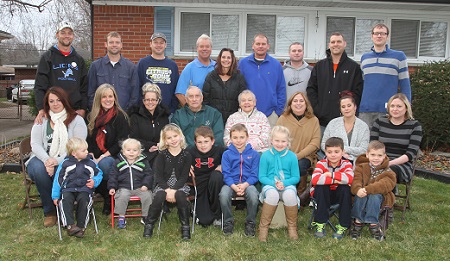 Brodie’s legacy lives on, not only in the continued work he is doing but in his son and daughter. Brodie’s son, Bob, has been the head basketball coach at Salem for 26 years and is in the Michigan High School Coaches Association Hall of Fame. He also has been an MHSAA registered official for 39 years in five sports.
Brodie’s daughter, Jann Stahr, is an MHSAA official in competitive cheer and swimming.
“They are why we don’t go to Arizona anymore,” Brodie said. “Both kids live in Flat Rock. My daughter is about seven houses away, and my son lives about three blocks away.”
The Brodie legacy has more meat to it. In addition to the Norris Award, Brodie is in the Michigan High School Coaches Association Hall of Fame, the Eastern Michigan University Hall of Fame and the Lincoln Park Hall of Fame, which has his bust on display at the Sportsmen’s Den in Riverview.
“I hate saying, ‘I did this,’ or ‘I did that,’” he said. “It’s never been about me. All I ever wanted to do was give back.”
Mission accomplished.
 Chip Mundy served as sports editor at the Brooklyn Exponent and Albion Recorder from 1980-86, and then as a reporter and later copy editor at the Jackson Citizen-Patriot from 1986-2011. He also co-authored Michigan Sports Trivia. E-mail him at [email protected] with story ideas for Jackson, Washtenaw, Hillsdale, Lenawee and Monroe counties.
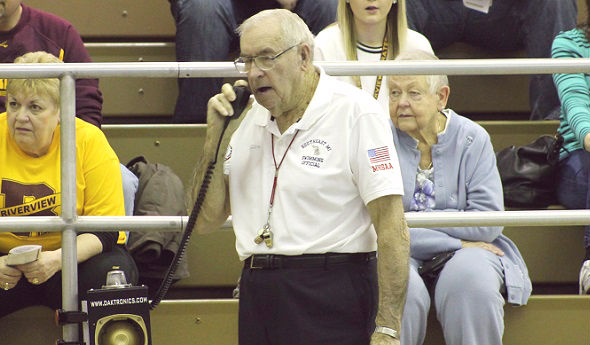
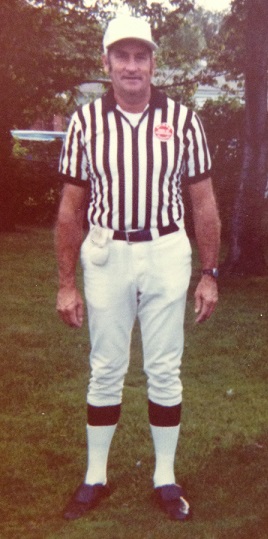
PHOTOS: (Top) Flat Rock's Joe Brodie officiates a swimming and diving meet Tuesday at Riverview. (Middle) Brodie, an official for 61 years, dresses for a football game during the 1970s. (Below) Brodie with the "Brodie Bunch," his family, which includes current officials, coaches, athletes and past coaches. (Photos courtesy of the Brodie/Stahr family.)