


'Larger-Than-Life' Pennfield AD Admired for Statewide Service
By
Pam Shebest
Special for MHSAA.com
April 14, 2021
BATTLE CREEK — To many Battle Creek sports enthusiasts, Bernie Larson was known as “Mr. Pennfield.”
 But for two former athletes, twins Chris and Cam Larson, that was not the case.
“I never knew him or thought of him as Mr. Pennfield; he was Dad,” Chris said.
Larson, 78, who served as athletic director at Pennfield for 29 years, died March 14 after an extended illness.
A memorial service is being planned for May 15 at a time and place to be determined.
“A lot more remembrances come back when someone passes,” said Chris Larson, who lives in Virginia. “You hear so many stories from people who remember him, including former students and coaches.
“It’s great to hear the impact he had on so many people that you never knew about.”
Stories are plentiful when it comes to Bernie Larson.
“He was a heckuva golfer,” said Karen Leinaar, the current executive director of the Michigan Interscholastic Athletic Administrators Association (MIAAA) who during an early stop served as athletic director at Delton Kellogg, which with Pennfield for a time was part of the Kalamazoo Valley Association. “If you needed golf balls on the course, everyone said, ‘Just ask Bernie.’ He always had them.”
The reason?
“If he had one ball in his bag, he had 50 or 60 in his bag,” said Larry Wegener, former Battle Creek Central athletic director. “He had milk crates full of golf balls in his garage” that he found on the course or fished out of ponds.
Championship City
When Larson was named Pennfield’s athletic director in 1970, it became a family affair.
“I had no clue, no clue,” said Joni, Larson’s wife of 56 years. “We never trained to be wives of athletic directors. We learned the most from other wives.”
 She became involved in the job, selling tickets at home games. When their sons were old enough, they helped out with the field.
“They knew where the flag was kept and how to play the national anthem. They learned how to keep score” and were active in playing sports, she recalled.
“Cam (who lives in Minnesota) played football, baseball and basketball,” Chris Larson said. “I played tennis, golf and basketball. We grew up playing little league baseball and football.”
One family favorite was the yearly athletic directors conference at Grand Traverse Resort.
“He was there for business; we kids were there for fun,” his son said. “As we got older, we went to the auditorium that was filled with booths with sports-related things.
“As a kid we went around and grabbed the swag. It was a kids of athletic directors thing.”
It was not all fun and games.
“Bernie Larson was instrumental putting Battle Creek on the map athletically,” Leinaar said. “Four of (the ADs), Bernie, Ralph Kenyon of Harper Creek, Glen Schulz of Lakeview and Larry Wegener of Central put on the tournaments and had crews of people every year right there helping.
“Their hard work and commitment to the MHSAA, running perfect tournaments, made Battle Creek a stop for athletics for many, many years. Many times, Bernie led the pack.”
In spite of his willingness to help others, there was a caveat, Leinaar said.
“He would say to me, ‘Karen, I’ll help you out however I can, but remember, Pennfield is going to win.’
“Pennfield joined the KVA in the late 1980s, so we saw each other quite a bit. Our football games were always barn burners as were track and field.”
 Wegener recalls those days full of tournaments and 65-hour work weeks.
“We did so many MHSAA events, I think a lot of people thought we were on the staff,” he said.
Those tournaments included more than 50 state championships in baseball and softball, team and individual wrestling, volleyball and girls basketball.
Brett Steele, Pennfield’s current AD, said Larson “was still a strong presence in the athletic department and community as a whole even after he retired.
“Up until last winter, Bernie still helped out at football and basketball games as our officials host. He knew most of the officials in those sports and was a familiar face to many when they worked games at Pennfield.”
Larson had served as an MHSAA basketball and baseball official. He also helped found and is a member of the Pennfield Hall of Fame and coached both girls and boys golf.
He received the MHSAA’s Allen W. Bush Award in 1997, the MHSAA’s Charles Forsythe Award in 1999 and was the MIAAA State Athletic Director of the Year for 1991-92.
All About Family
In spite of the hours spent with his job, Larson was a good family man, Wegener said.
“He spoke highly of his kids,” he said. “Chris and Cam were the pride of his life. Joni was a real good fit for him.”
Wegener said Larson was a larger-than-life guy.
“If you were going to run a tournament and you brought a notebook full of stuff for your tournament, Bernie brought a briefcase.
“If you brought a briefcase, Bernie brought a suitcase. He just believed in being prepared for everything.”
One thing the athletic directors did a lot was frequent restaurants, and Larson had his favorites.
“Perkins whenever he traveled, the Pancake House every Sunday and the Irish Pub,” Chris Larson said.
A person could always spot Larson. He was with one with the napkin tucked over his shirt.
“He always wore a suit and tie and would use a napkin as a bib because he was always spilling something on his necktie,” Joni Larson said.
Another thing her husband was famous for was his jokes.
“He always had a favorite joke that I’d hear 27 times,” she said, laughing. “It was like he had a joke of the week, and everybody had to hear it.”
During summers, Larson taught driver’s education at the school, something Chris Larson remembers well.
 “I remember on the last day of driver’s ed, you drove for 45 minutes,” he said. “My brother and I and one other kid were in the car, and I drove to Lansing to the MHSAA and we sat in the parking lot while my dad went inside.
“I know the MHSAA through his eyes and through my own eyes.”
Larson’s love of sports transferred to his sons.
“We all share a love of golf and would play together any chance we got, but over the past years his health wouldn't allow him to play,” Chris Larson said. “I miss that very much.”
Another tradition is being carried on by his son, but it evolved in an unusual way.
The twins were a Christmas surprise for Bernie and Joni.
“They didn’t do ultrasounds routinely back then (1974) so we didn’t know,” Joni Larson said. “We had Bernie’s middle name, Leon, picked out as a first name,” Joni Larson said.
“When we found out there were twins, we gave Chris ‘Leon’ as his middle name and Cameron ‘Noel’ which is Leon backwards, so both had dad’s middle name.”
Chris Larson has continued the tradition, giving his oldest son, Joshua, Leon as a middle name.
Chris Larson echoed the thoughts of many who knew Mr. Pennfield as a people person.
“In my opinion, he was the most Christian man I knew. He lived a Christian life and he shared it with others,” Chris said.
“He was chaplain for some baseball and basketball teams. He knew somebody everywhere no matter where we went in the state.”
Chris Larson paid a special tribute to his father after the funeral.
“He had a parking spot in the circle of the old Pennfield High School right in front of his office,” he said. “His van was there all the time.
“One of the things I did after the funeral was just hang out there for a while.”
 Pam Shebest served as a sportswriter at the Kalamazoo Gazette from 1985-2009 after 11 years part-time with the Gazette while teaching French and English at White Pigeon High School. She can be reached at [email protected] with story ideas for Calhoun, Kalamazoo and Van Buren counties.
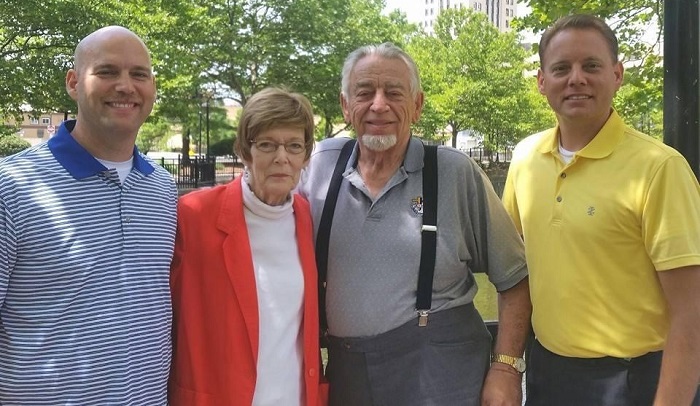
PHOTOS: (Top) Longtime Pennfield athletic director Bernie Larson also raised his family in the district, with sons Chris (left) and Cam among those to wear the uniform. (2) Bernie and Joni Larson were married 56 years. (3) Among Larson’s longtime colleagues were former Delton Kellogg athletic director Karen Leinaar and retired Battle Creek Central athletic director Larry Wegener. (4) The Larson family, more recently, from left: Cam, Joni, Bernie and Chris. (Family photos courtesy of the Larson family; head shots by Pam Shebest.)

UPDATE Meeting Series In 37th Year
September 15, 2014
By Geoff Kimmerly
Second Half editor
The Michigan High School Athletic Association will conduct its 37th annual Update Meeting series in the coming weeks, and this year’s schedule will again offer in-service programming for athletic directors at six of the seven locations.
The Update series is annually attended by more than 800 school administrators. During the meetings, information about current MHSAA activities is disseminated, issues affecting interscholastic athletics are discussed, and attendees are surveyed on various topics. Six luncheon meetings are scheduled in the Lower Peninsula, and a morning meeting is scheduled for Marquette in the Upper Peninsula.
MHSAA Executive Director John E. "Jack" Roberts will address high school superintendents, principals, athletic directors and school board members on a variety of topics at these meetings. Update Meetings also provide school administrators an opportunity to ask questions and discuss any recent changes in the Association's rules and regulations.
This will be the 12th year for Athletic Director In-Service programs to take place in morning-long sessions prior to most of the Update Meetings. These workshops are designed to help prepare those administrators for the rigors of their jobs, and with the Update Meetings offer those in attendance an opportunity to meet with administrators from neighboring school districts with whom they normally are not able to have day-to-day contact.
The meeting in Frankenmuth on October 8 also will serve as the Annual Business Meeting for the MHSAA. Click for the registration form for Athletic Director In-Service and Update Meetings.
- Sept. 24 – Pine West, Kalamazoo (Noon – Preceded by AD In-Service at 8:30 a.m.)
- Sept. 29 – DeCarlo’s Center, Warren (Noon - Preceded by AD In-Service at 8:30 a.m.)
- Oct. 2 – Best Western Plus, Lansing (Noon – Preceded by AD In-Service at 8:30 a.m.)
- Oct. 6 – English Hills Country Club, Comstock Park (Noon – Preceded by AD In-Service at 8:30 a.m.)
- Oct. 8 – Zehnder's Restaurant, Frankenmuth (Noon – Preceded by AD In-Service at 8:30 a.m.)
- Oct. 13 – Otsego Club & Resort, Gaylord (Noon – Preceded by AD In-Service at 8:30 a.m.)
- Oct. 24 – Northern Michigan University Superior Dome, Marquette (10 a.m. – Upper Peninsula Athletic Directors Meeting)
The MHSAA is a private, not-for-profit corporation of voluntary membership by more than 1,500 public and private senior high schools and junior high/middle schools which exists to develop common rules for athletic eligibility and competition. No government funds or tax dollars support the MHSAA, which was the first such association nationally to not accept membership dues or tournament entry fees from schools. Member schools which enforce these rules are permitted to participate in MHSAA tournaments, which attract more than 1.4 million spectators each year.