

In Memoriam: Vic Michaels (1954-2025)
By
Geoff Kimmerly
MHSAA.com senior editor
December 30, 2025
The hearts of the MHSAA and countless others in the school sports community are heavy after the unexpected death Monday of Catholic High School League director Vic Michaels, also a longtime and devoted member of the MHSAA’s Representative Council. He was 71.
Michaels was inducted into the CHSL Hall of Fame in 2024 as a “Legend” – a title carrying prestige that certainly described his contributions to school sports on a statewide level as well.
After a decorated 17-year career as a coach, teacher and administrator at Center Line St. Clement, Michaels joined the CHSL office as associate director in 1995, and then assumed the role as leader of the league in 2003 when then-director Tom Rashid left to become associate director at the MHSAA.
 Michaels also joined the Representative Council in 2003, representing non-public schools and serving as the Council’s secretary-treasurer. But his impact was much more far-reaching than titles could explain. As MHSAA executive director Mark Uyl told the Detroit Free Press in coverage of Michaels’ 2024 CHSL recognition, “I’m not sure there’s been anyone who’s been more important to the MHSAA over the last 40 years than Vic Michaels,” and called him one of the key builders of the MHSAA over its first 100 years as that milestone was celebrated in 2024-25.
Especially over the last decade, as numerous Council and MHSAA staff members have retired or move on from school sports, Michaels has supplied vital context and institutional knowledge especially as a long-serving member of the Executive Committee, which considers eligibility decision appeals and other issues that must be addressed on a frequent basis. He provided a calm voice of reason and advocacy, not only for students he represented from nonpublic schools but for athletes, coaches and administrators from all 1,500+ high schools and junior high/middle schools that make up the MHSAA membership. And serving as treasurer, he filled another crucial role in making sure the MHSAA stood on solid ground financially even amid the challenge of COVID-19 and while expanding its numbers of sponsored tournament sports and students served.
Michaels attended Detroit St. Phillip High School, and after St. Phillip closed, was part of the final graduating class at Detroit St. Ambrose in 1972. He attended and played college basketball at Detroit Institute of Technology and earned his teaching certificate from University of Detroit Mercy.
He coached junior varsity at Dearborn St. Alphonsus and Redford St. Mary before beginning a tenure in 1978 at St. Clement where he taught, served as athletic director and assistant principal and won more than 300 games as the school’s boys and girls varsity basketball coach, earning statewide “Coach of the Year” awards leading both programs during the 1980s.
Michaels and his wife Linda were married 46 years, and he also is survived by his sons Marc and Brad, their wives and grandchildren.
As the CHSL noted in its memorial to Michaels, “Vic dedicated his life to Catholic education, interscholastic athletics, and the young people entrusted to his care. His leadership of the CHSL was marked by integrity, vision, humility, and an unwavering belief that athletics are an extension of the classroom — meant to form the whole person in faith, character, discipline, and service. … His decisions were thoughtful, his counsel wise, and his love for the educational athletics unmistakable.”
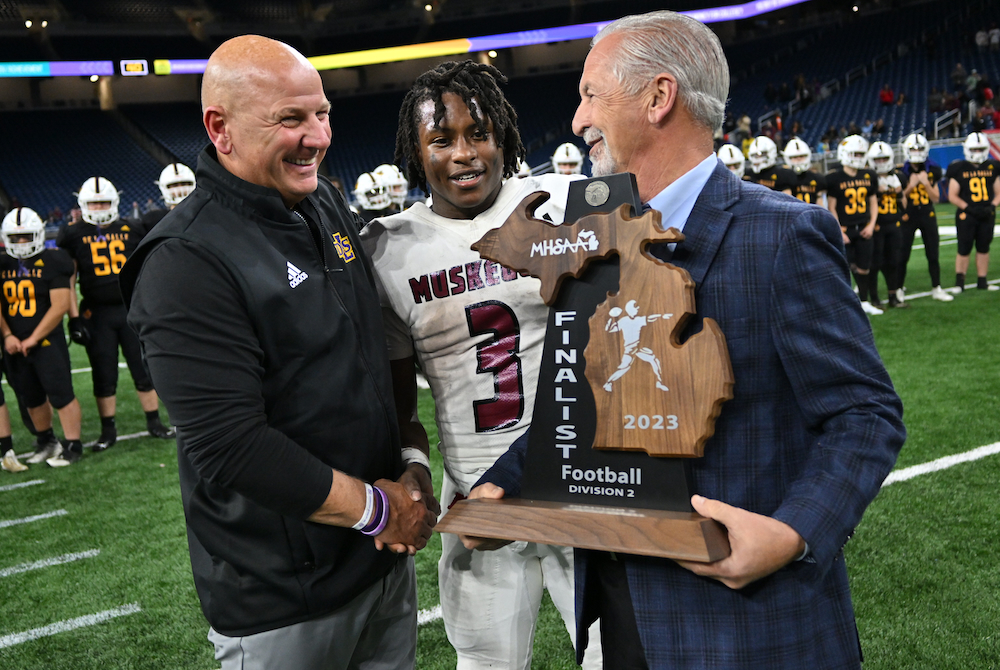
PHOTO MHSAA Representative Council member Vic Michaels, far right, with the assistance of MHSAA Student Advisory Council member M'Khi Guy from Muskegon, presents Warren De La Salle Collegiate coach Dan Rohn the finalist trophy after the 2023 11-Player Football Final at Ford Field. (Photo by Hockey Weekly Action Photos.)
And the MHSAA Survey Says ...
April 2, 2015
By Rob Kaminski
MHSAA benchmarks editor
A survey of MHSAA member schools was conducted in the fall of 2014 aimed to determine opinions for and against a myriad of out-of-season coaching/contact period topics within the school year.
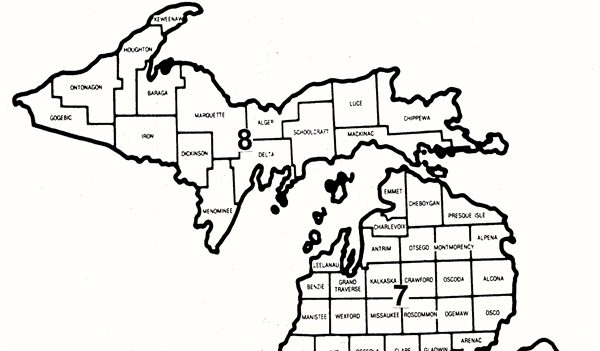
Below are some of the summaries drawn from that survey, plus a map of zones referred to in a number of points.
Survey Summary and Highlights
The larger the school, the higher the percentage of students who are involved in organized non-school sports.
The Detroit metro area (Zone 3) has the highest percentage of respondents in each of two groups in which the highest percentage of students are involved in organized non-school sports ... the 60 to 80% and 40 to 60% groups. The Grand Rapids area (Zone 6) ranks second.
The northern Lower Peninsula (Zone 7) and the Upper Peninsula (Zone 8) have the highest percentage of respondents in the group in which the lowest percentage of students are involved in organized non-school sports . . . the 0 to 20% group. This is also true of Zones 1, 2 and 5, although less dramatically.
In the majority of schools, coaches work with students out of season under the three- or four-player rule for a few weeks just before the season. This is generally true regardless of school classification or geographic zone.
In nearly 80% of schools, the frequency of coaches working with students out of season under the three- or four-player rule is one or two days a week.
100% of schools that sponsor basketball hold open gyms for basketball. Two-thirds of volleyball schools hold volleyball open gyms. Half of lacrosse schools hold lacrosse open gyms. Open gyms in baseball, softball and soccer occur in 40 to 45% of responding schools. Open gyms are less common for other sports.
More than half of all schools conduct open gyms for only a few weeks, just before the season begins.
In 85% of schools, the frequency of open gyms is one or two days a week.
The multi-sport athlete is common in schools of every classification, but more common in Class C and D schools than in Class A and B.
The multi-sport athlete is common in schools of every geographical zone, but more common in Zones 1, 2, 4, 7 and 8 than in Zones 3, 5 and 6.
Two-thirds of schools do not ban athletes from out-of-season workouts while in-season in a different school sport. Permitting weightlifting is most common (84%), then three- or four-player workouts (70%), then conditioning (66%) and open gyms (65%), and finally non-school competitions (57%).
Single-sport coaches are more common in smaller schools than larger (perhaps because fewer sports are sponsored in smaller schools).
For one question, schools were asked to rate ideas from 1 (I like the concept) to 6 (I do not like the concept). Average would be 3.5.
More than 60% of schools favor a no-contact period for all out-of-season sports at the start of every other sport’s season. (Support ranges from 55% for Class A schools to 65% for Class D schools and from 56% for Zones 1 and 3 to 71% for Zone 7.)
More than 72% of schools favor (in conjunction with a no-contact period) a defined contact period out of season. Support ranges from 69% for Class B schools to 76% for Class D schools and from 64% in Zone 6 to 88% in Zone 1.
Two-thirds of schools favor setting a limit on the number of contact days for out-of-season coaching. Support ranges from 63% for Class A schools to 72% for Class C schools and from 50% for Zone 2 to 73% for Zone 1.
More than 68% of schools favor setting a limit on the number of contact days in a week. There’s almost no difference based on school class. Support ranges from 58% in Zone 6 to 76% in Zone 5.
Counting days more than players – that is, allowing practice with any number of students for a defined number of days over a period of time – is favored by more than 72% of schools. Support ranges from 69% for Class D to 76% for Class A and from 59% for Zone 5 to 76.5% for Zone 3.
The least support of any idea surveyed was for allowing scrimmage competition (allowing the coach to coach any number of students from that coach’s school in competition against individuals not enrolled in that school).
More than 62% of schools favor a rule that would allow a school coach to coach a non-school team within a defined contact period; that is, a team with students from the coach’s school (and possibly other schools too), but not supported with school funds, administration, insurance, uniforms, etc. Support ranged from 58% for Class C schools to 68% for Class B schools. Support ranged from 54% for Zone 2 to 69% for Zone 6.
This is the most popular proposal (doesn’t preclude others being approved too): 84% of schools favor removing the phrase “under one roof” from Regulation II, Section 11(H) 2 a (see Tuesday's report). Support ranged from 80% for Class D schools to 86% for Class C schools and from 78% in Zone 2 to 89% for Zone 5.
Removing the portion of Interpretation 237 which prohibits setting up rotations that would allow a coach to work with dozens of players who rotate to his/her direct attention in groups of three or four is favored by 69% of schools, but with a distinct large school vs. small school difference of opinion: Class A (80.5% favorable), Class B (72.9%), Class C (61.3%) and Class D (61.7%).