

Singing the Praises of Unsung Heroes
By
Rob Kaminski
MHSAA benchmarks editor
July 2, 2013
“Standing in the Shadows of Motown” is a documentary released in 2002 celebrating a group of musicians who called themselves the Funk Brothers.
Never heard of them?
All this unheralded group did was rack up more No. 1 hits than the Rolling Stones, Beatles, Beach Boys and Elvis – combined – during their unparalleled run as the musicians who drove the Motown sound.
Smokey Robinson, Diana Ross, Martha Reeves, Marvin Gaye, et al, took the bows; but it was this group of selfless, tireless, talented artists which thrust the vocalists to the front of the stage.
How quickly we recognize those songs from the first notes of that signature bass; the vibrant siren of horns, and rhythmic snapping of fingers before a single lyric is introduced.
And now, ladies and gentlemen, without further ado, we introduce to you the Funk Brothers (and Sisters) of school sports: the athletic administrators.
The profession calls for selfless, tireless, talented individuals who trumpet the efforts of students, orchestrate harmony among coaches and parents, and set the stage for local, affordable entertainment within their communities.
In Michigan, the group assumes this responsibility with unwavering ambition and enthusiasm, setting a solid foundation for the futures of roughly 300,000 athletic participants annually.
As MHSAA Executive Director Jack Roberts notes, “They don’t try to be the stars of the show, but they are indispensable for letting the stars shine – the student-athletes and their coaches.”
It is a role they cherish, taking nearly as much pride in their school family as their own. It’s both a byproduct and a prerequisite for such a job that commands long hours and a knack for interaction with a wide array of personalities and age groups.
Mostly, it’s the young people who make it all worthwhile. They are, after all, the reason the job exists.
“Just watching so many students grow up from immature kids to young adults who now are very successful, and how they appreciate all the extra time you spent with them is rewarding,” said Marc Sonnenfeld, the district athletic director and dean of discipline at Warren Fitzgerald.
“And most important is the, ‘Thank You,’ you get five or 10 years later for pushing them and teaching them life lessons they will never forget.”
In a position largely devoid of gratitude, it’s little wonder that the smallest displays mean the most.
“Having a coach thank me for supporting them, and watching student growth through athletics mean a lot to me,” said Eve Claar, in her fourth year as athletic director and assistant principal at Ann Arbor Pioneer High School.
Brian Gordon, less than a year into his post as director of athletics and physical education for Novi High School/Middle School after 22 years as a coach and teacher in Royal Oak, also enjoys the impromptu reunions.
“One of the things I most enjoyed was having kids come back to the programs either as a coach, parent, or simply as a fan,” Gordon said. “Nothing is better than when I would look behind the backstop and see some former players watching and laughing while listening to me say the same things I had said 10 years earlier.”
Lessons learned along the way
The typical path taken to the administrative office usually includes a stop or two in the coaching realm, which assists in the transition to life outside the playing boundaries.
“The experiences you bring from coaching are a huge help. I made plenty of mistakes as a coach that I see my own coaches make to this day,” said Chris Ervin, in his seventh year as the activities director at St. Johns High School. “You make mistakes, learn from them, and then make sure not to make them again.
“My philosophy – although not realistic, but certainly something to strive for – is this: we would have much better coaches if these three prerequisites were in place. 1) Coaches must be a parent first; 2) must be an official, and 3) must be an athletic director. If coaches had to have these three experiences before being allowed to coach, they would have a whole new perspective when working with students, parents and officials.”
Having been coaches first, however, lends an appreciation to the task of working with students on a daily basis and an understanding as to how an athletic director can best assist his or her coaches.
“Being a coach helped me to learn time management, and I became better at making relationships. In my job now, it helps me to look at things from the coaches’ viewpoints,” said Christian Wilson, the athletic director and assistant principal at Gaylord High School for 11 years. “As a coach, you have an immediate impact on students; administration involves more interaction with adults.”
A coaching background also can cause an athletic director to re-examine his or her days as a coach, and how they might have had a greater awareness for a former administrator’s tasks.
”The learning curve as the athletic director is massive,” said Gordon. “The job itself is huge. As a coach, you just worry about your own sport. As athletic director, I have more than 70 teams to tend to and over 100 coaches to worry about. Coaching and teaching only scratch the surface of what happens in any athletic office every day, but doing that for more than 20 years has helped the transition significantly.”
It is a viewpoint shared by Ken Mohney, a 14-year director of student activities for both the high school and middle school at Mattawan Consolidated Schools.
“Athletic administration opens up the big picture of the department and school mission. Instead of only focusing on the sport that one coaches, administrators must coordinate a program so that all sports collectively enhance the academic success of the entire school,” said Mohney, who also coached three sports at Mattawan for eight years prior to assuming his current duties. “I miss the connection to players and students that I had as a teacher and coach, as it is much more difficult to create and maintain positive relationships with kids in an administrative role.”
The majority of administrators who have had experience coaching admit to missing the close interaction with students and the opportunity to watch them develop into successful adults.
But, in some respects, the number of lives one can reach as an administrator is multiplied, and the scrapbook moments just take on slightly different poses.
Mike Thayer, athletic director and assistant principal for the past six years at Bay City Western High School following a decade at Merrill, recounts one of his proudest days in the business.
“In 1999, Merrill Community Schools had two MHSAA Scholar-Athletes Award winners,” Thayer said. “The senior class that year had approximately 80 students; yet, they produced two winners of this prestigious award. I miss the student interaction and school pride associated with team-building in coaching, but I do not miss the travel.”
Many duties call
Some ADs, however, might rather board the buses than schedule them, another of the many duties carried out on a weekly basis. In some cases, the position is responsible for school-wide transportation, not just athletic transportation.
Where once being the AD meant just that, the title for many in the profession today also includes a “/” before or after the words “athletic director.” It’s a trend which threatens the growth and quality of athletics in the educational mission of schools.
Even in schools where athletics are well entrenched and participation numbers soar, the people leading the charge are being asked to do more with less, often taking on responsibilities once doled out to two, and even three, individuals.
“Some of the larger challenges for me include the budget, balancing a very large work load, and just having enough time to evaluate coaches and programs effectively,” said Claar, who estimates that 60 percent of Pioneer’s 1,893 students participate in at least one sport.
Figuring conservatively, that’s more than 1,000 students deserving of her utmost attention in their extracurricular pursuits. But Claar also is assistant principal to the entire student body.
“Given the additional responsibilities, ADs are often spread too thin,” she said. “The time constraints make it difficult to complete all of the assigned tasks.”
Sonnenfeld, like so many others, attempts to split the time down the middle, but it rarely works out that way by the time he’s also done monitoring the cafeteria during lunch for a couple periods most days.
“I see between 35-60 kids every morning for various discipline issue,” said Sonnenfeld of one portion of his title. “I usually get to athletics by 1:00. I do as much as I can in the time that I have and then stay late on game days and catch up. And in my free time I’m responsible for renting out the athletic facilities. I make myself leave at a normal time on non-event days so that my family sees me.”
Additionally, he oversees the middle school athletic program, and feels guilty that he can’t devote more time to that level. He needn’t feel that way. If it weren’t for Sonnenfeld, the middle school would not have athletics at all.
“The middle school suffers because I cannot get down there to watch over stuff, but this is better than not having any middle school sports at all. They canceled them for a year, and got rid of the middle school athletic coordinator position and put the duties on me,” he said.
Sonnenfeld is not alone. Duties seem similar across the board.
“I am also responsible for coordinating all building facility usage, fundraising and transportation as well as lunch/hallway supervision before, during and after school,” Mohney said. “Athletic administration alone for grades 6-12 in a Class A school is a full-time, 14-hour-a-day job. It is extremely difficult.”
While not included in his title of activities director, Ervin, too, is expected to mete out discipline and supervise lunches on a regular basis.
“Time is a major obstacle,” Ervin said. “When our assistant principal is out of the building I take on most of the discipline in his absence, which leads to days where athletics and activities get zero attention.”
Rewarding pursuit
While frustrations can mount, the leaders of school sports programs also tend to be tough self-critics. Somewhere along the line, these folks noticed sacrifices being made by people like them while they were the same age as today’s students. They now carry those lessons forward.
“I had a very positive experience as a three-sport athlete in high school. My coaches all motivated me toward excellence while providing positive lessons and guidance,” said Mohney. “After graduation and upon returning to Michigan after four years of active military duty, my high school football coach offered me a JV football coaching position and strongly suggested that I may have what it takes to be a good teacher and coach. That guidance inspired me.”
Ditto for Gordon.
“When I hired into Royal Oak, there were several people who impacted me as a professional,” Gordon said. “Chuck Jones was our district AD, and he along with Frank Clouser (varsity baseball coach) really made a difference in where I am today. Chuck was always the constant professional who is arguably the most organized and efficient man I have ever met. Frank is the best coach I have ever been around. I have never met a coach who would break down skills and have the unique ability to teach every facet of the game.”
Creating similar moments for countless student-athletes in their hallways is the ultimate goal for today’s athletic directors. Being told they’ve done just that is enough to make all the cafeteria supervision worthwhile.
“The most rewarding part of athletics is when I observe a student who has come from a tough home environment, and through his or her involvement in athletics, they shine,” said Ervin.
“I always love it when graduated student-athletes come back to visit the school,” Mohney said, “so I can meet their children and hear of their successes in life.”
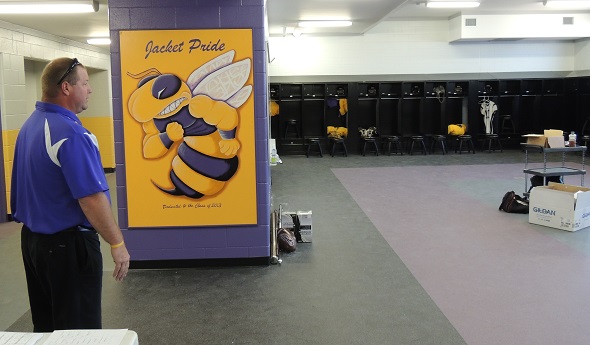
PHOTO: Greenville athletic director Brian Zdanowski points out features of the home lockerroom at Legacy Field, which opened for his school's football teams last fall.
Gordon to Receive MHSAA Hampton Award for Championing Unified Sports
By
Geoff Kimmerly
MHSAA.com senior editor
February 11, 2026
As athletic director at Novi High School a decade ago, Brian Gordon helped Michigan become a national leader in growing Special Olympics Unified Sports for students with intellectual disabilities. Nearly three years after retiring from school administration, he remains an impassioned advocate helping schools all over the state add these inclusive programs to their athletic offerings.
To recognize his pioneering and now continuing work in expanding these opportunities across the state, Gordon has been selected as the recipient of this year’s Nate Hampton Champion of Progress in Athletics Award by the Michigan High School Athletic Association.
The Hampton Award was created by the MHSAA’s Representative Council to honor Nate Hampton, who retired in 2021 after serving in education and educational athletics for 50 years, including the last 32 as an MHSAA assistant director. Honorees have championed the promotion and advancement of opportunities for women, minorities and other underrepresented groups within interscholastic athletics, while serving as an administrator, coach, official, educator or school sports leader in Michigan.
 Gordon will receive the Hampton Award during the Michigan Interscholastic Athletic Administrators Association (MIAAA) annual conference, March 13-16 in Traverse City.
“To me, (Unified Sports) is absolutely the purest form of sport – what you’re supposed to get out of participating in athletics. Kids that participate in this program get every bit of that – teamwork, camaraderie, adversity, how to win, how to lose, being part of something bigger than yourself. It was, to me, just so impactful,” Gordon said. “The whole idea of more kids being involved in their athletic program, where they have the opportunity to play in front of their parents, being members of an athletic department at their school, to me was just incredible. … And the life lessons that kids learn, families learn, you can’t even measure them.
“It’s just a great, positive experience – for everyone.”
Gordon began his professional career in educational athletics in 1990 as a physical education and health teacher for Royal Oak Schools, and moved into his first athletic director/assistant principal role at Royal Oak in 2010. He left to become the director of athletic and physical education at Novi High School in 2012, retired from Novi at the end of the 2020-21 school year but then returned to Royal Oak as athletic director the following fall for two more years.
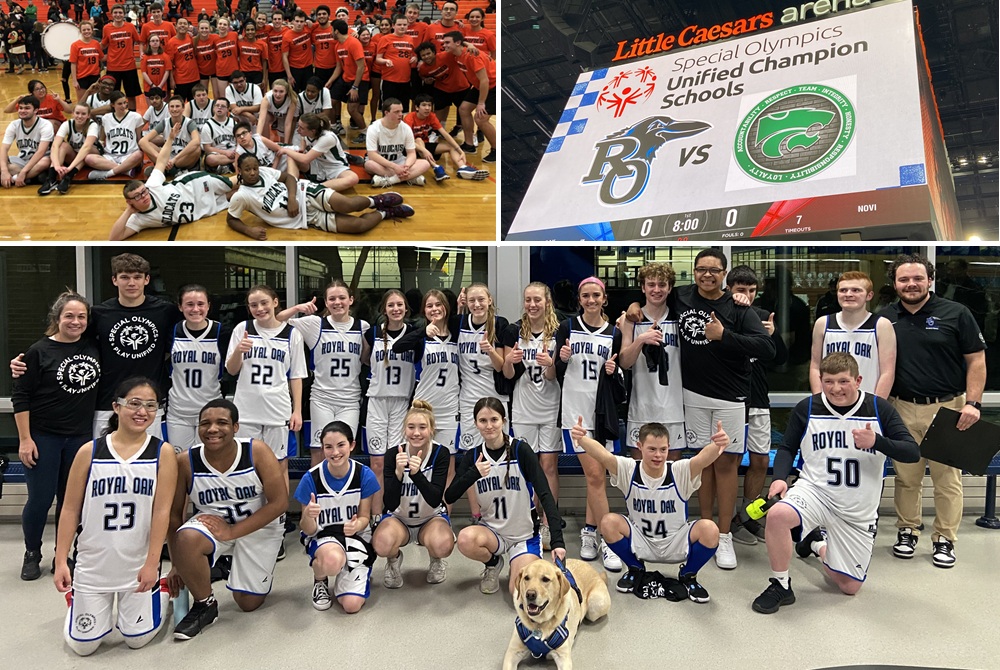
Unified Sports pair students with and without intellectual disabilities as teammates for training and competition. While at Novi, Gordon and Brighton athletic director John Thompson were inspired to bring Unified Sports not only to their schools, but to the Kensington Lakes Activities Association as a whole – and during the 2015-16 school year their schools were joined by Northville, Howell and Hartland in offering Unified teams, with the total soon growing to 13 KLAA schools. The KLAA, at Novi, hosted the first league tournament in the nation for Unified Sports teams – playing 21 basketball games during the inaugural event.
Also following his Novi retirement in 2021, Gordon became a liaison for Special Olympics of Michigan and Unified Sports. He meets with school administrators to promote Unified Sports and help districts build programs, and estimates there are more than 600 elementary, middle and high school Unified Sports teams across the state – with more than 100 high schools playing as part of leagues.
Current Unified offerings in Michigan include basketball, soccer and bocce, with track & field to be introduced this spring. Unified athletes have opportunities to play not just as part of leagues, but during special events like school-day assembly games and at venues like Little Caesars Arena in Detroit.
“Brian Gordon has spent more than 35 years promoting school sports and the athletes they serve, and who better to advocate for Unified Sports than someone who has dedicated his career to championing kids and creating opportunities for them to excel,” MHSAA Executive Director Mark Uyl said. “The MHSAA and the state’s school sports community have long benefitted from Brian’s positive approach and tremendous energy, and he’s poured all of himself into building bridges for Unified Sports in communities all over Michigan.”
In addition to his Special Olympics efforts, Gordon has served as a mentor for the MHSAA’s AD Connection Program since its creation at the start of the 2023-24 school year, working with first-year athletic directors as they transition to that role.
He’s also taught at the elementary and middle school levels, and supervised physical education and served as a health advisory chairperson at the district level. Including a season while still a college student, he has coached baseball, football, basketball and track & field from the junior high to varsity levels, including a stint as Royal Oak Kimball and Royal Oak High varsity baseball coach from 1995-2010. He was inducted into the Michigan High School Baseball Coaches Association Hall of Fame in 2011 and the Michigan High School Coaches Association Hall of Fame in 2021.
Gordon was selected for the MIAAA’s Jack Johnson Distinguished Service Award in 2021 and received an MHSAA Allen W. Bush Award in 2019 for his essential but often “behind-the-scenes” contributions to school sports. Previously, Gordon also was named Oakland County Athletic Director of the Year for 2018-19 by the Oakland County Athletic Directors Association, served as the OCADA president in 2014-15 and on its board from 2010-16, and also served as vice president of the Kensington Lakes Activities Association and president of the Kensington Conference. He has been a member of the MIAAA since 2008 and National Interscholastic Athletic Administrators Association (NIAAA) since 2010, and was named a Regional Athletic Director of the Year by the MIAAA in 2018.
“Being a recipient of the Nate Hampton Award – Nate has made such a difference in educational athletics in our state for so long, that it’s truly an honor to represent him in this award,” Gordon said. “I’m really proud of the fact that we’ve been able to make a difference in the state, just like he did, with Unified Sports.”
Gordon graduated from Clawson High School in 1985 and earned his bachelor’s degree at Central Michigan University – where he also played baseball – and master’s in sports administration and school leadership from Wayne State University. He earned his certified athletic administrator (CAA) designation from the NIAAA.
Prioritizing education and students has been a family focus for the Gordons; Brian’s wife Jill Gordon also is a retired teacher. They have two children – daughter McKenzie Ribbing and son Zachary Gordon, and retirement has allowed for more time with both as well as son-in-law Mike Ribbing and granddaughter Isabel.
The first Nate Hampton Champion of Progress in Athletics Award was presented in 2024.
Past recipients
2024 – Nicole Carter, Novi
2025 – Arnetta Thompson, Wyoming
(Photos courtesy of Brian Gordon.)