

Taking a Healthy Approach to Sports

By Rob Kaminski
MHSAA benchmarks editor

November 8, 2013

During election years, it’s a familiar rallying cry: “Four more years! Four more years!”

It’s become commonplace following the third quarter of football games around the country for members of the leading team to march down the gridiron with four fingers raised on one outstretched hand as teams switch ends of the field to signify, “Fourth quarter is ours; finish the job.”

The number four also is significant in education with school terms identified as freshman, sophomore, junior and senior years. 

To that end, the MHSAA is imploring everyone involved in educational athletics to go back to school in 2013-14 with a four-year mission in mind: “Four Thrusts for Four Years.”

The goal is to attain and maintain advanced degrees in sports safety, positioning Michigan schools in the center of best practices for ensuring the health of our product and students, today and beyond.

“Just a brief look around all levels of today’s athletic landscape reveals heightened awareness of health and safety issues,” said MHSAA Executive Director Jack Roberts. “Interscholastic sports as a whole – and particularly school sports in Michigan – has long led the charge to employ the safest contest rules and provide the healthiest environments for our games and participants.

“But, to put it in athletic terms, we can’t sit on the lead,” Roberts added. “We can, and must, improve our games in order to guarantee their existence for future generations. That is our goal, our thrust in the coming years.”

Following are the focal points for this four-year plan:

  • Implement heat and humidity management policies at all schools for all sports.
  • Require more initial and ongoing sports safety training for more coaches.
  • Revise practice policies generally, but especially for early in the fall season.
  • Modify game rules to reduce the frequency of the most dangerous play situations, and to reduce head trauma.

The directive actually kicked off last March, when the Representative Council approved a heat management policy for MHSAA tournaments and a detailed model policy for schools. While not setting requirements for member schools during the regular season, it suggests actions based on heat index – the degree of felt discomfort derived by combining temperature and humidity measurements – that are designed to minimize the risk of heat-related illness during interscholastic participation. 

The policy is mandatory for all MHSAA tournaments beginning this school year, and the MHSAA plans to monitor schools’ adoption of the plan throughout the year to determine best policies moving forward.

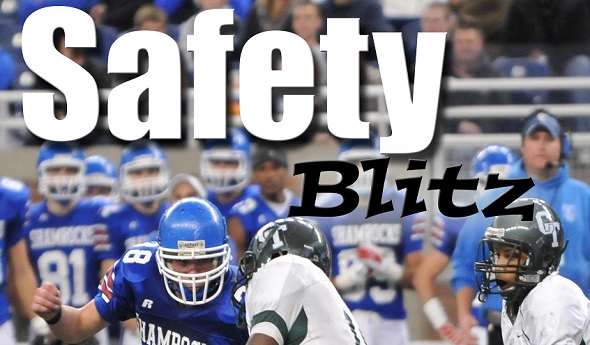
Laminated cards containing the policy and heat index chart were printed and mailed to schools in June and continue to be disseminated at statewide meetings this fall. Two publications, Heat Ways and Safety Blitz, were published, mailed and posted to MHSAA.com, heightening awareness of healthy practice regimens, and schools have been offered discounted psychrometer prices through the MHSAA to assist in their efforts to properly monitor weather conditions. 

“This action was significant; but it’s just the next step in a continuous series of actions being taken to make school sports as healthy as possible for students,” said Roberts.

The MHSAA’s proactive movements toward a safer tomorrow are taking place concurrently, rather than sequentially. While the heat and humidity plan is the most developed of the four “thrusts,” other initiatives are underway. Today’s climate prompts such action.

From the NCAA’s new “targeting fouls” to the NFL’s “crown” rule, and of course Major League Baseball’s Biogenesis/PED debacle, the headlines off the field in August centered on protecting the games rather than simply playing them.  Like it or not, it’s the type of news  fans need to get used to as their favorite sports audible to option plays in order to steer clear of the endangered species list.

The situation can’t be overstated. Athletics at all levels has been approaching a crossroads for years, and the time to heed the signals has come.

“Let’s make one thing abundantly clear: The people in charge of football at all levels are wise to craft rules that make the game safer, even if those rules will be controversial,” wrote Andy Staples for SI.com College Football on July 23.

The story continued: “As more information arrives about the long-term dangers of the headshots football players absorb at the high school, college and pro levels, something has to change. The next few years will be messy. The game needs saving, because if it continues as it has, it will get decimated by lawsuits and by parents of young children who decide the potential adverse effects aren't worth the risk.”

When kids stop playing, numbers at the high school level and beyond are bound to diminish as well. To trumpet the vast benefits of interscholastic football while easing parents’ minds on safety concerns, the MHSAA formed a Football Task Force in the spring of 2013. The task force is the first of several to be convened during the next four school years, and the objectives of each are to promote the sports involved as safe, low-risk, competitive athletics through the  development of  better practice policies and modification of playing rules. 

“These task forces will be central to the overarching mission of preserving sports for years to come,” said Roberts. “We believe the MHSAA Football Task Force has set a foundation on which to build. Our discussions involving revised practice policies have reached the draft stage, and we intend to have formal proposals ready to present to the Representative Council in March 2014.”

The work of the 13-member task force – made up of football coaches and school administrators from around the state – will be reviewed by the Michigan High School Football Coaches Association, the MHSAA Football Committee and at the MHSAA League Leadership meeting for fine-tuning prior to reaching the Council.

“It is important that we provide opportunities for children to participate in interscholastic athletics and crucial that we do all we can to ensure they will be safe when they do,” said Football Task Force member Tammy Jackson, principal at East Jordan High School, who has a sports medicine background. “The MHSAA has taken an active role in promoting safety by convening the Task Force to examine current rules and consider modifications to further protect children.”

With so much publicity concerning football safety, the football group was a natural to become the first of several task forces to be assembled.

“We must educate the public on the benefits of all school sports,” said task force member Bill Chilman, superintendent of Beal City Schools. “In the case of football, it must be impressed upon people that it is statistically a very safe game when taught and played properly. The Football Task Force being proactive rather than reactive to this safety movement is key to promoting the lifelong values of football and all school sports.”

And within that public is a group which has the most vested concerns: the parents.

“There is more information available to the general public regarding sport and sport injuries, and unfortunately parents and kids all too often hear about the negative side of sport,” suggests Mike Bakker, athletic director at Fenton High School, and another member of the MHSAA Football Task Force. “It is imperative for the integrity of the sport of football to have coaches and administrators provide information about the safety of the game and the steps we take to keep kids safe. We must educate parents about the proper way to play the game and the signs to look for if problems arise.”

Without getting into the minutia of the new NCAA and NFL playing rules regarding use of the helmet, suffice it to say this will be an interesting fall during which to monitor penalties and their effects on injury numbers, particularly when it comes to concussions.

The rules changes have been reported and debated at the national level ad nauseam, and the mood seems to inexplicably tilt toward skepticism and criticism from the very group that would stage a revolt of epic proportions if football ever became extinct: the fans.

Case in point: six targeting fouls were called in 75 games during the opening weekend of college football over Labor Day Weekend (one ejection was overturned by replay), and the outcry began. Analysts and fans are afforded frame-by-frame replays which onfield officials do not have the luxury of seeing before throwing the flag.

Like it or not, the rules are in place. And, they have been implemented to protect the future of the game. The impetus now falls to the caretakers of the game – the officials – who no doubt will bear the brunt of disapproving masses in the stadiums. Yet, football is their livelihood too; both players and officials are expected to make adjustments. 

At Officiate Michigan Day and the ensuing National Association of Sports Officials Summit this past July in Grand Rapids, the theme was clear: “The game has changed, and the officiating has to change with it.”

From NFL Referee Jeff Triplette to SEC Coordinator of Officials Scott Shaw to Big Ten Referee Alex Kemp and Fox Sports NFL Rules Analyst Mike Pereira – people who have been around the block – the message delivered was that the changes are necessary for the health and growth of football.

“We’re talking about taking out a specific type of play that, quite honestly, you didn’t see that much of before about 10 years ago,” Triplette said during a player safety panel at the NASO Summit. “They still played defense, there were still great hits. But somehow, these violent types of tackles began to get notoriety – whether it was all the ESPN highlights, YouTube, and maybe a combination of all of that stuff – and players started to celebrate those hits, and that became the goal.”

Not only can the game become safer; it might even become better by going retro. In recent comments on The Sports XChange, NFL analyst and former coach John Madden said, “You are always concerned how any change will impact the game. In this case, players are not going for the head shot, that big hit. They are keeping their heads up.  Better tackling has become the unintended consequence. That's a good thing. Good for football. Good for kids watching. Players are tackling the way they are supposed to, with their shoulders and wrapping up. The big hit, the big replay had become so popular that tackling suffered.”

In high school, the most notable rule change involving helmets involves penalties for players who lose their helmets during a play. However, illegal helmet contact continues to be a point of emphasis and carries a minimum of a 15-yeard penalty as it has for many years. In the NCAA the mantra on helmet-to-helmet blows is, “When in doubt throw them out,” as the foul now carries with it a player ejection.

That is not the high school rule—yet—but officials at all levels need to be on the lookout. Kemp was quick to warn a roomful of prep football officials during Officiate Michigan Day, “We’ve been told to err on the side of safety, and these plays will result in ejection,” while also adding that such plays will be reviewed by replay officials. “That portion of the rule isn’t there in high school yet, but be ready for it; it’s coming, so when it happens in your games take notice and determine the severity.”

Which brings us to contest rules for safer play. During the next few years, various sport groups will be assembled to follow the MHSAA football task force’s lead in scrutinizing rules and developing proposals for revisions or additions to be submitted to the National Federation of State High School Associations. Initial football discussions receiving some traction involve changing the enforcement spot on post-interception penalties and limiting the number of yards teams can run up on free kicks. Before any submissions are made to the NFHS Football Committee, the task force will conduct research and present findings to Michigan committees.

“We can make changes ourselves – through MHSAA sport committees – for the subvarsity level, but our committees can only make recommendations to national rules committees for varsity level play,” explained Roberts. “Over the next four years, we will be asking our sport committees to give more time to the most dangerous plays in their sport – identifying what they are and proposing how to reduce that danger.”

While the football task force here at home is finalizing practice policy proposals targeted for implementation in the fall of 2014, Texas and Illinois are two states which launched restrictions with the opening of football this season. Spokespersons from both states indicate that coaches and school administrators have been pleased with the new formats.

Coaches no doubt will need to adjust practice itineraries and budget time wisely.  Administrators need to remind staffs that the new era is dawning in the name of player safety, which is paramount to all parties.

“In game situations, coaches want our officials to throw the flag on late hits, low hits and other illegal contact,” Roberts said. “These are incidents that they have no control over. They do have control over practice time and teaching fundamentals; so let’s encourage safety measures that we can control, and employ those tactics to help the game prosper.”

Education will key the efforts to align coaches of all sports – and all levels – in the movement toward a healthy future.  School will be in session during the next four years as the MHSAA implements effective and practical means for raising coaches’ preparedness. Three avenues are on the map:

First, the Representative Council mandated that beginning with the 2014-15 school year, all assistant and subvarsity coaches at the high school level must complete the same MHSAA rules meetings currently only required of varsity head coaches or, alternatively, one of the free online sports safety courses posted on or linked from the MHSAA Website that is designated as fulfilling this requirement.

Second, it is proposed that by 2015-16, MHSAA member high schools will be required to certify that all of their varsity head coaches have a valid CPR certification.

Third, it is proposed that by 2016-17, any person who is hired for the first time to be the varsity head coach of a high school team, to begin after July 31, 2016, must have completed either Level 1 or Level 2 of the MHSAA Coaches Advancement Program. The MHSAA is preparing to subsidize some of the course cost for every coach who completes Level 1 or 2.

Together, these changes will move Michigan from one of the states of fewest coaching requirements to a position consistent with the “best practices” for minimizing risk in school sports and providing students a healthy experience.

At stake in these four thrusts – whether for an administrator, coach, official, student-athlete, parent or fan – are the environments that offer so many lessons and the games for which we root.

Serving a Balanced School Sports Diet

May 1, 2018

By John E. “Jack” Roberts
MHSAA Executive Director

If you really want to know what a person thinks is important, look at that person’s calendar and checkbook or credit card receipts. How a person spends his/her time and money tells you more than anything that person says.

The same can be said for organizations. How they spend their time and money identifies what they value.

So, an observer of the Michigan High School Athletic Association might notice that the only standing committee that meets more than once each year is the MHSAA’s Junior High/Middle School Committee, and the MHSAA’s longest-standing work group is the Task Force on Multi-Sport Participation, which has had six formal meetings during 2016 and 2017.

Promoting multi-sport participation, and doing so before students reach high school, is a documented MHSAA priority. We believe it’s good for students, schools and society.

By encouraging participation but not specialization, balanced multi-sport participation provides the sweet spot between two unhealthy extremes – on the one hand, inactivity that contributes to a childhood obesity epidemic or, on the other hand, year-round specialization that is too early, intense and prolonged, leading to an epidemic of overuse injuries in youth sports.

Within the pages of this issue of benchmarks are descriptions of initiatives to elevate the profile of school-sponsored sports programs for junior high/middle school age youth and to under-gird multi-sport participation as the means to maximize benefits for students and schools today, and for society in the future.

***

The MHSAA is tailoring efforts to put the multi-sport athlete back in style. Among the initiatives is bolstering participation at the junior high/middle school ages.

By Rob Kaminski
MHSAA benchmarks editor

Saugatuck’s high school football season had just come to an end with a 21-0 loss to Pewamo-Westphalia in the MHSAA Division 7 Final last November when three key players were being led up the tunnel to represent the school for postgame media interviews.

When asked how many on the team would have a one-day break before joining the basketball team for practice on that Monday, one of the players replied, “We have about seven of us who begin basketball Monday.”

The response was comforting to hear in an age that has seen specialization and year-round, single-sport focus render the multi-sport student-athlete to minority status in many hallways across the nation’s high schools.

Granted, participation in multiple sports is necessary for programs to exist in smaller schools such as Saugatuck, but even those communities can benefit from a renewed emphasis and earlier introduction to school-based athletics.

As MHSAA Executive Director Jack Roberts points out above, there are just two groups that meet more than once each year at the offices in East Lansing: the Junior High/Middle School Committee, and – during the past two years – the Task Force on Multi-Sport Participation.

Each will continue to play pivotal roles in promoting increased participation, one by examining early introduction to school sports at the junior high/middle school level, and the other by evaluating education, cooperation and recognition of multi-sport numbers at the high school age.

“One of the challenges we currently face is that in some cases students enter high school never having experienced school sports,” said MHSAA Assistant Director Cody Inglis, who oversees the Junior High/Middle School Committee. “Now they go cold-turkey into high school sports and we have to introduce them to rules and regulations that aren’t a fabric of non-school sports which they may play. The earlier we can expose them to our programs, the better off we’ll be at the high school level.”

Inglis outlined three main topics in front of the Junior High/Middle School Committee currently: 1) how to introduce school sports to students earlier; 2) the effect more games – not length of season – would have on JH/MS participation, and 3) whether the MHSAA should sponsor Regional tournaments in select sports prior to high school age.

The Task Force on Multi-Sport Participation, meanwhile, has turned its focus on the following: 1) educating groups on the benefits of variety in participation and the perils inherent in specialization, 2) preparing tools for administrators, and 3) creating recognition programs for multi-sport student-athletes.

The following are results from a fall 2017 survey on junior high/middle school programs and explanations of tools created by the multi-sport task force to encourage participation for all seasons.

Start in the middle ... or even before

The prevailing sentiment among athletic administrators, coaches and student-athletes themselves is that early introduction to a variety of sports will foster a culture of future participation and the tendency to continue in more than one sport.

“Students at the JH/MS level need to experience sports sampling so that they can be physically literate; to gain competence and confidence to move their bodies in a variety of movements so that they can achieve lifelong health and wellness and stay injury-free,” said Scott Przystas, teacher and coach at Grand Haven Area Public Schools and member of the MHSAA Task Force on Multi-Sport Participation.

The overriding question is how to strike a delicate balance between opportunity and excess at the target age group.

The good news is that MHSAA JH/MS membership has increased by more than 100 schools during the last two years, bringing the total to nearly 800. The MHSAA is exploring means to ensure the trend continues, surveying the schools last fall on matters such as modifying the Limited Team Membership rule to allow student- athletes at the JH/MS to compete in up to two outside events in the same sport in the same season, having the MHSAA sponsor regional or even state competitions in certain sports and expanding the number of JH/MS games and contests allowed during the 13-week season.

“The survey attempted to answer several questions,” Inglis said. “Would opening up options to participate in a couple non-school events during the same season draw athletes to our JH/MS programs or keep them in non-school sports? Would statewide or regional tournaments be attractive?”

Survey results reveal the current climate pertaining to several topics.

Of the 616 completing the survey, 436 were athletic directors and 166 were principals, with the remainder consisting of other positions within the schools, ranging from coaches to superintendents. The grades served by the schools were 6th-8th, with about 36 percent indicating that 5th-graders were also in their buildings.

“The survey response has shown there’s a definite hesitation for state tournaments at the JH/MS level, but there is some favorable feeling toward regional tournaments,” Inglis said.

For example, when asked about the possibility of regional tournaments in track & field and/or cross country, the results were about 50/50 for and against.

Yet, when it comes to the idea of statewide tournaments in those sports, the attitude changes significantly, with roughly 30 percent in favor. Further, when the question of JH/MS state championships for any other sports is posed, the response is an overwhelming “No,” from 84 percent of those surveyed.

Following is a sampling of comments regarding postseason tournaments at the JH/MS level:

• “Middle school athletics should be a time to expose students to the sport and develop their skills. Increasing the competitiveness of it would change the focus.”

• “Logistically, it would create more challenges to have regional and state tournaments at the middle school level. However, we are at the point where we are in a struggle competing with club sports such as basketball and soccer, to name two. At a minimum, a regional championship would create additional buzz and competitive atmosphere at the school setting. A state championship is not as critical. However, if we do this for one sport, we will have to consider doing this for all sports.”

• “I think we are headed down a dangerous path of too much too quick for junior high kids. They can play for championships in high school and beyond if they are good enough. More games mean less practice, more expense and less of a focus on the things that are important.”

• “I think middle school sports is a great opportunity to expose students to sports. We need to keep it pure with learning each day without the pressure of trying to win trophies and medals.”

• “State championships at a younger age will just start the clock earlier of recruiting and illegal transfers. Add more games to be competitive with the non-school sports.”

That last sentence hits a couple hot buttons. Can more games be added while maintaining an appropriate amount of competition? Can an environment be created to pull students from, or co-exist, with non-school options at the JH/MS level?

“Overall, our JH/MS constituents do not want to lengthen athletic seasons, but there is some opinion to increase the number of contests within the current seasons, particularly on days not followed by school days,” Inglis said.

For example, respondents indicated just 45 percent were in favor of increasing the number of basketball games in a season from 12 to 15, while only 39 percent would support the same increase in soccer schedules.

However, support resonated with the notion of allowing multi-contest events on days not followed by school days.

The group in favor of the above scenario was also 83 percent in favor of limiting such doubleheader dates to four per season.

In soccer, a similar scenario also was approached in the survey.

Basketball and soccer are two sports in which non-school entities offer plenty of competition for participants, even at ages prior to JH/MS.

For youth already involved in such programs prior to reaching local junior highs and middle schools, the challenge is to display the benefits of school-based sports.

Justin DiSanti is a doctoral student and research assistant at Michigan State University with a concentration in sport psychology who also serves on the multi-sport task force for the MHSAA. His research interests include talent development and sport specialization, particularly in youth and high school sports.

DiSanti points to a model that is frequently used in the world of youth sport, the Developmental Model of Sport Participation (DMSP).

“This model has three stages providing approximate age guidelines and associated recommendations for shaping youth athletes’ schedules,” DiSanti said. “I believe that this model is highly-applicable to today’s world of youth sport, but the proper interpretation of the model is critical. When looking at specialization through the lens of the DMSP, we can begin to answer the question, ‘Is an athlete specializing too early?’”

The first stage, “The Sampling Years,” affects children from 6 to 12 years old, during which time participation in a wide range of athletic endeavors is encouraged. By this model, many youngsters are already thinking about specializing, or at least narrowing their focus by the time they arrive at junior highs and middle schools.

Przystas, the 2016 Michigan Physical Education Teacher of the Year by the state’s chapter of Society of Health and Physical Educators, concurs that this is a key time for future student-athletes.

“I think the multi-sport message needs to start from the ground up, with elementary physical education teachers, continuing to middle school PE and middle school sports and then into high school,” Przystas said.

In an effort to ease the transition from community and club teams, or to introduce students to sports in a school setting, JH/MS programs are critical. Leaders were asked whether allowing some non-school participation in the same sport during the same season would create a viable bridge leading to school sports participation.

The vote was nearly split when considering the allowance of two non-school events for team and individual sports per season for current MHSAA JH/MS student-athletes, with 54 percent of respondents in favor.

Yet, 63 percent believe that scenario would create conflict between the two options, and the feeling was again split as to whether such an allowance would increase or decrease participation in either the school or non-school setting.

With the degree of uncertainty as to the effect of non-school allowances, some think it best to focus on the many unique benefits offered through school sports which are lacking in alternative settings.

“I think it is important for student-athletes at this level to understand what having school pride means,” Przystas said. “When they are playing with their school logo on the front of their jersey they are representing something bigger than themselves. It is important for the coach/teacher/administrator to emphasize the importance of history and tradition not only in sports, but in other endeavors such as Science Olympiad or Spelling Bee.”

Following is a sampling of comments regarding non-school relationships at the JH/MS level:

• “Junior high is a great time for kids to increase their skill, and for many kids who don't have parents to tote them to clubs and travel teams to try the sport.”

• “It is understood that in many areas, getting kids back from travel teams is important, but in our area finding gym time, etc., is very tough.”

• “I'm uncomfortable with allowing just two non-school sporting events; I have no idea how that will be monitored. I would rather allow it or not.”

• “My biggest concern for a middle school student to play on multiple teams during the season is safety. Their bodies are still growing and I see injury being the biggest concern.”

• “School-sponsored, MHSAA sports being offered by any particular school, should take precedent over any non-school sponsored sport being offered at the same time.

• “We have a lot of football players choose to play with area little league teams instead of our school team. The non-school teams have the opportunity to play more games than our school team and they also have the opportunity for playoffs. We are limited to six games and we have academic requirements that non-school teams don't have.”

• “In my opinion, kids are going to play for either the school or play outside. Many parents are of the mindset that their child is a star and playing travel sports will get them noticed. MS sports can't compete with this mindset and I believe we should not compete with it. Those who stay and play for schools are the ones we should be focusing on. Let's make it (a) better situation for them.”

The MHSAA also carries with it something else that other organizations lack: a brand. That much came through in the spring of 2017 when a pilot program on “Presenting Sponsorship of JH/MS events” was completed.

MHSAA staff visited five areas of the state and joined in presenting pre-existing track & field league or conference meets with branding presence and financial support.

“One of the big takeaways was the power of the MHSAA brand,” Inglis said. “Student-athletes flocked to get pictures with the MHSAA banner behind them and with their trophies or medals won. The power and positivity of the MHSAA brand is something that will be used to get additional JH/MS programs into school membership.”

Future plans include sponsorship at conference events that already exist in numerous other sports.

Multiple choice is the best answer

The meeting room where the MHSAA Task Force on Multi-Sport Participation gathered for its sixth meeting over a two-year span last November was plenty big enough for the group.

But, it would never contain all of those involved in school sports to whom the task force wishes to convey its message.

Therein lies the purpose and challenge of this most important group of individuals: how to get the attention of the desired audiences, and how to best deliver the virtues and benefits of multi-sport participation.

One task force member equated it to so many parent-teacher conferences; the parents that need to attend, do not. While it is universally accepted that specialization leads to burnout and detracts from the full school sports experience, all too often the two groups with the most influence – parents and coaches – are fine with that notion as long as it’s someone else’s kid, or someone else’s player.

“One obstacle to multi-sport participation are parents. They need to understand that by having their student-athlete play one sport year-round does not guarantee a full athletic scholarship,” Przystas said. “The benefits of exposing their student athlete to a variety of sports needs to be reiterated by coaches and ADs.”

Athletic directors can further assist in the movement by coordinating coaches within their schools.

“The high school coaches need to be on board with encouraging their athletes to play multiple sports and must understand the benefits they will receive from it in the long run; athletes will not be burned out, will still have another level to at which to compete, will be willing to learn, healthy and uninjured,” Przystas said. “I think the message should be advertised in middle school events that the MHSAA sponsors as well as throughout communities and at youth level leagues.”

And, the younger the better in terms of sampling a wide variety of activities, thus preparing students for the opportunities that await them as they move through the school system.

“I believe the message needs to be heard at the elementary and middle school levels,” St. Joseph athletic director and task force member Kevin Guzzo said. “Any type of informative flyers or public service announcements touting the benefits of multi-sport participation would help educate parents on this message.”

That is the task of the group, which is currently considering numerous methods to apply the force.

Prior to the November meeting, a brochure entitled “Coaching Our Coaches” was produced and disseminated statewide, and posted to the Multi-Sport Participation page of MHSAA.com.

An accompanying PowerPoint presentation was presented by Przystas at a state conference for physical education professionals in October. Feedback from the presentation led to modifications in the PowerPoint. Among the modifications were slides less directed at the audience and more toward what the audience can do to help promote the initiative.

“The feedback from that first presentation showed us that we need to acknowledge the very many aspects of the problem, establish a positive tone, set realistic expectations and goals for the session, and identify target audiences – perhaps parents and coaches,” said MHSAA Executive Director Jack Roberts. “We might ask audiences how they can put the right people in place and what methods they use to promote the multi-sport experience to athletes, parents and coaches.”

Further educational tools and settings also have been discussed. Any time gatherings of MHSAA constituents take place, the time is ripe for delivering the message – including sportsmanship summits and coaches association meetings.

The medium for delivery must reach far beyond print and personal interaction. Social media will play a key role in advancing multi-sport participation initiatives with great frequency,

Ultimately, the task force concluded that the best way to influence and shape the culture of school sports moving forward is to recognize those schools and individuals who are living the multi-sport life and reaping the benefits.

"Recognizing Our Best" has been created and will be fluid in its content, periodically updated and delivered electronically to recognize exemplary efforts.

Some discussion took place regarding the creation of MHSAA or MIAAA awards to recognize efforts in promoting multi-sport participation, but the consensus was that local efforts and existing success stories will get greater results.

“We have implemented a program called the Iron Bear Club at our school that rewards those who are three-sport athletes,” Guzzo said. “Numbers have slightly increased over the last few years and we are hoping to continue to see an increase. Students who are three-sport athletes receive an ‘Iron Bear’ shirt, and we celebrate them on social media.”

Local efforts serve to strengthen relationships within school buildings and school systems.

“Coaches – both of in-house school-sponsored sports and private club coaches – need to be on the same page as to what is best for the athlete long-term and what advice they are giving their athletes once their season is over,” Przystas said. “This is a big obstacle that needs attention because some coaches are selfish and want what’s best for themselves and will do whatever they can do to win. 

"Coaches – especially middle school and subvarsity coaches – need to understand that no one cares what their record is, but rather whether the student-athletes are having fun and continuing with school-sponsored athletics after their season is over.”

PHOTOS: (Top and top middle) Letter jackets from Owosso and Fenton, respectively, display recognition for high school athletic careers with plenty of variety. (Middle) Davison athletes pose with an MHSAA banner at a junior high event. (Below) East Grand Rapids lacrosse players high five before a game.