

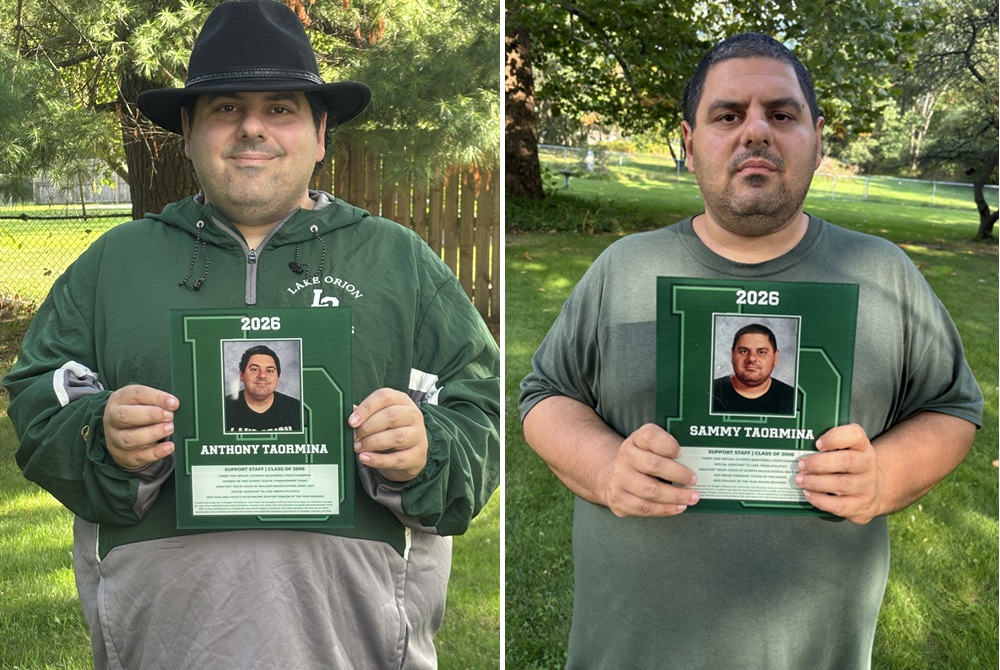
Taorminas Recognized by Lake Orion for Hall of Fame-Level Contributions in Several Roles
By
Keith Dunlap
Special for MHSAA.com
October 1, 2026
LAKE ORION — Sammy and Anthony Taormina are two fantastic examples that you don’t necessarily have to be a great athlete in high school to have a Hall of Fame impact on a school and sports community.
 Twin brothers, the Taorminas are 2006 graduates of Lake Orion High School who were members of the football and track & field teams (Sammy competed in both sports, Anthony in track) but neither stacked stats or accolades most all-state and future college athletes accumulate in high school.
Still, it was a no-brainer when Lake Orion athletic director Chris Bell and a committee chose the Taorminas to become part of the school’s first Hall of Fame class last week.
Simply put, there have been few who have had a bigger impact and served in more roles for the school than the Taorminas over the past two decades.
Both have been statisticians for teams, clock operators, announcers, mentors, and promoters of the school and athletic department. Sammy even has spent time inside a Dragon costume as the school’s mascot.
They regularly host a podcast called “OAA Now,” where coaches from around the league call in to chat and give insight on their teams. The two also have a blog where they regularly break coaching news.
During the spring, both have served as middle school track coaches, mostly presiding over throwers.
More importantly, both work for the district as middle school aides, with their friendliness and knowledge regularly mentoring kids to become better students and people.
“When you make an impact on someone’s life for the positive, then you know you’ve done your job,” Anthony Taormina said.
Students and communities are drawn to the Taorminas not only for how much they help, but because they have overcome obstacles and adversity during their lives. Both have navigated autism and related challenges.
“I originally did not want to be a mentor, but I became one,” said Anthony Taormina, who like Sammy is also a graduate of Oakland University and who served as a team manager for Oakland men’s basketball coach Greg Kampe.
That first Lake Orion Hall of Fame class also included 20 athletes, the 1990 wrestling team that won a Class A championship, and longtime track & field and cross country coach Stan Ford.
Despite all the great athletes inducted such as Mr. Baseball Award winner Randy Frye, Mr. Soccer winner Billy Weaver, all-state girls basketball player Bethany Watterworth and all-state running back Marques Stevenson, the most popular inductees were likely the Taorminas, who five years ago also were named Citizens of the Month by Orion Township.
During a football pregame ceremony Friday before Lake Orion played Rochester Adams, the Taorminas got the loudest ovation from the crowd, likely because both current students and alums know them well.
Sammy Taormina said they found out the news from Bell in August after leaving a doctor’s appointment.
“At first I was like, ‘Please don’t call me, I’m in the doctor’s office,’” he said. “Then I called back and he told me the news we were going into the Hall of Fame. We were just very ecstatic about it.”
Now, the two will have plaques displayed in the school halls for all to see, although students will still love seeing their real faces each and every day.
The Taorminas are as much a part of the fabric and identity of Lake Orion as the Dragon or lake itself, and plan on continuing to put kids first in everything they do for years to come in every role they serve.
“I would always encourage kids to be the best they can be,” Anthony Taormina said. “That’s all you can ask in this game we call life. It’s not a bad thing to be a manager or support staff person because you can be successful while not being a student-athlete. I’ve had a lot of students that may or may not have been athletes, but they end up helping me and Sammy out on several occasions, whether it be on the (score)book or on the (game) clock. Those type of things. I’m extremely proud of that.”

Keith Dunlap has served in Detroit-area sports media for more than two decades, including as a sportswriter at the Oakland Press from 2001-16 primarily covering high school sports but also college and professional teams. His bylines also have appeared in USA Today, the Washington Post, the Detroit Free Press, the Houston Chronicle and the Boston Globe. He served as the administrator for the Oakland Activities Association’s website from 2017-2020. Contact him at [email protected] with story ideas for Oakland, Macomb and Wayne counties.

Working Through Transfer Trends
December 2, 2015
By Jack Roberts
MHSAA Executive Director
One of the responsibilities that schools have asked organizations like the MHSAA to execute is the management of transfer student eligibility. Historically, many associations have linked eligibility to residence ... thus, for some the regulation has been called the “Residency Rule” or “Transfer/Residency Rule,” not merely the “Transfer Rule.”
Over the years, as society became more mobile and families less stable, these rules became more and more complicated; and now, for most state high school associations, this is the regulation that consumes the most (or second) most pages of their handbooks. Over the years, this has also been the regulation most frequently challenged in court.
Over the years, some states have relaxed their transfer rule and others have refined their transfer rule. In either case, the transfer rule remains an imperfect rule, an imperfect net. Sometimes this net snags students who should not be made ineligible, and for those situations all associations have arranged some kind of waiver or appeal process.
And sometimes, and much less easily solved, the net fails to catch the situations it really should ... the transfers that are not hardship related or the result of some very compelling educational need, but those that are obviously for athletic reasons. It is those that we have been most focused on in Michigan.
Our first effort to get at the most problematic transfers was the adoption for the 1997-98 school year of what we called the “Athletic-MOTIVATED Transfer Rule” ... Regulation I, Section 9(E). Examples of an athletic-motivated transfer are included in the rule. The rule only applies to transfer students who do NOT meet any of the stated exceptions for immediate eligibility and are ineligible for one semester under our basic transfer rule. They become ineligible for 180 scheduled school days if there is a finding that the transfer was more for athletics than any other compelling reason.
This effort has not been successful enough because it requires a school that loses a student to another school to promptly allege to the MHSAA office, with supporting documentation, that the transfer was more for athletic reasons than any other compelling reason. The receiving school then must respond to those allegations. Then the executive director makes the decision. The unfortunate result of applying this rule is that it usually causes hard feelings between the schools, and hard feelings toward the executive director by the school decided against. In 17 years, schools have invoked this rule only 45 times.
Our more recent effort to address the most egregious athletic transfers resulted from requests from the coaches associations for wrestling and basketball, which were watching too many students change schools for athletic reasons, usually related to an out-of-season coaching relationship. The new rule – the “Athletic-RELATED Transfer Rule” – is Regulation I, Section 9(F). The difference between Section 9(E) and the newer Section 9(F) is that in 9(F) one school does not have to make and document allegations before staff can act. If MHSAA staff discover or are informed of any of the circumstances listed in 9(F), we can act. Again, the rule only applies to those transfer students whose circumstances do NOT meet one of the automatic exceptions. It applies only to students who are ineligible for a semester under the basic transfer rule. If there is a finding that one of the athletic related “links” exists (usually an out-of-season coaching relationship), then this transfer student who would be ineligible for one semester is made ineligible for 180 scheduled school days.
So far, it appears that 9(F) may be a better deterrent than 9(E). It has been referenced when students are rumored to be transferring, and it has stopped many of those transfers before they occur. We expect 9(F) to be an even better deterrent in 2015-16 because the rule has been broadened to apply to administrators and parents (not just coaches) and to address directing and coordinating athletic activities (not just coaching).
We have said that if this latest effort does not succeed in slowing athletic transfers, then the next step is 180 days of ineligibility – at least in any sport the student played in high school previously – for all transfer students who do not qualify for an exception that permits immediate play. I fear that would catch far too many students who should not be withheld so long from competition and could lead to a period like the early 1980s when the MHSAA, at the request of the state principals association, adopted the core of the transfer rule we have today and which resulted in a period of busiest litigation for the MHSAA when, at one time, the association had more than a dozen cases in court simultaneously on transfer matters. We’ve got to make the current rules work – with tweaks, perhaps; but not with radical revision.