

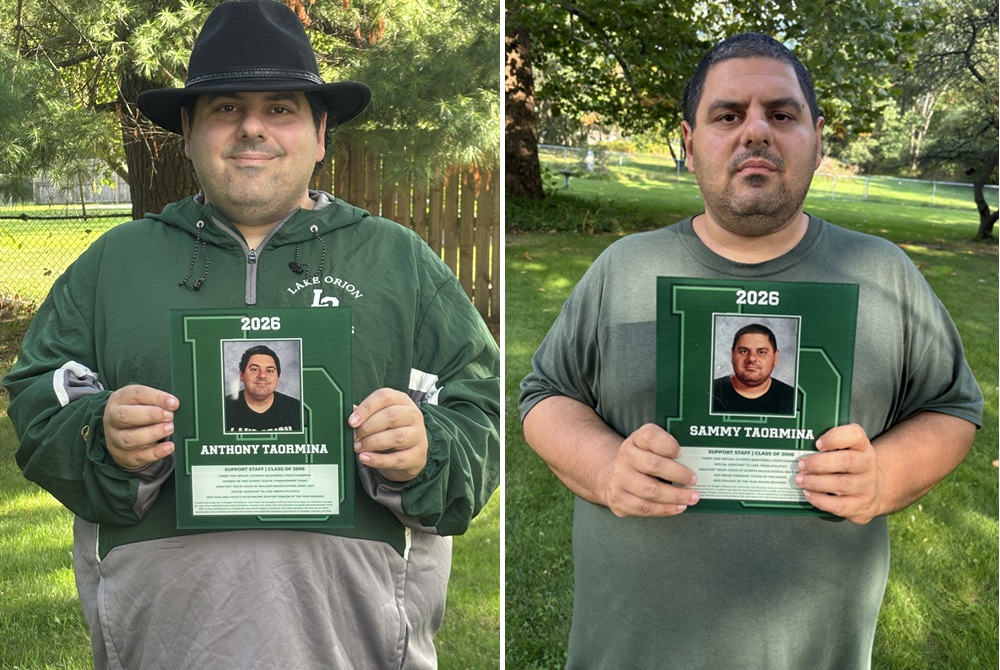
Taorminas Recognized by Lake Orion for Hall of Fame-Level Contributions in Several Roles
By
Keith Dunlap
Special for MHSAA.com
October 1, 2026
LAKE ORION — Sammy and Anthony Taormina are two fantastic examples that you don’t necessarily have to be a great athlete in high school to have a Hall of Fame impact on a school and sports community.
 Twin brothers, the Taorminas are 2006 graduates of Lake Orion High School who were members of the football and track & field teams (Sammy competed in both sports, Anthony in track) but neither stacked stats or accolades most all-state and future college athletes accumulate in high school.
Still, it was a no-brainer when Lake Orion athletic director Chris Bell and a committee chose the Taorminas to become part of the school’s first Hall of Fame class last week.
Simply put, there have been few who have had a bigger impact and served in more roles for the school than the Taorminas over the past two decades.
Both have been statisticians for teams, clock operators, announcers, mentors, and promoters of the school and athletic department. Sammy even has spent time inside a Dragon costume as the school’s mascot.
They regularly host a podcast called “OAA Now,” where coaches from around the league call in to chat and give insight on their teams. The two also have a blog where they regularly break coaching news.
During the spring, both have served as middle school track coaches, mostly presiding over throwers.
More importantly, both work for the district as middle school aides, with their friendliness and knowledge regularly mentoring kids to become better students and people.
“When you make an impact on someone’s life for the positive, then you know you’ve done your job,” Anthony Taormina said.
Students and communities are drawn to the Taorminas not only for how much they help, but because they have overcome obstacles and adversity during their lives. Both have navigated autism and related challenges.
“I originally did not want to be a mentor, but I became one,” said Anthony Taormina, who like Sammy is also a graduate of Oakland University and who served as a team manager for Oakland men’s basketball coach Greg Kampe.
That first Lake Orion Hall of Fame class also included 20 athletes, the 1990 wrestling team that won a Class A championship, and longtime track & field and cross country coach Stan Ford.
Despite all the great athletes inducted such as Mr. Baseball Award winner Randy Frye, Mr. Soccer winner Billy Weaver, all-state girls basketball player Bethany Watterworth and all-state running back Marques Stevenson, the most popular inductees were likely the Taorminas, who five years ago also were named Citizens of the Month by Orion Township.
During a football pregame ceremony Friday before Lake Orion played Rochester Adams, the Taorminas got the loudest ovation from the crowd, likely because both current students and alums know them well.
Sammy Taormina said they found out the news from Bell in August after leaving a doctor’s appointment.
“At first I was like, ‘Please don’t call me, I’m in the doctor’s office,’” he said. “Then I called back and he told me the news we were going into the Hall of Fame. We were just very ecstatic about it.”
Now, the two will have plaques displayed in the school halls for all to see, although students will still love seeing their real faces each and every day.
The Taorminas are as much a part of the fabric and identity of Lake Orion as the Dragon or lake itself, and plan on continuing to put kids first in everything they do for years to come in every role they serve.
“I would always encourage kids to be the best they can be,” Anthony Taormina said. “That’s all you can ask in this game we call life. It’s not a bad thing to be a manager or support staff person because you can be successful while not being a student-athlete. I’ve had a lot of students that may or may not have been athletes, but they end up helping me and Sammy out on several occasions, whether it be on the (score)book or on the (game) clock. Those type of things. I’m extremely proud of that.”

Keith Dunlap has served in Detroit-area sports media for more than two decades, including as a sportswriter at the Oakland Press from 2001-16 primarily covering high school sports but also college and professional teams. His bylines also have appeared in USA Today, the Washington Post, the Detroit Free Press, the Houston Chronicle and the Boston Globe. He served as the administrator for the Oakland Activities Association’s website from 2017-2020. Contact him at [email protected] with story ideas for Oakland, Macomb and Wayne counties.

'Hearts' Focus Includes Action Planning
November 12, 2015
By Geoff Kimmerly
Second Half editor
As most of Michigan’s high school athletes move inside this month for the start of winter sports, many will take part in a program introduced to Michigan High School Athletic Association member schools this fall that assists coaches and students in preparing for the possibility of a health emergency during their after-school practices and events.
Prior to the start of this 2015-16 school year, the MHSAA sent every member school the “Anyone Can Save a Life” emergency action plan authored by the Minnesota State High School League and the Medtronic Foundation. The program instructs schools to assemble teams made up of coaches and their students that will act in the event someone suffers sudden cardiac arrest or another emergency medical situation.
“Anyone Can Save a Life” suggests a game plan that establishes four teams on every level of every sport in a school – a 911 Team, CPR (cardiopulmonary resuscitation) Team, AED (automated external defibrillator) Team and Heat Stroke Team. The groups are made up of coaches and their students who will be in close proximity to all after-school activities.
It’s another valuable tool as the MHSAA begins work on the fourth piece of its eight-year “4 H’s” health and safety emphasis. The next two school years focus on Hearts to go with efforts over the last six years centered on Health Histories, Heads and Heat issues faced by MHSAA athletes. This fall, for the first time, all varsity head coaches at MHSAA member schools were required to have CPR certification – another means by which athletic personnel can work to counter the random, unpredictable nature of sudden cardiac arrest.
“There is something we can do. We can be prepared. We can develop emergency plans, display AEDs and deliver CPR. And, like any good sports teams, we need to practice our preparations,” MHSAA Executive Director John E. “Jack” Roberts said. “’Anyone Can Save a Life’ can help schools revise or revitalize their existing emergency plans in ways that engage team members in planning, practice and execution. This could help save lives now and also convey important lifelong life-saving lessons to students involved on these teams.”
Students are a vital component to having a successful emergency action plan. They will be put in position to call 911, meet the ambulance at a pre-determined access point, locate the nearest AED, make sure immersion tubs are filled for hot-weather practices, and for those who are trained, to assist with CPR. Coaches identify students at the beginning of the season and prior to an emergency taking place, and provide them with the details of the job they are assigned so they will be ready to assist in the event of an emergency.
The “Anyone Can Save a Life” plan was sent to schools nationwide with assistance from the National Federation of State High School Associations and the NFHS Foundation. Click for information on "Anyone Can Save a Life."
“The ‘Anyone Can Save a Life’ initiative promotes the need to have and to practice planning for different kinds of emergencies,” Roberts said. “The result can be a fresh, comprehensive emphasis on preparing for emergencies well before they occur and then responding with more confidence when those emergencies inevitably happen. It is the perfect link between the last two years when we focused on heat illness and the next two years when we focus on sudden cardiac arrest.”
This fall’s focus on “Hearts” began in the wake of 122 Michigan schools receiving recognition this spring as HEARTSafe by the Michigan Department of Health and Human Services, Michigan Department of Education, American Heart Association, Michigan Alliance for Prevention of Sudden Cardiac Death of the Young and the MHSAA.
Public Act 12 of 2014 requires all schools (grades kindergarten to 12) to have a cardiac emergency response plan in place. This MI HEARTSafe School designation recognizes 122 schools that have taken steps above and beyond to prepare to respond in the event of a cardiac emergency, and is awarded for a period of three years.
In order for a school to receive MI HEARTSafe designation, it must perform at least one cardiac emergency response drill per year, have a written medical emergency response plan and team, have current CPR/AED certification of at least 10 percent of staff, have accessible, properly maintained and inspected AEDs with signs identifying their location, and ensure pre-participation sports screening of all student-athletes using the current physical and history form endorsed by the MHSAA.
Schools that meet all requirements are able to apply for the MI HEARTSafe School designation each year. Click for information and for a list of designated schools.