


Taorminas Recognized by Lake Orion for Hall of Fame-Level Contributions in Several Roles
By
Keith Dunlap
Special for MHSAA.com
October 1, 2026
LAKE ORION — Sammy and Anthony Taormina are two fantastic examples that you don’t necessarily have to be a great athlete in high school to have a Hall of Fame impact on a school and sports community.
 Twin brothers, the Taorminas are 2006 graduates of Lake Orion High School who were members of the football and track & field teams (Sammy competed in both sports, Anthony in track) but neither stacked stats or accolades most all-state and future college athletes accumulate in high school.
Still, it was a no-brainer when Lake Orion athletic director Chris Bell and a committee chose the Taorminas to become part of the school’s first Hall of Fame class last week.
Simply put, there have been few who have had a bigger impact and served in more roles for the school than the Taorminas over the past two decades.
Both have been statisticians for teams, clock operators, announcers, mentors, and promoters of the school and athletic department. Sammy even has spent time inside a Dragon costume as the school’s mascot.
They regularly host a podcast called “OAA Now,” where coaches from around the league call in to chat and give insight on their teams. The two also have a blog where they regularly break coaching news.
During the spring, both have served as middle school track coaches, mostly presiding over throwers.
More importantly, both work for the district as middle school aides, with their friendliness and knowledge regularly mentoring kids to become better students and people.
“When you make an impact on someone’s life for the positive, then you know you’ve done your job,” Anthony Taormina said.
Students and communities are drawn to the Taorminas not only for how much they help, but because they have overcome obstacles and adversity during their lives. Both have navigated autism and related challenges.
“I originally did not want to be a mentor, but I became one,” said Anthony Taormina, who like Sammy is also a graduate of Oakland University and who served as a team manager for Oakland men’s basketball coach Greg Kampe.
That first Lake Orion Hall of Fame class also included 20 athletes, the 1990 wrestling team that won a Class A championship, and longtime track & field and cross country coach Stan Ford.
Despite all the great athletes inducted such as Mr. Baseball Award winner Randy Frye, Mr. Soccer winner Billy Weaver, all-state girls basketball player Bethany Watterworth and all-state running back Marques Stevenson, the most popular inductees were likely the Taorminas, who five years ago also were named Citizens of the Month by Orion Township.
During a football pregame ceremony Friday before Lake Orion played Rochester Adams, the Taorminas got the loudest ovation from the crowd, likely because both current students and alums know them well.
Sammy Taormina said they found out the news from Bell in August after leaving a doctor’s appointment.
“At first I was like, ‘Please don’t call me, I’m in the doctor’s office,’” he said. “Then I called back and he told me the news we were going into the Hall of Fame. We were just very ecstatic about it.”
Now, the two will have plaques displayed in the school halls for all to see, although students will still love seeing their real faces each and every day.
The Taorminas are as much a part of the fabric and identity of Lake Orion as the Dragon or lake itself, and plan on continuing to put kids first in everything they do for years to come in every role they serve.
“I would always encourage kids to be the best they can be,” Anthony Taormina said. “That’s all you can ask in this game we call life. It’s not a bad thing to be a manager or support staff person because you can be successful while not being a student-athlete. I’ve had a lot of students that may or may not have been athletes, but they end up helping me and Sammy out on several occasions, whether it be on the (score)book or on the (game) clock. Those type of things. I’m extremely proud of that.”

Keith Dunlap has served in Detroit-area sports media for more than two decades, including as a sportswriter at the Oakland Press from 2001-16 primarily covering high school sports but also college and professional teams. His bylines also have appeared in USA Today, the Washington Post, the Detroit Free Press, the Houston Chronicle and the Boston Globe. He served as the administrator for the Oakland Activities Association’s website from 2017-2020. Contact him at [email protected] with story ideas for Oakland, Macomb and Wayne counties.
Schools Continue to Manage the Heat
July 16, 2015
By Rob Kaminski
MHSAA benchmarks editor
It certainly was not the MHSAA’s intent to spur the most historically frigid back-to-back winters the state has seen. Nor did the Association wish for one of the mildest summers in recent memory during 2014.
Seemingly, it’s just Mother Nature’s way of reading into MHSAA efforts for managing heat and humidity and acclimatizing student-athletes for warm-weather activities.
Since guidelines were put in place (recommended for regular-season sessions and required for postseason tournaments) before the 2013-14 school year, there have been relatively few days during which psychrometers have had to be implemented.
“The key is, we’ve got plans in place for when the climate returns to normal trends for return-to-school practices and contests in August and September, as well as early June events,” said MHSAA Executive Director Jack Roberts. “It is a bit ironic that there have been relatively few days since the guidelines were established that they’ve actually come into play.”
In a nutshell, the guidelines provide instruction for four ranges of heat index: below 95 degrees; 95-99 degrees; 99-104 degrees, and heat indexes above 104 degrees, with increasing precautions in place as heat indexes rise. An index above 104 calls for all activity to cease.
Certified athletic trainers Gretchen Mohney and James Lioy agree that recent requirements in heat and hydration guidelines are a step in the right direction and encourage that – when possible – an athletic trainer oversee the implementation. Simply taking a reading from just outside the AD’s office or at home does not simulate on-site conditions.
“This doesn’t take into account the radiant heat at the site, which can drastically affect the conditions that athlete plays in. It is essential that all parties involved in making decisions to play collaborate with one another,” Mohney said.
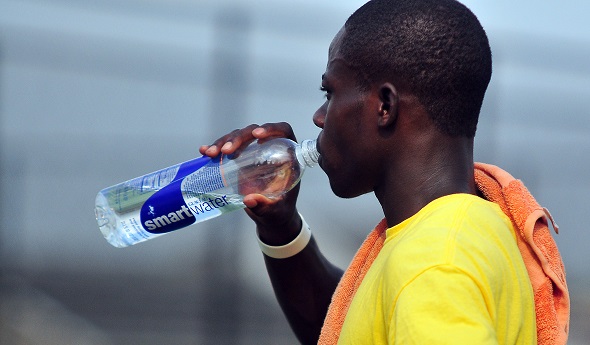
Heat-related deaths in athletics rank only behind cardiac disorders and head and neck injuries, but such fatalities might lead the way in frustration for families and communities of the victims. The reason? Heat-related illness is totally preventable.
Another source of mild frustration is the lack of recording within the state for those practice and game situations which warrant heat protocols.
When the Representative Council was formulating the Heat and Humidity Policy, it was also mindful of ways in which the MHSAA could assist schools in putting the plan into practice. Coaches, athletic directors and trainers needed a method to record information for athletic directors to view and for the MHSAA to track. The MHSAA developed interactive web pages on MHSAA.com which allow registered personnel to record weather conditions as practices and contests are taking place, using psychrometers.
Additionally, discounted Heat and Humidity Monitors and Precision Heat Index Instruments are offered to schools through a partnership between the MHSAA and School Health.
Yet, since the availability of such tools came to fruition two years back, fewer than 1,000 entries have been recorded, and many are multiple entries from the same schools.
Of the 772 entries, only 15 took place when the heat index was in excess of 104, while just 21 indicated an index of greater than 100. Cooler temperatures could be playing a factor in the overall number of participation, particularly in the northern areas of the state.
Nearly all of the responses came during fall practices, with a few isolated cases coming during the spring.
As Mohney pointed out, all resources must be properly used in concert with one another to achieve desired results.
Reminders of the tools available to schools are disseminated throughout the state each summer.