

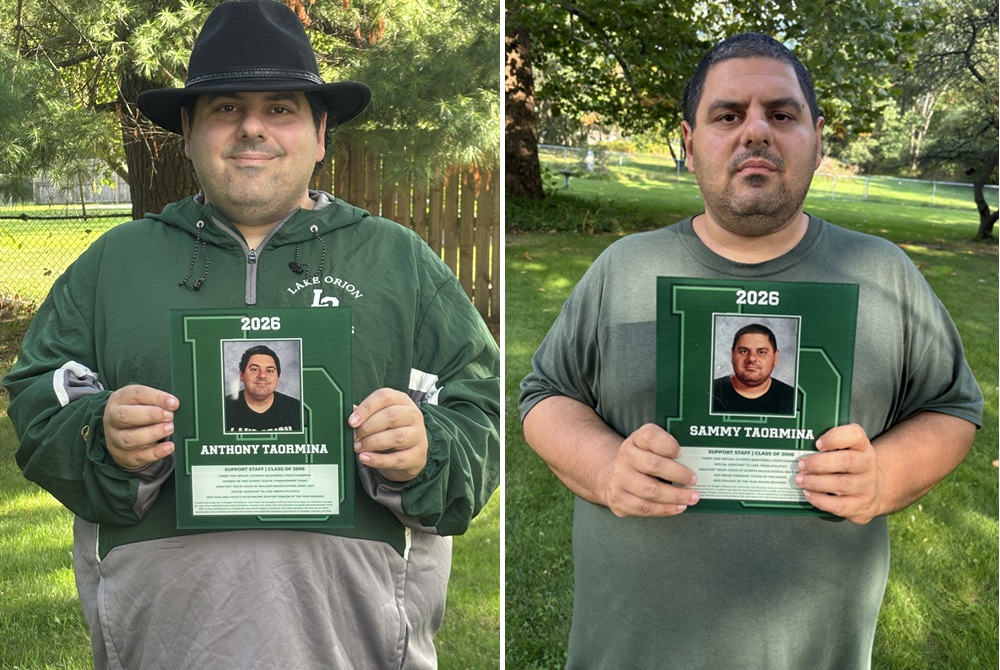
Taorminas Recognized by Lake Orion for Hall of Fame-Level Contributions in Several Roles
By
Keith Dunlap
Special for MHSAA.com
October 1, 2026
LAKE ORION — Sammy and Anthony Taormina are two fantastic examples that you don’t necessarily have to be a great athlete in high school to have a Hall of Fame impact on a school and sports community.
 Twin brothers, the Taorminas are 2006 graduates of Lake Orion High School who were members of the football and track & field teams (Sammy competed in both sports, Anthony in track) but neither stacked stats or accolades most all-state and future college athletes accumulate in high school.
Still, it was a no-brainer when Lake Orion athletic director Chris Bell and a committee chose the Taorminas to become part of the school’s first Hall of Fame class last week.
Simply put, there have been few who have had a bigger impact and served in more roles for the school than the Taorminas over the past two decades.
Both have been statisticians for teams, clock operators, announcers, mentors, and promoters of the school and athletic department. Sammy even has spent time inside a Dragon costume as the school’s mascot.
They regularly host a podcast called “OAA Now,” where coaches from around the league call in to chat and give insight on their teams. The two also have a blog where they regularly break coaching news.
During the spring, both have served as middle school track coaches, mostly presiding over throwers.
More importantly, both work for the district as middle school aides, with their friendliness and knowledge regularly mentoring kids to become better students and people.
“When you make an impact on someone’s life for the positive, then you know you’ve done your job,” Anthony Taormina said.
Students and communities are drawn to the Taorminas not only for how much they help, but because they have overcome obstacles and adversity during their lives. Both have navigated autism and related challenges.
“I originally did not want to be a mentor, but I became one,” said Anthony Taormina, who like Sammy is also a graduate of Oakland University and who served as a team manager for Oakland men’s basketball coach Greg Kampe.
That first Lake Orion Hall of Fame class also included 20 athletes, the 1990 wrestling team that won a Class A championship, and longtime track & field and cross country coach Stan Ford.
Despite all the great athletes inducted such as Mr. Baseball Award winner Randy Frye, Mr. Soccer winner Billy Weaver, all-state girls basketball player Bethany Watterworth and all-state running back Marques Stevenson, the most popular inductees were likely the Taorminas, who five years ago also were named Citizens of the Month by Orion Township.
During a football pregame ceremony Friday before Lake Orion played Rochester Adams, the Taorminas got the loudest ovation from the crowd, likely because both current students and alums know them well.
Sammy Taormina said they found out the news from Bell in August after leaving a doctor’s appointment.
“At first I was like, ‘Please don’t call me, I’m in the doctor’s office,’” he said. “Then I called back and he told me the news we were going into the Hall of Fame. We were just very ecstatic about it.”
Now, the two will have plaques displayed in the school halls for all to see, although students will still love seeing their real faces each and every day.
The Taorminas are as much a part of the fabric and identity of Lake Orion as the Dragon or lake itself, and plan on continuing to put kids first in everything they do for years to come in every role they serve.
“I would always encourage kids to be the best they can be,” Anthony Taormina said. “That’s all you can ask in this game we call life. It’s not a bad thing to be a manager or support staff person because you can be successful while not being a student-athlete. I’ve had a lot of students that may or may not have been athletes, but they end up helping me and Sammy out on several occasions, whether it be on the (score)book or on the (game) clock. Those type of things. I’m extremely proud of that.”

Keith Dunlap has served in Detroit-area sports media for more than two decades, including as a sportswriter at the Oakland Press from 2001-16 primarily covering high school sports but also college and professional teams. His bylines also have appeared in USA Today, the Washington Post, the Detroit Free Press, the Houston Chronicle and the Boston Globe. He served as the administrator for the Oakland Activities Association’s website from 2017-2020. Contact him at [email protected] with story ideas for Oakland, Macomb and Wayne counties.

Athletes: Prepare to Beat the Heat
August 4, 2014
By Geoff Kimmerly
Second Half editor
Despite unseasonably cool temperatures this summer in Michigan, high school athletes should prepare for the heat that usually accompanies August and the beginning of Michigan High School Athletic Association fall practices as they kick off next week.
Each year, the MHSAA provides information to its member schools to help them prepare for hot weather practice and game conditions in the late summer and early fall. Football practice can begin August 11, followed by first practices for all other fall sports August 13.
The topic of heat-related injuries receives a lot of attention at this time of year, especially when deaths at the professional, collegiate and interscholastic levels of sport occur, and especially since they are preventable in most cases with the proper precautions. In football, data from the National Federation of State High School Associations shows that nationally 41 high school players died from heat stroke between 1995 and 2013.
Many MHSAA schools this fall are expected to again follow the MHSAA’s Model Policy for Managing Heat & Humidity that directs schools to monitor heat index prior to and during activity and recommends actions based on those readings.
Also this school year, for the first time, the MHSAA is requiring all assistant and subvarsity coaches at the high school level to complete the same rules and risk minimization meeting requirement as high school varsity head coaches, or, in the alternative, one of several online courses designated for this purpose on MHSAA.com.
“It’s not an accident that causes severe heat illness and death. It’s a lack of attention to what should’ve been taking place, a lack of preparation,” said John E. “Jack” Roberts, executive director of the MHSAA. “We’re trying to communicate to our constituents that if we make the precautions that we should, plan as we should, we will have none of these tragedies in school sports.”
The MHSAA Representative Council adopted in 2013 the Model Policy for Managing Heat & Humidity that, while not mandated for member schools, has been adopted by many at the local level. The plan directs schools to begin monitoring the heat index at the activity site once the air temperature reaches 80 degrees and provides recommendations when the heat index reaches certain points, including ceasing activities when it rises above 104 degrees.
The model policy is outlined in a number of places, including the publication Heat Ways, which is available for download from the MHSAA Website. Heat Ways not only provides the model policy, but addresses the need for proper acclimatization in hot weather.
Heat, hydration and acclimatization also are again focuses of the MHSAA’s required preseason rules meetings for coaches and officials. The online presentation discusses the need for good hydration in sports, regardless of the activity or time of year.
The Health & Safety Resources page of the MHSAA Website has a number of links to different publications and information and a free online presentation from the National Federation of State High School Associations. Visit MHSAA.com, click on “Schools” and then on “Health & Safety Resources” to find the information.
Roberts said the first days of formal practices in hot weather should be more for heat acclimatization than the conditioning of athletes, and that practices in such conditions need planning to become longer and more strenuous over a gradual progression of time.
He added schools also must consider moving practices to different times of day, different locations, or change practice plans to include different activities depending on the conditions.
“I think all schools need to prepare themselves in these ways,” Roberts said. “They need to educate participants, parents and coaches about proper hydration and the dangers of practicing and competing when the heat and humidity are too high.”