


Transfer Regulation Preserves Boundaries
December 1, 2015
By Rob Kaminski
MHSAA benchmarks editor
The conversation, speculation and anticipation begin early each July, building to a crescendo on the last day of the month. It’s the Major League Baseball trade deadline, which has come to overshadow the actual games, rendering numerous teams as quitters with more than a third of the season remaining.
Imagine a similar scene affecting not just one sport, but all sports, a month before each school year begins. Marquette is talking to Grand Haven about a left tackle. Port Huron needs a competitive cheer flyer. Detroit Pershing is looking for a point guard.
Why not? With an increasing number of school-of-choice districts statewide, those students with the means to do so could change jerseys each year.
Thankfully, MHSAA member schools agree to be bound by the rules and regulations of the Association, perhaps none more important to the pursuit of athletic equity than Regulation I, Section 9: the Transfer Regulation. Oft-changed, expanded, misinterpreted, and – at times – circumvented, the MHSAA Transfer Regulation attempts to identify and penalize athletically motivated enrollment decisions.
Origins of the rules involving transfers date to 1925, but the continual evolution has been necessitated by the erosion of geographic boundaries which once defined home turf in school sports.
One recent addition to this vital section of the MHSAA Handbook is commonly referred to as the “links” rule for athletic-related transfers, which went into effect prior to the 2014-15 school year.
“If I could summarize a global opinion from the phone calls I take from administrators around the state, it’s this: ‘enough is enough,’” said MHSAA Associate Director Tom Rashid, explaining the impetus for the most recent codicil. He estimates that 75 percent of the multitude of phone and written correspondence he entertains involves transfer issues and waiver requests.
The most recent changes include links from non-school and previous school teams; international student enrollment, and enhanced subvarsity participation. Those components, an overview of the Regulation and expansion to its current breadth and depth, and possible modifications for the future will serve to illustrate the rule’s importance to high school sports in Michigan, keeping the games local and community based, allowing people to root for the home team.
Rule That's Transferred Through the Decades
From the first Constitution of the MHSAA in 1924 through the most recent modifications in the 2015-16 Handbook in which nine pages are dedicated to student transfer issues, a regulation has been in place to govern athletic participation for students changing schools. While exceptions and details have grown, the basic premise has largely stayed the same. In 1924, students changing schools were required to sit one semester prior to participating in athletics, even those returning home from military schools such as Culver Academy in Indiana. Over the years the rule was weakened by allowing the two school principals to make exceptions. As one might imagine, such authority proved too whimsical from situation to situation, and even-handed governance became problematic. Eventually, Michigan’s association of principals asked the MHSAA for a more stringent rule which was adopted in the early 1980s, closely resembling its current form.
“The transfer/residency rule is a legally and historically tested but still imperfect tool to control athletic-motivated transfers and other abuses. It is a net which catches some students it should not, and misses some students that should not be eligible,” said MHSAA Executive Director Jack Roberts. “This is why all state high school associations have procedures to review individual cases and grant exceptions.”
As the old adage states, “There is an exception to every rule.” Or, in the case of the MHSAA Transfer Regulation, 15 of them, in an attempt to not penalize students who change districts for legitimate circumstances unrelated to athletic participation (See the “Exceptions” inset below).
Perhaps the most oft-used exception of the Transfer Regulation is that which involves full and complete residential changes, in which the “Rule of Four” is then applied. When a student meets the residency requirement, he or she has immediate eligibility at the school of the new residence or closest nonpublic or charter school closest to the new home in drivable roadway miles. The fourth option is eligibility at the former school after the move.
“This ‘Rule of Four’ provides a geographic boundary for nonpublic and charter schools to even the playing field with the public school whose new student-athletes also must abide by a boundary,” Rashid said.
Other exceptions involve more extenuating circumstances, and even one which is not an exception at all in the case of first-time 9th-graders, who are eligible for the first day of activity in any sport at the school in which they enroll. The exceptions fall under three main categories: Residency, School Status and Student Status, as a way of simplifying the rule.
There are many common reasons for changing schools which are not exceptions to the “sit out” period. Among these non-exceptions are “school-of-choice” enrollment after starting the 9th grade, returning to the school of residence after attending as a school-of-choice student, guardianship, being unable to afford tuition, transferring because the former school does not offer a sport or sports, or cancels a sport team. These students are not eligible for approximately one-half the school year.
Rashid conducts in-service meetings around the state each fall, in addition to hosting multiple training sessions at the MHSAA building each year for new athletic directors. Regulation 1, Section 9 receives heavy emphasis, and if attendees have one take-away from each session, it should be this: “When in doubt, sit them out and find out.”
“The energy and efforts of this office to educate administrators on the transfer rule which has become more complicated have helped to insure eligibility for those who qualify,” Rashid said. “There’s no substitute for experience, and our veteran ADs statewide are quite familiar with the rules. We attempt to give the new ADs a basic understanding and encourage them to contact our office for clarification on any issue, at any time. Our darkest days are when ineligible athletes participate and schools are required to forfeit contests.”
When schools believe they have compelling cases, requests for waivers are submitted for review by the MHSAA Executive Committee on a monthly basis. The vast majority of these requests involve the Transfer Regulation, although numbers have been on the decline in recent years. The 2007-08 school year saw 372 waiver requests for the Transfer Regulation hit the MHSAA office, with 275 cases being approved. During 2014-15, 300 such requests were received, and 213 were approved.
The recent decline can be attributed to a number of factors.
“Our Executive Committee does a wonderful job of reviewing and deciding the multitude of waiver requests while maintaining this rule which has existed for some time,” Rashid said. “The minutes of each meeting are public, and schools will often check to see if similar cases have been approved before they go through with a request to MHSAA staff.
“I don’t think there’s been a decrease in students changing schools, but there’s better communication between MHSAA staff and schools pertaining to the rule, which might tend to decrease the number of requests for waiver.”
The apex of waiver requests might have correlated with the number of students who took advantage of Michigan’s school-of-choice landscape as its popularity grew near the turn of the century, which led to a misunderstanding of enrollment versus athletic eligibility.
In 1996, the state of Michigan made it easier for parents to choose their child's school from among those in their own and neighboring public school districts. By 2001 according to the Michigan Department of Education, 283 out of 554 districts were participating in Michigan's state schools-of-choice plan, and, without a doubt, it was the first time many were exposed to the MHSAA’s Transfer Regulation for athletic eligibility.
“Our transfer rule is sometimes difficult for the public to grasp due to school-of-choice laws,” Rashid said. “Often times, the public has school-of-choice mentality regarding enrollment. But there is a difference between enrollment and athletic eligibility. I feel badly for those who move and expect immediate eligibility at the new school without understanding the consequences. School-of-choice legislation both respects and permits MHSAA transfer rule ineligibility.”
In fact, the MHSAA transfer rule provided for choice in athletics well before it was available in Michigan education. Long before school of choice was popularized, the MHSAA transfer rule allowed first-time 9th-graders the choice of attending any school in Michigan which would allow them to enroll, and have immediate athletic eligibility. Subsequent changes in enrollment would result in at least one semester of ineligibility for interscholastic athletics unless the student's circumstances complied with one of the 15 stated exceptions.
“As school-of-choice options were expanded for students' enrollment, it has had no effect on the rules governing athletic eligibility,” said Roberts. “Those introducing and passing the bills did not want the legislation to provide a free pass for more students to change schools for sports, and effectively undermine the intended positive educational purposes of expanded parental choice in public education.”
School of choice is here to stay, certainly. However, according to a recent article in Bridge Magazine, families aren’t always finding the grass greener in neighboring school yards.
According to the story: “In 2012-13 alone, 26,305 students transferred from their home districts to school-of-choice districts (in Michigan, grades K-12). That same school year, 16,138 transferred out of school-of-choice districts, most of whom likely returned to the schools they would attend by residency.”
All of the instability keeps MHSAA member school administrators and MHSAA staff on their collective toes. Societal change continues to keep one of the oldest MHSAA rules at the forefront, and also drives further evolution of the rule.
With school of choice, the instance of a student’s changing schools for athletic reasons has increased and become more difficult to pinpoint. Add the increasing dependence on non-faculty coaches within schools and the related increased profile of non-school youth sports programs, and it’s the perfect storm for swelling athletic transfer issues.
Recent years have also thrown an additional curveball into the arsenal. Not only are students from neighboring communities roaming the hallways on the first day of school, but students from foreign countries have posed increased eligibility concerns.
“During the most recent decade, increasing numbers of students from foreign countries have been enrolling in U.S. schools on F-1 visas, and without being placed by approved programs,” Roberts said. “And once again questions related to unscrupulous placements and competitive balance emerged.”
Both festering issues addressed in the preceding paragraphs have led to the recent and more stringent Transfer Regulation modifications.
Mending Fences with Stronger Links
As Roberts alluded to in discussing the origins of the Transfer Regulation, it is a dragnet which serves the membership well, yet can never catch all intended targets, while sometimes reeling in those with legitimate cases. Over time, the gate can be weakened or exposed in some areas, and it’s time to reinforce the links.
On May 5, 2013, the MHSAA adopted a rule – known appropriately as the “links” rule – which advocates believe is more straightforward than the athletic motivated section of the Transfer Regulation and is a needed next step to address increasing mobility of students between schools. The rule took effect in August 2014 and links certain described activities to a longer period of ineligibility after a transfer. It intends to catch some of the most overt and egregious of transfers for athletic reasons.
“This rule was born of frustrations expressed to the MHSAA staff by coaches associations in wrestling and basketball,” Rashid said. “Kids were consistently changing schools after non-school, offseason contact with individuals from other districts. Under the old rule, they’d sit half the year, then play the second half, which includes the state tournament.
“It is also born from the most well publicized, ridiculous situations where students were transferring into the schools of a former coach or personal trainer who was newly hired,” Rashid said. “Except for an occasional instance when the rule hits home, ADs file this under ‘enough is enough’ and so many administrators have applauded the efforts.”
In general terms, this portion of the transfer rule Section 9(F), increases ineligibility for transfers not meeting a stated exception from 90 school days to 180 in situations as follows:
If a student has played on a team at one high school and transfers to another where he or she is ineligible, the period of ineligibility is extended to 180 scheduled school days if, during the previous 12 months, this student ...
- Participated at an open gym at the high school to which the student has transferred.
- Participated as an individual or on a non-school team or activity coached, coordinated or directed by any of that high school’s parents, administrators or coaches in the sport involved (this rule is sport-specific) for either gender. This includes summer basketball teams with school coaches if a student participated prior to registering to attend that school.
- Has a personal sport trainer, conditioner or instructor who is a coach at the high school to which the student has transferred.
- Transfers to a school where his or her previous high school coach is now employed.
Unlike Section 9(E), this new Section 9(F) does not require one school to allege athletic motivation. If one of the four athletic related links exists, the student is ineligible for 180 scheduled school days.
After just one year in practice, the “links” component has shown strength.
“I think it’s had a few effects. I know from my phone conversations that it has certainly deterred some students from changing schools,” Rashid said. “It has clearly increased awareness of people who participate in non-school programs and then change schools. It’s heightened awareness of recruiting, which is the basis of the rule, and school-shopping because of sport.
“The rules can serve best in advance of a transfer to discourage changing schools for sports. We encourage ADs to inform prospective transfer students and parents of the anti-recruiting rule and all parts of the transfer rule before they attempt to change schools.”
Maxing Out the Visa
As difficult a task as it is to police meanderings from school district to school district throughout Michigan, the influx of enrollment from other countries adds an entirely new level of complexity.
Responding to the growing number of international exchange students taking classes in Michigan schools and the potential effect on equity in school sports, the MHSAA Representative Council adopted new rules for 2014-15 intended to treat J-1 and F-1 visa students similarly and to minimize the disparate impact of Federal Law on public schools in comparison to non-public schools.
“Until recently, foreign exchange students were primarily here on J-1 visas; they ‘journeyed’ here and ‘journeyed’ back after one year,” Rashid said. “We’ve seen a growing number of F-1 students who can have only one year in a public school, but then have multiple years at non-public schools. So our rule invoked two years ago said we are going to treat both types of exchange students the same. Play one year, then sit one year, no matter what kind of school.”
For those asking how many individuals this could possibly affect, consider this: the state of Michigan ranked second nationally in the number of exchange students hosted by its schools in 2014-15, and in years prior was No. 1 by a long shot. More than 2,500 students were here on F-1 or J-1 visas a year ago, a significant number indeed.
The tipping point for taking action was the 2013-14 school year when several high-profile situations occurred involving F-1 visa students, some of whom received the maximum penalty for a violation of undue influence (the anti-recruiting rule) – a calendar year of ineligibility.
The penalty has since increased to up to four years of ineligibility for a student or four years of suspension for a coach or disconnection of an adult associated with the school. The undue influence rule applies to all students, grades 7-12 including international students.
The key changes (applicable to international students not enrolled [attending classes] in an MHSAA member school during the 2013-14 school year) include:
- The automatic exception which allows immediate eligibility for first-time-ever 9th-graders does not apply to international students.
- Only those international students (J-1 or F-1) enrolled under Transfer Rule Exception 1, 2, 3, 5, 8, 12 or 13, or placed through an MHSAA “Approved International Student Program,” can have varsity eligibility.
- Those international students who are placed through an MHSAA Approved International Student Program are immediately eligible for one academic year and then ineligible for one academic year (“Play One, Wait One”).
- Other international students have no varsity eligibility. After the normal (approximately one semester) waiting period for transfer students, local schools may provide those students subvarsity eligibility, regardless of grade level and previous sports experience and without MHSAA Executive Committee approval.
A list of approved AISP organizations appears on MHSAA.com.
Subvarsity Clause Encourages Participation
One of the unintended consequences of the subvarsity component for transfers was that it failed to account for smaller schools or individual sports in which no freshman or JV teams existed. The most recent iteration of the rule now provides eligibility for such students.
As a result of changes made for 2015-16, a transferring 9th- or 10th-grade student, who has never played in a high school scrimmage or game and is granted an Executive Committee waiver in advance of participation, may now be eligible in individual varsity heats, matches or races on a non-scoring basis. Previously, subvarsity eligibility was only for team sports with 9th-grade or JV teams. This expansion, with an approved waiver for a student who meets the above criteria, would permit some non-scoring involvement in cross country, golf, swimming & diving or track & field on a non-scoring basis where there is no separate JV team. This would not apply to relay teams in swim or track if they will be scored within the varsity race.
Eyes Forward
The three modifications related to the Transfer Regulation put into action during the last two years illustrate just how volatile, mobile and unstable boundaries and communities have become. Another way to look at it is how expansive a rule has become to regulate a part of the world that has become so small.
With that in mind, while the recent actions purport to quell the most egregious transfer eligibility issues currently brought to light, state association leadership must keep heads up and eyes forward for potential concerns on the horizon.
“There may be a large percentage of the MHSAA’s constituents who do not believe the links rule goes far enough; that this should be applied to all transfer students, not merely those whose transfer does not fit one of the 15 stated exceptions which allows for immediate eligibility,” Roberts said. “That could become the MHSAA’s next step in fighting one of the most aggravating problems of school-based sports today.”
Rashid points out that some states require that their executive staffs sign off on all transfers. For smaller states, that might be practical, but he fears that task would be unwieldly for the MHSAA, which has more than 700 member high schools.
Like Roberts, Rashid also can see a push coming for one year of ineligibility for all transfers not meeting prescribed exceptions, but warns of possible complications.
“Would such a step lead to more litigation and would it also net some who simply want to be part of a team?” he asks. “Would it also invite ineligibility for those who change schools for socialization issues? It sometime feels like the tail wagging the dog. I’d like more hard data. How many transfers are there overall, and how many transfers are even involved in athletics and to what extent?”
Future discussion could involve a combination of thoughts, according to Rashid, including a rule which is sport-specific. That is, transfers may become eligible for any sport after half a year, except for sports which they played at the former school at the varsity level. In those sports, the period of ineligibility would be a full year. Some would like to tighten the new links rule by applying 180 days of ineligibility to a transfer who has a sports connection to the new school (link) even if the student meets an exception or changes residence.
Those are topics for another day, but ones which the MHSAA is sure to keep in the forefront as it discusses and monitors the most recent upgrades – just as its leadership has done since 1924.
15 Exceptions for Immediate Eligibility
8 RESIDENCY EXCEPTIONS
- Student moves with the people he/she was living with previously (full & complete)
- Not living with either parent moves back to them +
- Ward of the Court, placed with foster parents
- Students from an Approved International Student Program (AISP on F-1 or J-1 visa) placed with host family in district. Play 1 year, wait 1 year. Non-AISP may have subvarsity only for all years without waiver after sitting out (through Martin Luther King Day or Aug. 1 depending on when enrolled)
- Married student moves into school district
- Student moves with or to divorced parent +
- An 18 year old moves without parents +
- A student resides in a boarding school +
5 SCHOOL STATUS EXCEPTIONS
- School ceases to operate, not merged (Handbook Int. 64 & 90)
- School is reorganized or consolidated
- School Board orders safety or enrollment shift transfer
- Achieved highest grade available in former school
- New school established; enrolled on first day
2 STUDENT STATUS EXCEPTIONS
- Incoming 9th-grader not here on an F-1 or J-1 visa
- Expelled student returns under pre-existing criteria
+Four exceptions are allowed once in grades 9-12.
Transfers and Subvarsity Status
The Executive Committee has the authority to approve immediate eligibility at the subvarsity level for transferring 9th or 10th-grade students (after entering 9th grade, before completing 10th grade) who have not previously participated in an interscholastic scrimmage or contest in any MHSAA sport at the high school level (whether MHSAA member schools or not) and who do not qualify for one of the 15 stated exceptions to the transfer regulation and have transferred for reasons having nothing to do with athletics, discipline or family finances and would not require Executive Committee evaluation or comparison of school demographics or curriculum.
Note: Subvarsity eligibility under this Section permits participation in the following scrimmages or contests (but not in MHSAA tournaments):
- Non-varsity team sports: Teams consisting primarily of 9th- and/or 10th-graders and against other teams primarily of 9th-and/or 10th-graders.
- Individual sports subvarsity level: Races or heats, designated as subvarsity for all participants in that heat or race and not scoring within a varsity meet.
- Individual sports without a subvarsity level: On a non-scoring basis in the same events and even in the same heats/foursomes/rotations of those events designated as varsity level competition. Participation in relays would not be permitted if it is intended that the relay score within a varsity contest.
- In 1, 2 and 3 above:
- This is not an opportunity for ineligible students to participate; it is only for those students who are eligible by rule or by MHSAA Executive Committee action.
- This does not require schools to conduct non-scoring events or sub-varsity competition.
- This does not create opportunities for “exhibitions” in sports where such is not permitted.

Fresh from Cancer Fight, Disbrow Returns to Coaching Ready to Continue 'Winning the Day'
By
Doug Donnelly
Special for MHSAA.com
September 16, 2026
Nikki Disbrow grabbed her keys and started to get into the family vehicle to pick up her son from a summer 7-on-7 practice. Her husband, Sand Creek football coach Sid Disbrow, told her he wanted to come, too.
 “What are you doing?” she asked. “You can barely walk.”
Sid, who had just returned home from surgery to have a tumor removed while battling colorectal cancer for the second time in three years, wasn’t having it. He got in the vehicle.
When Nikki arrived at the field, Sid opened the door.
“Where are you going?” she asked.
Sid, unrelenting, got out of the car and began making his way to the field.
“She was kind of my walker,” he said. “I couldn’t walk on my own, but I needed to address the kids. I needed to be out there. I needed to show them that it’s about winning the day, because you never know what might happen.”
Disbrow, 49, has been coach for just about 30 years. It’s part of who he is in the Sand Creek school district and community. He’s been an assistant football coach, youth baseball and softball coach, varsity boys and middle school basketball coach. He’s detailed, organized, loves the competition and thrives on being around kids.
Last year around the eighth or ninth week of the football season, he began noticing the symptoms of the cancer he had chemotherapy and radiation to treat a couple years prior. He finished the season, knowing middle school basketball was getting ready to start.
Within a week of finding out the cancer had indeed returned, he was able to get everything scheduled and begin chemotherapy. He was getting treated at Flower Hospital in Sylvania, Ohio, about 45 minutes from Sand Creek.
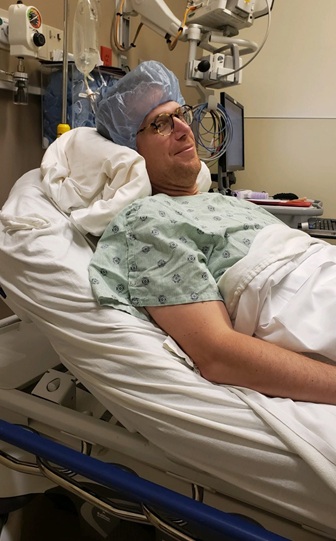 “They would give me the last appointment of the day so I could get there after school,” he said. “They were great to work with.”
It wasn’t easy trying to maintain a rigorous coaching schedule while fighting cancer.
“There are no rules in cancer. You don’t get to do as you wish. Chemotherapy is real,” Disbrow said.
He wasn’t deterred. He coached the entire middle school basketball season – which ended around Christmas. Some days, he was exhausted. Still, quitting wasn’t an option.
“I wanted to be out there for my son and all of the other kids that I’ve been coaching all the way through,” he said. “That was important to me. That was my driving force.”
Not long after basketball season ended, he began eight weeks of radiation. It ended just in time for him to coach his son’s baseball team.
After that season ended, something still wasn’t right. Doctors found a tumor, although they weren’t sure if it was shrinking or growing. They gave him an option – surgery to remove it or wait a few months, get tested again. At that point, if it returned, it meant starting chemotherapy and radiation all over again. He checked the calendar.
“I thought about football season,” he said. “My son is on JV this year. That’s not something I want to miss.”
He went in for surgery and had the tumor successfully removed. Doctors found out later it was indeed cancerous and growing.
“I made the right decision,” he said.
He was recovering from that round of surgery when he made it onto the football field to talk to the Aggies players. The football field is more than a place for Disbrow to forget all about cancer and focus on the lives of the young men on the field. It’s a place him and Nikki, a former varsity volleyball coach at Sand Creek herself, got married.
“It’s probably the first time there was a wedding on the football field, and probably the last time,” he said.
On Aug. 3 – one week before two-a-days started for Sand Creek – he found out the cancer was in remission. He was back with the team when practice began.
“I brought my lawn chair with me,” he said. “There were some days where I just didn’t have the strength.”
Through it all, he’s endured, never wavering.
“The credit goes to God,” he said. “I don’t see how people go through something like this without their faith. I owe it all to Him. He’s given me this chance to continue to teach and coach. I don’t take that lightly.”
 Sand Creek varsity football coach Derek Hewitt said seeing Disbrow come back to practice after all he went through was inspiring. Disbrow coaches special teams, the quarterbacks and helps Hewitt with the offense. On most Fridays he’s in the coach’s box.
“It’s great to have him back out there,” Hewitt said. “He’s not the scout team quarterback anymore, but he’s there, every day. It’s great for me to have him by my side.”
One thing Disbrow is not planning to do is stop coaching. In fact, he’s going to be even busier. He was recently named the school’s junior varsity boys basketball head coach.
“Coaching really kept me going through all of this,” he said. “The kids have been great through it all.”
The father of four is from Morenci, the neighboring town to the south and heated rival of Sand Creek, which he admits caused some angst when he moved from coaching football at his alma mater to Sand Creek.
He was part of the 1995 Morenci football team that played for a Class C championship in the Pontiac Silverdome, graduating in 1996. He was a sophomore at Adrian College when a Morenci coach asked him to join that coaching staff. A couple years later he began coaching at Sand Creek.
Now, he, his wife and four kids are engrained in the Aggies community.
“I wasn’t one of those people who got into teaching because I wanted to coach,” he said. “I wanted to be a teacher, to be around young people and help them. Coaching was something I loved once I started doing it. It’s who we are now as a family. It’s part of our lives.”
 Doug Donnelly has served as a news and sports reporter at the Adrian Daily Telegram and the Monroe News for 30 years, including 10 years as city editor in Monroe. He's written a book on high school basketball in Monroe County and compiles record books for various schools in southeast Michigan. He is now publisher and editor of The Blissfield Advance, a weekly newspaper. E-mail him at [email protected] with story ideas for Jackson, Washtenaw, Hillsdale, Lenawee and Monroe counties.
PHOTOS (Top) Sand Creek assistant football coach Sid Disbrow mans the headset while on the sideline during a game. (Middle) Disbrow lays in a hospital bed while receiving care in 2023. (Below) Disbrow stands for a photo with wife Nikki last fall. (Top photo by Becky Serin. Hospital and family photos courtesy of the Disbrow family.)