


Beginning Another Tourney Journey
August 8, 2016
Below is the introductory commentary to the MHSAA's spring issue of benchmarks. Histories of MHSAA tournaments published in that issue have been appearing on Second Half every Tuesday and Friday.
By Jack Roberts
MHSAA Executive Director
Concussions and cutbacks. Participation fees and part-time employment. Student safety and specialization. International students and interstate travel. Transfers and trials.
Through a myriad of issues which periodically cloud our mission, the foundation on which the MHSAA was built still shines brightest three times each year: Tournament Time!
It can be daunting and overwhelming to make a living at this business of interscholastic athletics these days, not to mention a tad confusing. Do we need legal degrees? Medical degrees? Business degrees? Marketing degrees? There seems to be no escape from threat of legislative mandates which continually change the landscape of our product and how it’s delivered. Demands pile up, resources dwindle.
Add the daily challenges of scheduling issues, inclement weather and pleasing teenagers and their parents on a daily basis, and it’s easy to lose focus of the primary missions for the MHSAA and its member schools.
And then, scenes like this happen:
• Holly Bullough, a senior cross country runner from Traverse City St. Francis takes her second straight Division 3 championship, winning by 36.4 seconds ... with a stress fracture in her left foot.
• Detroit Martin Luther King QB Armani Posey directs a game-winning drive to give his school the Division 2 football championship ... a drive which started on his own 3-yard line with 37 seconds left and ended with a 40-yard heave to receiver Donnie Corley on the final play of the game.
• Leland sweeps the Class D volleyball title match 3-0 over Battle Creek St. Philip ... ending a string of nine straight titles for St. Phil, the 10th longest national streak in history.
• Davison’s Taylor Davis becomes only the fourth person in MHSAA Girls Bowling history to roll a 300 game in the Singles portion of the tournament ... and the first ever in the championship match.
• The Upper Peninsula’s Hancock HS wins the Division 3 ice hockey title in its first trip to the Final since 2000 ... a trip funded in part from a “Go Fund Me” web page that raised $6,620 from 99 donors in two days.
• Junior Kierra Fletcher of Warren Cousino carries her team to the Class A girls basketball championship with 27 points in the Final ... after scoring 37 of her team’s 60 points in the Semifinals and totaling 198 during eight tournament games.
That’s just a sampling of the magic from last fall and winter.
These moments shine through the current challenges and the unseen future that awaits us as they always have. The uniforms and faces are different, but the tournaments have always yielded the fruits of our labors, and the memories for our mental scrapbooks.
PHOTO: Leland's volleyball team hoists its Class D championship trophy last fall at Kellogg Arena.
Century of School Sports: Why Does the MHSAA Have These Rules?
By
Geoff Kimmerly
MHSAA.com senior editor
September 18, 2024
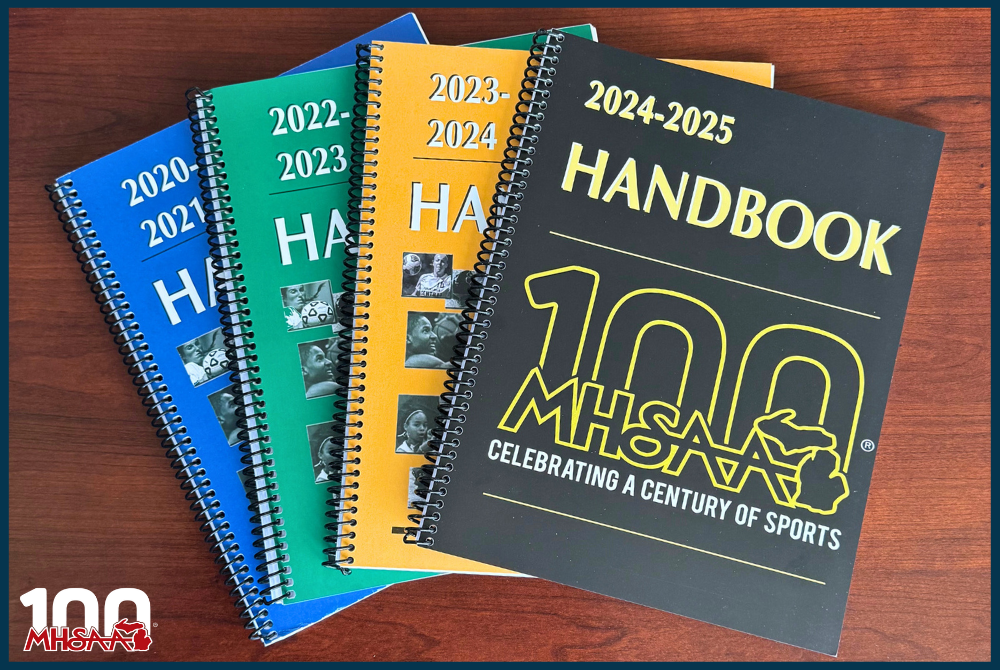
MHSAA administrators are two trips into their annual seven-stop fall tour that has become a tradition during nearly half of the Association’s “Century of School Sports” – and this year, a focus has been on answering a key question at the heart of educational athletics since long before the MHSAA was formed during the 1924-25 school year.
The MHSAA’s Update meeting series is in its 47th year and includes half-day conferences in seven locations – generally in the Kalamazoo, Metro Detroit, Grand Rapids, Saginaw, northern Lower Peninsula and mid-Michigan areas, and at Northern Michigan University in Marquette. The six Lower Peninsula sessions begin with an athletic director in-service during which MHSAA assistant directors explain recent rules changes and discuss challenges our administrators face on a daily basis (with Upper Peninsula athletic directors participating in a similar in-service during the spring).
Those in-services are followed by a session with executive director Mark Uyl, who speaks to athletic directors, superintendents, principals and school board members on a variety of topics including the MHSAA’s current objectives and ideas for the future, while also reinforcing the longstanding values that remain the bedrock of our daily work.
And that leads to the question he’s presenting across the state this fall:
Why does the MHSAA have these rules?
Frankly, the answer goes back to the beginning of school sports in Michigan – all the way back to 1895, when the first MHSAA predecessor organization was formed.
The first MHSAA Representative Council president Lewis L. Forsythe explained in his book “Athletics in Michigan High Schools – The First Hundred Years” how regulations always have been necessary:
“Eligibility rules are a necessity in interscholastic competition. It was common acknowledgement of this fact that led to the first State inter-school organization in 1895. The rules at first were few, simple and liberal. But with the passing of the years they came to be more numerous, more complex, and more restrictive, again through common acknowledgment of desirability if not of necessity.”
That necessity – and the reasoning behind it – has not changed.
Two main points explain why rules are absolutely imperative for educational athletics to thrive.
► 1. Participation – through providing as many opportunities as possible for students to play – has been the mission of school sports since their start. Rules contribute to the value of participation.
If there are requirements for children to participate in athletics – for example, an academic standard or rules that dissuade students from switching schools every year – then school sports programs mean more to all involved.
If we raise the bar, raise the standards of eligibility and conduct, we raise the value of our school sports programs. If we lower the bar, we lower the value of being part of school sports – because without rules, contest results are meaningless, and the value of participating is diminished.
► 2. We have rules where the stakes are higher, and agreement is lower – because where the stakes are highest, there is the greatest tendency for some people to try to gain an unfair advantage, and the greatest need for rules to curb possible dishonest activity.
This statement goes to the heart of the history, rationale and application of MHSAA rules. Obviously and simply put, school sports mean a lot to those who take part, and that significance is high enough to stoke disagreement – and we need rules to govern those disagreements. We have the most rules for high school sports, where championships are at stake and the possibility of disagreement is greatest.
***
Finally – and perhaps providing the strongest reinforcement of the two points above – is this:
Schools choose to make MHSAA rules their own.
Quite literally, school districts vote annually to be part of the MHSAA – and confirming this voluntary membership comes with the requirement to follow all MHSAA rules.
When schools challenge our rules, they literally are seeking to break the rules they already have committed to uphold.
These rules, and this commitment, are the strength of our organization across 752 member high schools and several hundred more middle schools and junior high schools. They have been constructed on a century of precedents and after considerations by representatives of those same member schools – representatives those schools have voted to elect every school year during the MHSAA’s history.
Previous "Century of School Sports" Spotlights
Sept. 10: Special Medals, Patches to Commemorate Special Year - Read
Sept. 4: Fall to Finish with 50th Football Championships - Read
Aug. 28: Let the Celebration Begin - Read