

Beginning Another Tourney Journey
August 8, 2016
Below is the introductory commentary to the MHSAA's spring issue of benchmarks. Histories of MHSAA tournaments published in that issue have been appearing on Second Half every Tuesday and Friday.
By Jack Roberts
MHSAA Executive Director
Concussions and cutbacks. Participation fees and part-time employment. Student safety and specialization. International students and interstate travel. Transfers and trials.
Through a myriad of issues which periodically cloud our mission, the foundation on which the MHSAA was built still shines brightest three times each year: Tournament Time!
It can be daunting and overwhelming to make a living at this business of interscholastic athletics these days, not to mention a tad confusing. Do we need legal degrees? Medical degrees? Business degrees? Marketing degrees? There seems to be no escape from threat of legislative mandates which continually change the landscape of our product and how it’s delivered. Demands pile up, resources dwindle.
Add the daily challenges of scheduling issues, inclement weather and pleasing teenagers and their parents on a daily basis, and it’s easy to lose focus of the primary missions for the MHSAA and its member schools.
And then, scenes like this happen:
• Holly Bullough, a senior cross country runner from Traverse City St. Francis takes her second straight Division 3 championship, winning by 36.4 seconds ... with a stress fracture in her left foot.
• Detroit Martin Luther King QB Armani Posey directs a game-winning drive to give his school the Division 2 football championship ... a drive which started on his own 3-yard line with 37 seconds left and ended with a 40-yard heave to receiver Donnie Corley on the final play of the game.
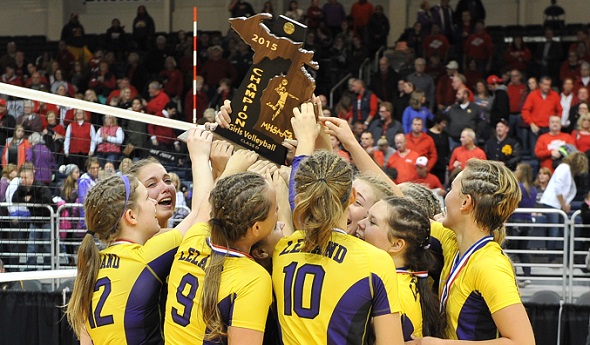
• Leland sweeps the Class D volleyball title match 3-0 over Battle Creek St. Philip ... ending a string of nine straight titles for St. Phil, the 10th longest national streak in history.
• Davison’s Taylor Davis becomes only the fourth person in MHSAA Girls Bowling history to roll a 300 game in the Singles portion of the tournament ... and the first ever in the championship match.
• The Upper Peninsula’s Hancock HS wins the Division 3 ice hockey title in its first trip to the Final since 2000 ... a trip funded in part from a “Go Fund Me” web page that raised $6,620 from 99 donors in two days.
• Junior Kierra Fletcher of Warren Cousino carries her team to the Class A girls basketball championship with 27 points in the Final ... after scoring 37 of her team’s 60 points in the Semifinals and totaling 198 during eight tournament games.
That’s just a sampling of the magic from last fall and winter.
These moments shine through the current challenges and the unseen future that awaits us as they always have. The uniforms and faces are different, but the tournaments have always yielded the fruits of our labors, and the memories for our mental scrapbooks.
PHOTO: Leland's volleyball team hoists its Class D championship trophy last fall at Kellogg Arena.
Why Athletes Should See A Sport Psychologist
By
Elizabeth Swanson
Henry Ford Health
January 9, 2024
Whether at the professional or intramural level, there are so many benefits to being an athlete. Participating in a sport teaches communication skills, how to overcome adversity—and regular exercise has so many incredible health effects on the mind and body.
 But that’s not to say athletes don’t have their own set of challenges. Pressures to perform, physical injuries and intense schedules can take a toll on anyone’s mental health, which is where a sport psychologist comes in.
“It’s helpful that a sport psychologist knows the culture of athletics and the typical stressors that athletes face,” says Seth Swary, Ph.D., a sport psychology clinician at the Henry Ford Center for Athletic Medicine. “We’re familiar with the influence the world of athletics can have on someone and how it can affect their well-being.
“Athletes have a whole team around them to help them perform — athletic trainers, nutritionists, etc.— so why shouldn’t they have an expert who is dedicated to supporting their mental health? A sport psychologist acts as a strength-training coach for the mind.”
Mental Health Challenges That Athletes Face & How Sport Psychology Can Help
Athletes often have a built-in support system: teammates and coaches who know what they’re going through and trainers and physicians who can help manage aches and injuries. But still, it’s not always easy. Some of the difficulties that athletes face include:
- Increased attention on body image. Especially if you play a sport that requires revealing outfits — or a sport with increased focus on weight — it might be difficult to maintain a healthy body image. For some, this can lead to an increased risk of developing an eating disorder.
- The pressure to perform. “If you’re an athlete at the college or professional level and play badly during a game, you get roasted on Twitter,” says Dr. Swary. “But even if you’re not in the public eye, there is pressure to perform — from coaches, teammates, family members.”
- Navigating demanding schedules. “I work with many college athletes and their schedules are packed — practicing at least two hours a day, team meetings, traveling to and from games — and then they’re trying to keep up with school,” says Dr. Swary. “It can be stressful.”
- Debilitating physical injuries. The physical demand of sports can also bring about its own set of challenges — especially when injuries occur. “You’re not only dealing with surgery and rehabilitation, but you’re also out of the game for a while,” says Dr. Swary.
- Making career transitions. “I’ve worked with many athletes who are transitioning from one level of athletics to another (for example, middle school to high school, high school to college, college to professional) along with athletes who are transitioning out of their career,” says Dr. Swary. “They wonder how they can leave this sport they’ve been doing their whole lives — some since they were 3 or 4 years old. It can be a huge part of their identity and a tough transition to make. Even more so if it’s an injury that abruptly derails their career. We can provide them with ways to make a smooth, healthy transition.”
That said, nothing “bad” has to happen to benefit from sport psychology. As Dr. Swary says, you don’t see a personal trainer because you’re not strong, you see a personal trainer because you could benefit from being stronger. It’s the same with sport psychology — and it can help improve your performance.
“We have specific skills we work on for performance optimization,” says Dr. Swary. “How do we talk to ourselves? How do we respond in certain situations? How do we stay in the moment when we’re distracted?
“A high school athlete may have had a rough day at school; then they have to refocus and find energy at the end of the day for their game. It can be helpful for any athlete at any time.”
Reviewed by Seth Swary, Ph.D., a sport psychology clinician at the Henry Ford Center for Athletic Medicine.
To learn more about the sport psychology program at Henry Ford or to request an appointment, visit henryford.com/sportpsychology.