

Beginning Another Tourney Journey
August 8, 2016
Below is the introductory commentary to the MHSAA's spring issue of benchmarks. Histories of MHSAA tournaments published in that issue have been appearing on Second Half every Tuesday and Friday.
By Jack Roberts
MHSAA Executive Director
Concussions and cutbacks. Participation fees and part-time employment. Student safety and specialization. International students and interstate travel. Transfers and trials.
Through a myriad of issues which periodically cloud our mission, the foundation on which the MHSAA was built still shines brightest three times each year: Tournament Time!
It can be daunting and overwhelming to make a living at this business of interscholastic athletics these days, not to mention a tad confusing. Do we need legal degrees? Medical degrees? Business degrees? Marketing degrees? There seems to be no escape from threat of legislative mandates which continually change the landscape of our product and how it’s delivered. Demands pile up, resources dwindle.
Add the daily challenges of scheduling issues, inclement weather and pleasing teenagers and their parents on a daily basis, and it’s easy to lose focus of the primary missions for the MHSAA and its member schools.
And then, scenes like this happen:
• Holly Bullough, a senior cross country runner from Traverse City St. Francis takes her second straight Division 3 championship, winning by 36.4 seconds ... with a stress fracture in her left foot.
• Detroit Martin Luther King QB Armani Posey directs a game-winning drive to give his school the Division 2 football championship ... a drive which started on his own 3-yard line with 37 seconds left and ended with a 40-yard heave to receiver Donnie Corley on the final play of the game.
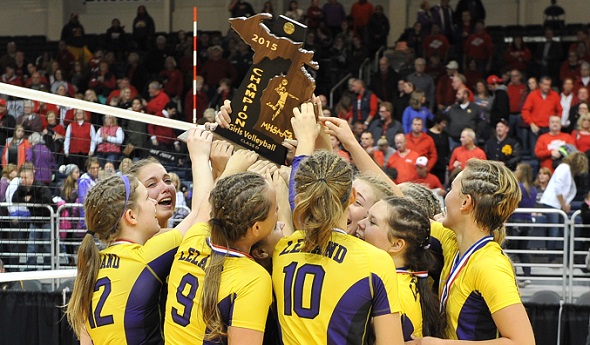
• Leland sweeps the Class D volleyball title match 3-0 over Battle Creek St. Philip ... ending a string of nine straight titles for St. Phil, the 10th longest national streak in history.
• Davison’s Taylor Davis becomes only the fourth person in MHSAA Girls Bowling history to roll a 300 game in the Singles portion of the tournament ... and the first ever in the championship match.
• The Upper Peninsula’s Hancock HS wins the Division 3 ice hockey title in its first trip to the Final since 2000 ... a trip funded in part from a “Go Fund Me” web page that raised $6,620 from 99 donors in two days.
• Junior Kierra Fletcher of Warren Cousino carries her team to the Class A girls basketball championship with 27 points in the Final ... after scoring 37 of her team’s 60 points in the Semifinals and totaling 198 during eight tournament games.
That’s just a sampling of the magic from last fall and winter.
These moments shine through the current challenges and the unseen future that awaits us as they always have. The uniforms and faces are different, but the tournaments have always yielded the fruits of our labors, and the memories for our mental scrapbooks.
PHOTO: Leland's volleyball team hoists its Class D championship trophy last fall at Kellogg Arena.

Is My Student Athlete's Pain More Than Just Growing Pains?
February 14, 2023
There are a few factors that can make student athletes prone to injury. They might be overusing their muscles (thanks to a more rigorous exercise regimen), and they might not yet have developed the proper technique for their sport.
 “These factors, combined with the fact that student athletes have growing bodies that they’re still getting used to—especially after a growth spurt — can make them more prone to injury,” says Nancy White, M.D., a sports medicine physician with Henry Ford Health System.
However, just because your child is feeling pain doesn’t necessarily mean they’ve sustained an injury. There is such a thing as growing pains, although the term may be misleading. “Most experts feel that growth itself does not cause pain,” says Dr. White. “The most likely reason for ‘growing pains’ is overuse of the muscles, causing pain and soreness after an activity.”
These growing pains typically occur at the front of the thighs, the back of the knees and the calves, she says, and occur commonly in the late afternoon, evening, or night. If your child is experiencing pain outside of these areas or times of day, it might not be growing pains — and it’s a good idea to get it checked out by a doctor.
Tell-Tale Signs That Pain Should Be Examined
If the pain goes away by the next day — if your child has rested during night and feels better the next morning — there’s no need for concern. But you should head to the doctor if:
► the pain is lingering into the next day.
► the pain is also accompanied by bruising, swelling or redness.
► the pain is so intense that they’re unable to put weight on their legs.
“In these cases, don’t wait — the longer you wait, the more dangerous the injury can become,” says Dr. White.
How Student Athletes Can Help Prevent Injuries
Encourage your child to take proper precautions and maintain healthy habits, all of which can lower the likelihood that they’ll sustain an injury. Dr. White recommends the following tips:
- Maintain proper technique. “Knowing and understanding the movements needed for whatever sport they practice is so important,” says Dr. White. “Figure skating and gymnastics are two sports where I tend to see injuries more often during growth phases. These athletes are often learning difficult skills at a time in their lives when they’re going through a growth spurt, and that combination can lead to injury.”
- Stretch before and after playing a sport. “Try dynamic stretching — where you’re actually moving while stretching — instead of static stretching, where you’re holding the stretch,” says Dr. White. “Dynamic stretching is a great warm up. It can help improve flexibility and reduce the risk of injury.”
- Strength train, especially in the core and limbs. Doing so will help create stable, strong muscles to keep the body properly aligned and lessen the chances of injury.
- Eat a balanced diet and stay hydrated. While it’s normal for kids to have sugar every once in a while, filling the bulk of their diet with plenty of water, fresh fruits and vegetables, healthy protein, fats and carbohydrates will help them function to their best ability.
- Get enough rest each night. Sleep is necessary for health and well-being in general, but when it comes to athletes, rest is incredibly important to help their bodies recuperate. In general, kids need about 10 hours of sleep per night. So if your child plays a sport, you want to really be sure that they’re hitting that 10-hour mark, says Dr. White.
Dr. Nancy White is a sports medicine physician with Henry Ford Health System. She sees patients at Henry Ford Medical Center – Columbus in Novi, and Henry Ford Medical Center — Bloomfield Township.
Want to learn more? Henry Ford Health System sports medicine experts are treating the whole athlete, in a whole new way. From nutrition to neurology, and from injury prevention to treatment of sports-related conditions, they can give your athlete a unique game plan. To find a sports medicine physician at Henry Ford, visit henryford.com or call 1-800-436-7936.