

Beginning Another Tourney Journey
August 8, 2016
Below is the introductory commentary to the MHSAA's spring issue of benchmarks. Histories of MHSAA tournaments published in that issue have been appearing on Second Half every Tuesday and Friday.
By Jack Roberts
MHSAA Executive Director
Concussions and cutbacks. Participation fees and part-time employment. Student safety and specialization. International students and interstate travel. Transfers and trials.
Through a myriad of issues which periodically cloud our mission, the foundation on which the MHSAA was built still shines brightest three times each year: Tournament Time!
It can be daunting and overwhelming to make a living at this business of interscholastic athletics these days, not to mention a tad confusing. Do we need legal degrees? Medical degrees? Business degrees? Marketing degrees? There seems to be no escape from threat of legislative mandates which continually change the landscape of our product and how it’s delivered. Demands pile up, resources dwindle.
Add the daily challenges of scheduling issues, inclement weather and pleasing teenagers and their parents on a daily basis, and it’s easy to lose focus of the primary missions for the MHSAA and its member schools.
And then, scenes like this happen:
• Holly Bullough, a senior cross country runner from Traverse City St. Francis takes her second straight Division 3 championship, winning by 36.4 seconds ... with a stress fracture in her left foot.
• Detroit Martin Luther King QB Armani Posey directs a game-winning drive to give his school the Division 2 football championship ... a drive which started on his own 3-yard line with 37 seconds left and ended with a 40-yard heave to receiver Donnie Corley on the final play of the game.
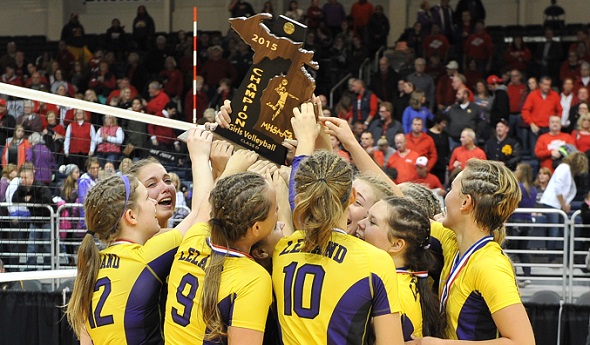
• Leland sweeps the Class D volleyball title match 3-0 over Battle Creek St. Philip ... ending a string of nine straight titles for St. Phil, the 10th longest national streak in history.
• Davison’s Taylor Davis becomes only the fourth person in MHSAA Girls Bowling history to roll a 300 game in the Singles portion of the tournament ... and the first ever in the championship match.
• The Upper Peninsula’s Hancock HS wins the Division 3 ice hockey title in its first trip to the Final since 2000 ... a trip funded in part from a “Go Fund Me” web page that raised $6,620 from 99 donors in two days.
• Junior Kierra Fletcher of Warren Cousino carries her team to the Class A girls basketball championship with 27 points in the Final ... after scoring 37 of her team’s 60 points in the Semifinals and totaling 198 during eight tournament games.
That’s just a sampling of the magic from last fall and winter.
These moments shine through the current challenges and the unseen future that awaits us as they always have. The uniforms and faces are different, but the tournaments have always yielded the fruits of our labors, and the memories for our mental scrapbooks.
PHOTO: Leland's volleyball team hoists its Class D championship trophy last fall at Kellogg Arena.
Bloomingdale Trainer Performing Invaluable Role in Keeping Athletes Playing
By
Pam Shebest
Special for MHSAA.com
November 22, 2022
BLOOMINGDALE — If Scott Allison looks bored during one of Bloomingdale’s sporting events, that is a good thing.
 “Trainers like to be behind the scenes and in the shadows,” the certified athletic trainer said. “We’re only needed in emergencies.
“It’s one of those jobs that if we’re sitting around looking bored, then things are going well.”
But if an athlete goes down with an injury, Allison is quick to run onto the court or field.
In his first year at Bloomingdale, he has found that working with middle and high school students is a lot different than his previous work with the minor-league hockey Kalamazoo Wings.
Treating the hockey team, with whom he spent much of his 22 years, “There was a lot of traumatic stuff like lacerations or deep contusions, overuse injuries like hip flexors or core injuries or broken bones.
“Everything’s acute and fast. It’s a different animal. In hockey, they’re all pro athletes so they know their bodies really well.”
However, high school and middle school athletes are still in a growing phase.
“These kids don’t really know what’s going on a lot of times, so it’s a lot more education on what’s happening,” Allison said.
“Is it an injury, or is it just soreness? You get a lot of kids that don’t understand the difference between aches and pains or an injury. We see a lot of ankle sprains or shin splints because they’re just developing. They’re in that awkward range where their bodies try to grow too fast.”
 Allison is the Cardinals’ first certified athletic trainer, a new position for which athletic director Jason Hayes campaigned.
“What we notice is that if a kid’s injured, they’re out a lot less if you have a trainer because it speeds up recovery time,” said Hayes, who also coaches varsity football and is an assistant wrestling coach. “It’s like having a built-in physical therapist on your staff, too.”
Studies support Hayes’ statements.
According to information from The Sports Institute at University of Washington, “‘The athletic trainers know the athletes,” says Stan Herring, M.D., cofounder of The Sports Institute at (University of Washington) Medicine and a team physician for the Seattle Seahawks and Seattle Mariners. “They see the athletes frequently, if not every day. They know when something is wrong. They are medical professionals who evaluate, treat and rehabilitate athletes.’”
The article continued: “Three recent studies suggest that athletic trainers are linked to significant improvements in the diagnosis of concussion in young athletes and significant reductions in ‘time-loss’ injuries that require athletes to take time away from sports.”
Allison sees himself as a teacher as well as a trainer.
“We see a lot more strains or growth issues,” he said. “A lot of it is maintenance and teaching kids what’s going on with their bodies or what they need to do to change things.”
He also meets with parents and coaches to talk about the best way to prevent injuries.
Allison’s day begins about 1:30 or 2 p.m., giving athletes a chance to talk with him before practices or games.
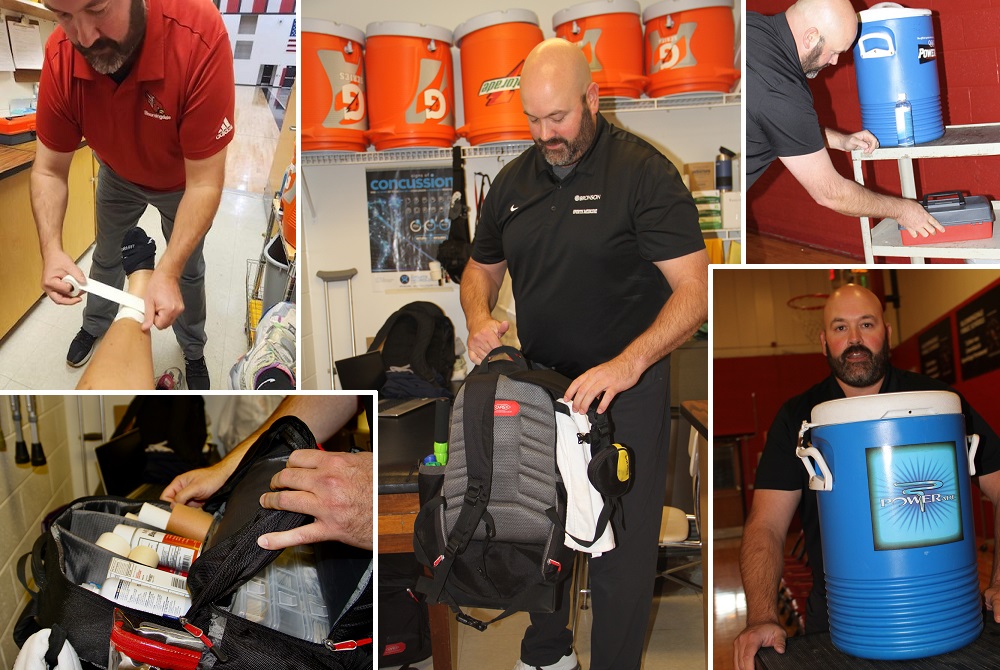
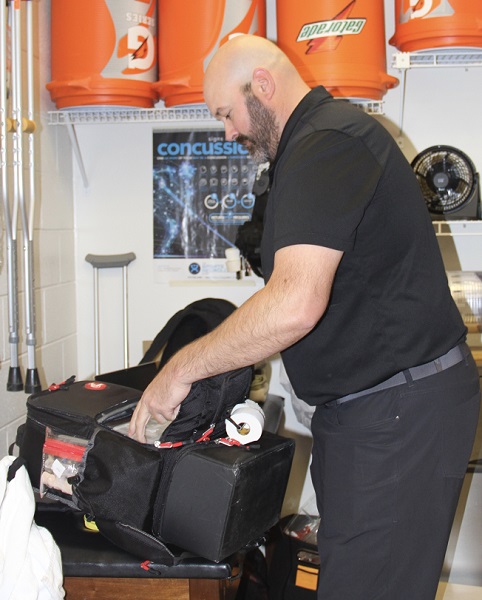
During the action, he always has his first aid backpack filled with the basics: air splints for fractures or dislocations, AED, EpiPens, and bench kits (with taping and bandaging supplies, splints, gauze, ACE wraps, ice bags, latex gloves and other basic first aid supplies.)
He travels with the teams when they are involved in high-impact sports, such as football, and many times he is also called to treat an opposing player if that team has no trainer.
 Allison is a perfect fit with Bloomingdale, Hayes said.
His wife, Kirsten, coached the Cardinals girls basketball team for seven years. His daughter Emma, now at Glen Oaks Community College, graduated from there, and his daughter Bailey is an eighth grader.
“We are a very lucky town,” Hayes said. “We had Doc (Robert) Stevens, who had been volunteering as our athletic trainer for 15 years. He’s just aging out.
“About a year ago, he came to me and said that it was his last year. Scott has 22 years experience, and he has relationships here. To me, it was a no-brainer.”
Assistant varsity football coach Lance Flynn, who also coaches the middle school football team, saw Allison in action during competition in the fall.
“First quarter in a middle school football game, a kid broke his arm,” Flynn said. “My own son, Ryder, was on the varsity team and he sprained his AC socket and Scott took care of him.
“If something happens during a game, they can go see him and I don’t have to worry much because I know they’re in good hands.”
Allison’s affiliation with Bronson Sports Medicine is also a plus, the trainer said.
“With Bronson, we can offer a lot more and expedite getting in to see doctors or specialists if we need to,” he said. “We’re on the same system as the doctors, so we can diagnose and send notes to the doctors and they can send notes back to us.
“If there’s anybody we need to keep track of with the doctors, I can talk with the doctors and figure out how that’s going. If anybody needs to see me, they know I’m here early if they just want to come down to talk.”
Bronson also provides certified athletic trainers at 21 other southwest Michigan high schools: Brooke Vandepolder (Battle Creek Central), Lindsay Aarseth-Lindhorst (Climax-Scotts), Amanda Monsivaes (Comstock), Makenzie Hodgson (Delton Kellogg), Salvador Robles-Soriano (Gobles), Holly Ives (Richland Gull Lake), Katelyn Baker-Contreras (Kalamazoo Hackett Catholic Prep), Lizzy Smith (Kalamazoo Central), Emma Beener (Kalamazoo Christian), Holly Sisson (Kalamazoo Loy Norrix), Nico Talentino (Mattawan), Aaron Eickhoff (Otsego), Quincey Powell (Parchment), Malorie Most (Paw Paw), Jessica Bakhuyzen (Plainwell), Lance LeTourneau (Portage Central), Janelle Currie (Portage Northern), Carrie Calhoun (Schoolcraft), Chelsea Harrison (South Haven), Alexis Walters (Three Rivers) and Natalie McClish (Vicksburg).
 Pam Shebest served as a sportswriter at the Kalamazoo Gazette from 1985-2009 after 11 years part-time with the Gazette while teaching French and English at White Pigeon High School. She can be reached at [email protected] with story ideas for Calhoun, Kalamazoo and Van Buren counties.
PHOTOS (Top) Bloomingdale trainer Scott Allison has several tasks as he works to keep the school’s student-athletes healthy and pain-free. (Middle) Bloomingdale athletic director Jason Hayes, left, and assistant varsity football coach Lance Flynn. (Below) Allison packs his bag for another full afternoon. (Ankle-taping photo by Andreya Robinson; all other photos by Pam Shebest.)