

Beginning Another Tourney Journey
August 8, 2016
Below is the introductory commentary to the MHSAA's spring issue of benchmarks. Histories of MHSAA tournaments published in that issue have been appearing on Second Half every Tuesday and Friday.
By Jack Roberts
MHSAA Executive Director
Concussions and cutbacks. Participation fees and part-time employment. Student safety and specialization. International students and interstate travel. Transfers and trials.
Through a myriad of issues which periodically cloud our mission, the foundation on which the MHSAA was built still shines brightest three times each year: Tournament Time!
It can be daunting and overwhelming to make a living at this business of interscholastic athletics these days, not to mention a tad confusing. Do we need legal degrees? Medical degrees? Business degrees? Marketing degrees? There seems to be no escape from threat of legislative mandates which continually change the landscape of our product and how it’s delivered. Demands pile up, resources dwindle.
Add the daily challenges of scheduling issues, inclement weather and pleasing teenagers and their parents on a daily basis, and it’s easy to lose focus of the primary missions for the MHSAA and its member schools.
And then, scenes like this happen:
• Holly Bullough, a senior cross country runner from Traverse City St. Francis takes her second straight Division 3 championship, winning by 36.4 seconds ... with a stress fracture in her left foot.
• Detroit Martin Luther King QB Armani Posey directs a game-winning drive to give his school the Division 2 football championship ... a drive which started on his own 3-yard line with 37 seconds left and ended with a 40-yard heave to receiver Donnie Corley on the final play of the game.
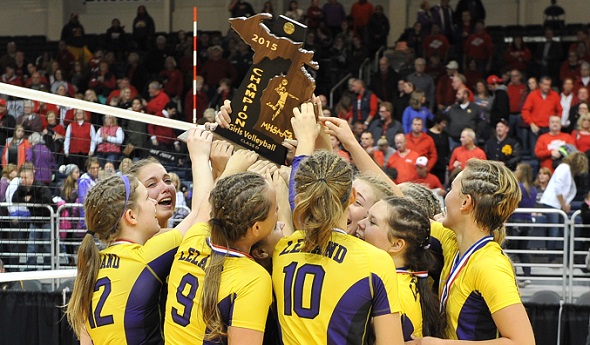
• Leland sweeps the Class D volleyball title match 3-0 over Battle Creek St. Philip ... ending a string of nine straight titles for St. Phil, the 10th longest national streak in history.
• Davison’s Taylor Davis becomes only the fourth person in MHSAA Girls Bowling history to roll a 300 game in the Singles portion of the tournament ... and the first ever in the championship match.
• The Upper Peninsula’s Hancock HS wins the Division 3 ice hockey title in its first trip to the Final since 2000 ... a trip funded in part from a “Go Fund Me” web page that raised $6,620 from 99 donors in two days.
• Junior Kierra Fletcher of Warren Cousino carries her team to the Class A girls basketball championship with 27 points in the Final ... after scoring 37 of her team’s 60 points in the Semifinals and totaling 198 during eight tournament games.
That’s just a sampling of the magic from last fall and winter.
These moments shine through the current challenges and the unseen future that awaits us as they always have. The uniforms and faces are different, but the tournaments have always yielded the fruits of our labors, and the memories for our mental scrapbooks.
PHOTO: Leland's volleyball team hoists its Class D championship trophy last fall at Kellogg Arena.
When Can I Walk Off Knee Pain — And When Should I See A Doctor?
June 7, 2022

Whether you wake up with a stiff knee, sustain an injury, or start feeling knee pain for seemingly no good reason, you might wonder what to do. Should you immediately rush off to the doctor? Can you just ignore it and hope it will get better? Can you treat it yourself? Knowing when you need a doctor’s intervention can be a tricky decision to make.
We see people at the start of injuries and after they’ve been ongoing,” says Nancy White, M.D., a sports medicine physician at Henry Ford Health. “While the sooner you see an expert, the better, there’s really no right or wrong to it. However, there are a few key signs that it’s a good idea to get it checked out.”
Dr. White recommends seeing a doctor if:
► You are waking up with consistent knee stiffness. If there’s no history of an injury involved, it could be due to osteoarthritis or rheumatoid arthritis.
► If your knee pain isn’t going away.
► Your knee is swollen and you can’t bear weight on it.
► You can’t fully flex or extend your knee.
► Your knee is warm to the touch. This could signal inflammation.
If your pain is mild — or you’re trying to decide whether to see someone — Dr. White recommends icing it on a scheduled basis. “That means two to three times a day,” she says. “Apply the ice to your knee. It will get cold. It will burn, then it will get numb. Remove the ice when it gets to the numb stage.”
She also recommends elevating your leg and putting a compression wrap or sleeve on your knee. If the pain is bad, you can try taking ibuprofen or naproxen for a few days.
Common Causes of Knee Pain
But if your knee is not getting better, it’s a good idea to see a doctor, as common causes of knee pain include:
► ACL sprains and tears. Short for anterior cruciate ligament, the ACL is one of four ligaments in the knee that allows it to flex and extend. The ACL can tear when your foot is firmly planted in place, and the knee locks and twists or pivots at the same time.
► MCL sprains and tears. Short for medial collateral ligament, the MCL connects your shinbone to your thighbone. It can tear when landing after a jump, or after an exterior blow to the knee (usually during contact sports). Luckily, most MCL injuries heal on their own.
► Meniscal tears. The menisci are your knee’s shock absorbers; they're two discs made of soft cartilage. Abrupt movements (like pivots, stops, turns, squats or lifts) can cause them to tear.
► Kneecap dislocation. A direct hit to the knee — or a sudden twist or pivoting of the leg — can make the kneecap can shift out of place.
► Patellar tendonitis. This is also known as Jumper’s Knee, as it’s a common injury in basketball and volleyball players. The patellar tendon connects the bottom of the kneecap to the top of the shinbone, and can become inflamed from overuse, excessive force or repetitive stress.
Knee bursitis. The bursa is a small, fluid-filled sac located near the knee joint. Knee bursitis occurs when the bursa becomes inflamed, often because of a knee injury or overuse from frequent kneeling.
How to Help Prevent Knee Pain
And if you want to help prevent knee pain in the future? “Exercise regularly so that you’re strengthening your quadriceps, hamstrings and gluteal muscles,” says Dr. White. “It’s also important to stretch to increase quadricep and hamstring flexibility.”
Wearing shoes with sturdy soles and proper arch support can also help ease pain and issues you may already have, says Dr. White. “I would say the top reasons people get into trouble with their knees are things they could prevent by changing lifestyle habits. This includes maintaining a healthy weight, as being overweight can also lead to increased wear and tear on the joints.
To learn more about your orthopedic condition or to find a provider, visit henryford.com/ortho.
Dr. Nancy White is a sports medicine physician at Henry Ford Health. She sees patients at Henry Ford Medical Center – Novi, and Henry Ford Medical Center — Bloomfield Township.