

Beginning Another Tourney Journey
August 8, 2016
Below is the introductory commentary to the MHSAA's spring issue of benchmarks. Histories of MHSAA tournaments published in that issue have been appearing on Second Half every Tuesday and Friday.
By Jack Roberts
MHSAA Executive Director
Concussions and cutbacks. Participation fees and part-time employment. Student safety and specialization. International students and interstate travel. Transfers and trials.
Through a myriad of issues which periodically cloud our mission, the foundation on which the MHSAA was built still shines brightest three times each year: Tournament Time!
It can be daunting and overwhelming to make a living at this business of interscholastic athletics these days, not to mention a tad confusing. Do we need legal degrees? Medical degrees? Business degrees? Marketing degrees? There seems to be no escape from threat of legislative mandates which continually change the landscape of our product and how it’s delivered. Demands pile up, resources dwindle.
Add the daily challenges of scheduling issues, inclement weather and pleasing teenagers and their parents on a daily basis, and it’s easy to lose focus of the primary missions for the MHSAA and its member schools.
And then, scenes like this happen:
• Holly Bullough, a senior cross country runner from Traverse City St. Francis takes her second straight Division 3 championship, winning by 36.4 seconds ... with a stress fracture in her left foot.
• Detroit Martin Luther King QB Armani Posey directs a game-winning drive to give his school the Division 2 football championship ... a drive which started on his own 3-yard line with 37 seconds left and ended with a 40-yard heave to receiver Donnie Corley on the final play of the game.
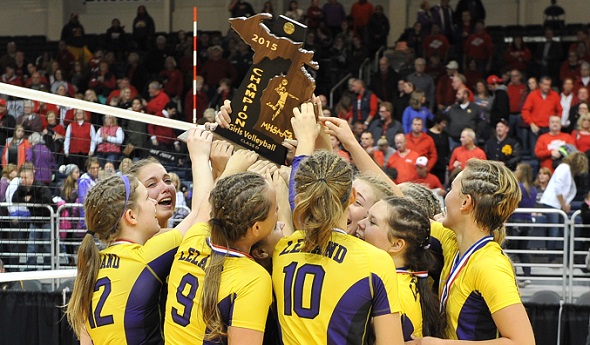
• Leland sweeps the Class D volleyball title match 3-0 over Battle Creek St. Philip ... ending a string of nine straight titles for St. Phil, the 10th longest national streak in history.
• Davison’s Taylor Davis becomes only the fourth person in MHSAA Girls Bowling history to roll a 300 game in the Singles portion of the tournament ... and the first ever in the championship match.
• The Upper Peninsula’s Hancock HS wins the Division 3 ice hockey title in its first trip to the Final since 2000 ... a trip funded in part from a “Go Fund Me” web page that raised $6,620 from 99 donors in two days.
• Junior Kierra Fletcher of Warren Cousino carries her team to the Class A girls basketball championship with 27 points in the Final ... after scoring 37 of her team’s 60 points in the Semifinals and totaling 198 during eight tournament games.
That’s just a sampling of the magic from last fall and winter.
These moments shine through the current challenges and the unseen future that awaits us as they always have. The uniforms and faces are different, but the tournaments have always yielded the fruits of our labors, and the memories for our mental scrapbooks.
PHOTO: Leland's volleyball team hoists its Class D championship trophy last fall at Kellogg Arena.
Is Baseline Concussion Testing Right For You?
November 2, 2021

Did you know there’s a test that can aid your recovery if you sustain a concussion?
Read on to get the facts about baseline testing from Michelle Gambino-Gorney, a certified athletic trainer for Henry Ford Health System.
What Is Baseline Concussion Testing?
“Baseline testing is an evaluation of your normal brain function that tests for neurocognitive abnormalities,” explains Gambino-Gorney. “We recommend baseline testing prior to the start of a sports season, before tryouts or practice.”
During baseline concussion testing, athletic trainers or physicians collect extensive information about an athlete’s brain health. They evaluate health, family history and neurocognitive function. Gambino-Gorney says that might include assessing everything from balance and reflexes to memory, vision and concentration. “If the athlete does sustain a concussion during the season, we can compare pre-injury test results to post-injury test results and find out how the injury is affecting an athlete’s brain. It helps us make the right recovery plan and determine when it’s safe for them to return to their sport.”
Myth: Concussion Baseline Testing Is Only for Football Players
While baseline testing is ideal for athletes (ages 9 and up) who play high-impact collision sports, any athlete at risk of a concussion should consider baseline testing. This includes football, lacrosse and hockey players, in addition to gymnasts, snowboarders, skateboarders and lots of other athletes.
In fact, even if you just take the occasional weekend bike ride, go jogging or lift weights, there’s no harm in having baseline test results on file. Pre-concussion screenings can also benefit people with physically demanding jobs, such as first responders, military personnel and tactical athletes.
Myth: You Only Need to Get Baseline Testing Once
Just as your joints and muscles change as you get older, your brain changes, too. It’s best to get annual baseline testing. Yearly tests help your healthcare team keep track of your brain health over time. They can spot problems or changes early, before they develop into serious issues. Ask your physician about baseline neurocognitive testing as part of your annual sports physical.
Myth: Baseline Testing Is Only Useful If You Get a Concussion
First and foremost, baseline testing tracks your physical and mental well-being. Even if you never sustain a concussion, the test is a way to stay proactive about your brain health. Gambino-Gorney explains that they can look at test results across seasons to detect changes in neurocognitive function that can indicate disorders such as:
► Anxiety
► Attention-deficit/hyperactivity disorder (ADHD)
► Depression
► Learning disabilities
Myth: Baseline Testing Diagnoses a Concussion
Baseline testing is not a diagnostic tool for concussions. It’s one piece of all the information a healthcare provider needs to determine if you sustained a mild traumatic brain injury. In addition to comprehensive neurocognitive testing, your provider assesses a broad range of concussion signs and symptoms to confirm a diagnosis after you’ve sustained an impact to your head.
To find a primary care or sports medicine specialist at Henry Ford, visit henryford.com or call 1-800-436-7936.
Michelle Gambino-Gorney is a certified athletic trainer in the Henry Ford Kutcher Clinic for Concussion and Sports Neurology.