

Beginning Another Tourney Journey
August 8, 2016
Below is the introductory commentary to the MHSAA's spring issue of benchmarks. Histories of MHSAA tournaments published in that issue have been appearing on Second Half every Tuesday and Friday.
By Jack Roberts
MHSAA Executive Director
Concussions and cutbacks. Participation fees and part-time employment. Student safety and specialization. International students and interstate travel. Transfers and trials.
Through a myriad of issues which periodically cloud our mission, the foundation on which the MHSAA was built still shines brightest three times each year: Tournament Time!
It can be daunting and overwhelming to make a living at this business of interscholastic athletics these days, not to mention a tad confusing. Do we need legal degrees? Medical degrees? Business degrees? Marketing degrees? There seems to be no escape from threat of legislative mandates which continually change the landscape of our product and how it’s delivered. Demands pile up, resources dwindle.
Add the daily challenges of scheduling issues, inclement weather and pleasing teenagers and their parents on a daily basis, and it’s easy to lose focus of the primary missions for the MHSAA and its member schools.
And then, scenes like this happen:
• Holly Bullough, a senior cross country runner from Traverse City St. Francis takes her second straight Division 3 championship, winning by 36.4 seconds ... with a stress fracture in her left foot.
• Detroit Martin Luther King QB Armani Posey directs a game-winning drive to give his school the Division 2 football championship ... a drive which started on his own 3-yard line with 37 seconds left and ended with a 40-yard heave to receiver Donnie Corley on the final play of the game.
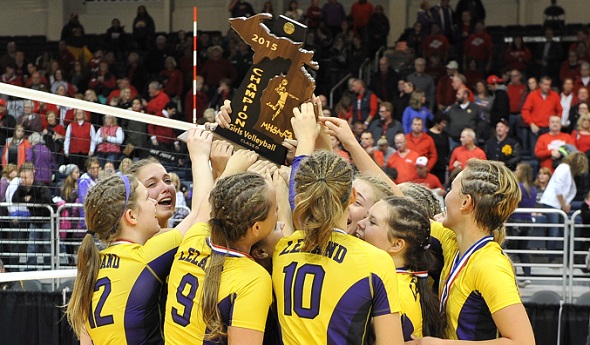
• Leland sweeps the Class D volleyball title match 3-0 over Battle Creek St. Philip ... ending a string of nine straight titles for St. Phil, the 10th longest national streak in history.
• Davison’s Taylor Davis becomes only the fourth person in MHSAA Girls Bowling history to roll a 300 game in the Singles portion of the tournament ... and the first ever in the championship match.
• The Upper Peninsula’s Hancock HS wins the Division 3 ice hockey title in its first trip to the Final since 2000 ... a trip funded in part from a “Go Fund Me” web page that raised $6,620 from 99 donors in two days.
• Junior Kierra Fletcher of Warren Cousino carries her team to the Class A girls basketball championship with 27 points in the Final ... after scoring 37 of her team’s 60 points in the Semifinals and totaling 198 during eight tournament games.
That’s just a sampling of the magic from last fall and winter.
These moments shine through the current challenges and the unseen future that awaits us as they always have. The uniforms and faces are different, but the tournaments have always yielded the fruits of our labors, and the memories for our mental scrapbooks.
PHOTO: Leland's volleyball team hoists its Class D championship trophy last fall at Kellogg Arena.
Michigan's Ranking for High School Sports Participation Continues to Outpace Population
By
Geoff Kimmerly
MHSAA.com senior editor
September 4, 2026
Michigan enjoyed the sixth-highest boys participation in high school sports nationally in 2025-26, moving up one spot in that ranking, and maintained its girls and overall rankings of eighth as well – continuing to outpace where it ranks nationally for population of school-aged children according to U.S. Census Bureau estimates.
Michigan’s overall participation ranking was based on a total of 295,634 participants, data collected as part of the annual national participation study conducted by the National Federation of State High School Associations (NFHS) – of which the Michigan High School Athletic Association is a member. That total number of participants counts students once for each sport played, meaning students who are multiple-sport athletes are counted more than once.
A total of 171,573 boys participants moved Michigan up to sixth nationally on that list, after ranking seventh the past two school years and ninth in 2022-23. The girls total of 124,061 participants ranked eighth for the third-straight school year after Michigan was listed ninth for girls participation also in 2022-23.
Meanwhile, Michigan continued to rank 10th for both high school-aged boys and girls populations – and all high school-aged children combined – according to U.S. Census Bureau estimates.
Three sports for which the MHSAA sponsors postseason tournaments moved up on their respective national lists. Michigan counted the fifth-most boys basketball players, the state’s highest ranking in that sport since 2012-13 and two spots ahead of 2024-25. Girls competitive cheer also moved up two spots to ninth nationally, and boys wrestling moved up one spot on its list to seventh.
Participation in several more MHSAA sports continued to outpace the state’s ranking for high school-aged population.
For girls, bowling (third), tennis (third), golf (fourth), cross country (sixth), track & field (sixth), volleyball (sixth), basketball (seventh), softball (eighth), swimming & diving (eighth), and soccer (ninth) joined cheer in ranking higher than their population listing of 10th nationally. Among boys sports, bowling (second), ice hockey (fourth), golf (fifth), track & field (fifth), tennis (sixth), football (all contact formats combined – sixth), cross country (seventh), swimming & diving (eighth), baseball (ninth) and lacrosse (ninth) joined basketball and wrestling in exceeding the boys ranking of 10th for population. Boys soccer participation placed 10th on its national list.
Only 12 states sponsor alpine skiing, but Michigan again ranked third on both the girls and boys lists for that sport.
Nationally, participation in high school sports increased for the fifth consecutive year and set another record, with the total of 8,415,684 participants an increase of 1.8 percent from 2024-25. The total included 4,761,095 boys and 3,654,589 girls – both record highs as well – according to figures obtained from the 51 NFHS member state associations, which include Washington, D.C.
Eleven-player football remained the most popular boys (and overall) sport, totaling 1,043,716 athletes. Next on the boys list were outdoor track & field, basketball, soccer, baseball, wrestling, cross country, golf, tennis, and swimming & diving, respectively, repeating the same top 10 as in 2024-25.
For girls, the top nine sports remained the same from the previous year – outdoor track & field, volleyball and soccer, in that order, followed by basketball, softball, competitive spirit, tennis, cross country and swimming & diving, respectively. Flag football moved ahead of lacrosse into the 10th spot this past school year.
Texas (911,405) and California (859,022) remained atop the list for overall state participation. Ohio (347,994) ranked third, followed by Illinois (326,756), Pennsylvania (315,647), New York (312,563), Florida (311,233), Michigan (295,634), New Jersey (273,711) and Minnesota (241,536).
The NFHS participation survey was started in 1971 and compiled in its current form through the 2018-19 school year, resuming annually with the 2021-22 survey.
The NFHS, based in Indianapolis, is the national leadership organization for high school sports and performing arts activities. Since 1920, the NFHS has led the development of education-based interscholastic sports and performing arts activities that help students succeed in their lives. The NFHS writes playing rules for 18 sports for boys and girls at the high school level. Through its 50 member state associations and Washington, D.C., the NFHS reaches more than 19,800 high schools and 12 million participants in high school activity programs, including more than 8.4 million in high school sports.
The MHSAA is a private, not-for-profit corporation of voluntary membership by more than 1,500 public and private senior high schools and junior high/middle schools which exists to develop common rules for athletic eligibility and competition. No government funds or tax dollars support the MHSAA, which was the first such association nationally to not accept membership dues or tournament entry fees from schools. Member schools which enforce these rules are permitted to participate in MHSAA tournaments, which attract more than 1.4 million spectators each year.