


Nonfaculty Coaches
June 18, 2012
Since the so-called heyday of school sports in the 1950s, when you could count on more talk in a community about its few high school teams than about all the college and professional sports teams in the country combined, some things have improved – diversity and safety, for example; but some things have not met the high ideals hoped for in educational athletics.
During the explosive growth period of school sports in the 1970s and 1980s, when girls programs were introduced or reintroduced to schools and well-established community programs were added to the school sports curriculum, schools in almost every state had to backpedal from the ideal that only trained educators – certified teachers – could coach interscholastic athletic teams. (In Michigan, except for two years in the mid 1950s when certified teachers were required, the rules only urge that coaches be certified teachers.)
While the number of sports and levels of teams have greatly expanded these past five or six decades, the coaching pool within the faculty of a school district has not. Furthermore, teachers’ salaries improved so much that coaching stipends became less necessary to supplement teachers’ incomes, so teachers “volunteered” less readily to serve as coaches for a second and third sport.
Moreover, the coaching demands for one sport increased out of season, interfering with a person’s availability to help coach second and third sports during the school year. This was commonplace in the sports that moved from the community into schools, but the out of season demands have increased significantly for traditional school sports as well.
There is irony that community youth sports programs not only have provided school districts with a pool of informed and interested people to serve as coaches, but they have also increased the demands on coaches so much out of season that coaches must specialize in a single sport and therefore are less available to assist with the many different sports and levels of teams that school districts struggle to provide students.
It is estimated now that more than half of all high school coaches do not work in the school building where they coach, which can create communications challenges for schools. A smaller but growing number of high school coaches do not work at all in the field of education, which can create philosophical problems as well. Not always, of course; in fact, many nonfaculty coaches are a rich and increasingly indispensible blessing for school sports.
The Changing Face(book?) of Coaching
March 26, 2013
By Rob Kaminski
MHSAA benchmarks editor
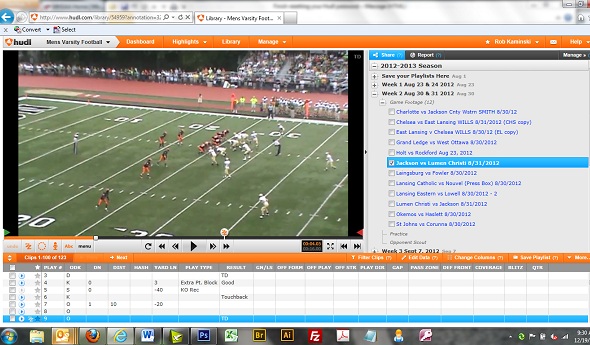
From online video exchange programs such as hudl.com to social media platforms like Facebook, Twitter, and LinkedIn, the face of coaching and communicating with teams is ever-changing. How much is too much, and how are the new tools being used by the old guard?
With increasing frequency, today’s coaches are turning to technology to assist in their endeavors, particularly in video review and data compilation, as the number of programs available to them seems to grow on a daily basis.
Among the recent leaders, hudl.com seems to have won the favor of football coaches across the state, reducing video exchange and study to a couple clicks of the mouse.
Several members of the MHSAA Student Advisory Council report that their football coaches use the web-based program, and even local officials associations are using it for film study.
Similar programs are making it easier for today’s coaches to analyze data and compile statistics as well.
“The dispensing of information is much quicker than it used to be,” said Marshall bowling coach Sue Hutchings. “We use a scoring software for our stats.”
In more “visual” sports such as competitive cheer, online video is now essential.
“Video playback and feedback to athletes has helped the sport 10-fold,” said Middleville Thornapple-Kellogg coach Abby Kanitz.
In some cases, coaches are taking the lead on such initiatives.
“I run the MISCA (Michigan Interscholastic Swim Coaches Association) website and receive plenty of positive feedback about us posting meet results and top times reports,” said Bloomfield Hills Andover coach David Zulkiewski. “I also visit MHSAA.com weekly. Since I run the MISCA website, I want to make sure I have accurate and up-to-date information posted.”
Technology has also made the world a bit “greener” even in the small corner that is interscholastic athletics. From the required MHSAA rules meetings moving to an online format, to volumes of data now stored on flash drives rather than in file cabinets, coaches are realizing savings in both time and cost.
“The current state of track and field and cross country is so much more manageable than when I began,” said East Kentwood’s Dave Emeott. “I remember compiling actual papers from all over the state to keep track of the opposition, and now thanks to Athletic.net we have this access at the tip of our fingers. These programs have also replaced nights spent inputting data and record-keeping. I am sure I have replaced all that time elsewhere, but it is probably spent with kids and not with data.”
With the saturation and availability of these reports around the clock also comes temptation for those who are driven, and even obsessed, with such numbers. Coaches can rank near the top of that list.
“Technology can be extremely helpful and time-saving for coaches and teachers,” said Grand Haven wrestling coach James Richardson. “But, the disadvantage is the coaches and athletes have a more difficult time getting away from the sport, as we have access to so much information, and others have more access to us. This can lead to too much time being devoted to our sport.”
It also might even take some of the fun out of the actual competition.
“I think the one negative side of technology is the lack of the unknown,” Emeott said. “There was a day when we would enter a meet and not really know how the day would turn out. Now I have most meets scored within 10 points the day before we arrive.”
At times, such advance information also can lead to overconfidence heading into competition.
“Currently the MHSAA Final draw is posted online, and my players often see it and draw their own conclusions before I have a chance to talk to them about it,” said Allegan tennis coach Gary Ellis. “In the past, I was able to present their draw in the light in which I wanted them to see it.”
Another side effect is the indirect push to play beyond high school.
“There is a lot more social promotion and glamourizing of the athletes,” said Mike Van Antwerp, Holt lacrosse coach. “The recruiting pressure has increased tremendously, which is causing kids to commit earlier and go to great lengths to have a chance at being recruited.”
The world has indeed become a smaller, more familiar place. Not only can students and coaches learn pertinent statistics relating to any given opponent, they can also learn personal information about their competition through the deluge of social media vehicles.
It is in this realm where the greatest divide exists between coaches and their athletes when the subject of technology comes up.
Several members of the MHSAA Student Advisory Council indicate that their coaches do not use social media to assist with the daily activities involved with their sport, while others are but only on a limited basis.
It’s not that the coaches don’t know about Facebook, Twitter, LinkedIn, or the other platforms. More likely, they are all too well versed in the abuses of such mediums by young adults not yet ready to understand the lasting ramifications of a random tweet or damaging photo.
“We have specific rules for use of cell phones at practice, games, in the locker room, etc.,” said Diane Laffey, athletic director and coach at Warren Regina. “We also have a form for parents to sign if they want the coach to be able to text their daughter about practice or game cancellations or changes. We stress that the texting only be for necessary things, and the parents are to give permission.”
Safeguarding against the misuse of handheld devices is becoming as commonplace as handing out uniforms prior to the season.
“By rule, our players aren’t allowed to bring electronic devices to the court with them. We restrict cell phone usage at practice,” said Portage Central tennis coach Peter Militzer. “Players must ‘friend’ the coach on either Facebook or Twitter, and I monitor their activities to make sure their language and behavior meets our standards. We restricted a player’s opportunity to play on varsity last season due to excessive use of crude language and an offensive user name on Twitter.”
PHOTO: This is a screenshot from Hudl.com, an online service used by high school football coaches for video analysis and archiving.