


Valuable Victories
June 30, 2014
The 95th annual meeting of the National Federation of State High School Associations occurs June 28 to July 2 in Boston. I wonder if any speaker will say anything as profound as this statement by philosopher/psychologist William James during a lecture in Boston in 1906 (just months after the founding of the National Collegiate Athletic Association):
“. . . the aim of a football team is not merely to get the ball to a certain goal (if that were so, they would simply get up on some dark night and place it there), but to get it there by a fixed machinery of conditions – the game’s rules and the opposing players.”
Competitive athletics is nothing without a set of rules that opponents must follow. All opponents. Even those with “helicopter parents” who try to provide a parachute to their child after a mistake. Even those who believe their money or connections should give them a free pass. Even for star players; even for substitutes.
Without rules of eligibility and competition, and opponents playing by the very same rules, there is no validity in moving the ball to the goal. Without rules, there is no value in sinking the putt, making the basket, clearing the bar or crossing the finish line.
Without a regulatory scheme adhered to by all competitors, victory is hollow. Rules are a big part of what gives school sports meaning and value.
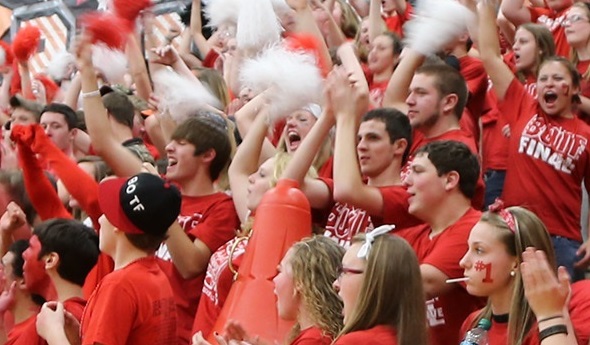
It's Time: Bring on Battle of the Fans IV
December 10, 2014
By Geoff Kimmerly
Second Half editor
Our games have moved inside, and student fan sections have followed. Gyms are jammed, cheers fill the air, and all is merry and bright.
It's that Battle of the Fans time of year, and the MHSAA's Student Advisory Council is again preparing to reward the top high school student cheering section in Michigan.
 Battle of the Fans was started during the 2011-12 school year to promote the opportunity for a fun, positive cheering experience for fans supporting their teams.
Beaverton was named last year’s champion and presented with a banner during the MHSAA Boys Basketball Finals at Michigan State University’s Breslin Center. Sections from Bridgman, Buchanan, Frankfort and Traverse City West also were finalists last winter.
Schools are invited to submit a short video, via YouTube, of their cheering sections in action. Video submissions should be between 90 seconds and three minutes long and explain how that section meets the following contest criteria: positive sportsmanship, student body participation, school spirit, originality of cheers, organization of the group, student section leadership and fun.
The deadline for student-submitted video applications is noon Jan. 10. Five finalists including at least one Class C or D school then will be chosen and visited on a home game night by MHSAA staff and Advisory Council representatives. The MHSAA will produce a video of that finalist after each visit, with the champion being selected by the Student Advisory Council based in part on activity on the MHSAA’s social media sites.
This year’s winner will be announced Feb. 20 and recognized March 27 at the Breslin Center.
Rules, directions for submitting videos, plus links to coverage of finalists from the first three years of the contest can be found on the MHSAA Website. As in the past, this year’s finalist videos plus the announcement of the 2014-15 winner will be published on Second Half.
Make sure to mark all of your social media postings regarding Battle of the Fans III with the hashtag #BOTF – and keep an eye out for more information on the MHSAA's Facebook, Twitter and Instagram sites. Click the links below to see the stories and videos from visits to our first three champions:
Frankenmuth (2012) - Buchanan (2013) - Beaverton (2014)
The Student Advisory Council is made up of eight seniors and eight juniors, who each serve two-year terms. The Council acts as the voice of Michigan's student-athletes; it serves as a student sounding board for the MHSAA's Representative Council, assists in planning Sportsmanship Summits, Captains Clinics and other student leadership events; participates in a yearly focus group about the state of high school sports for Michigan State University's Institute for the Study of Youth Sports and assists with medal ceremonies at MHSAA championship events.